
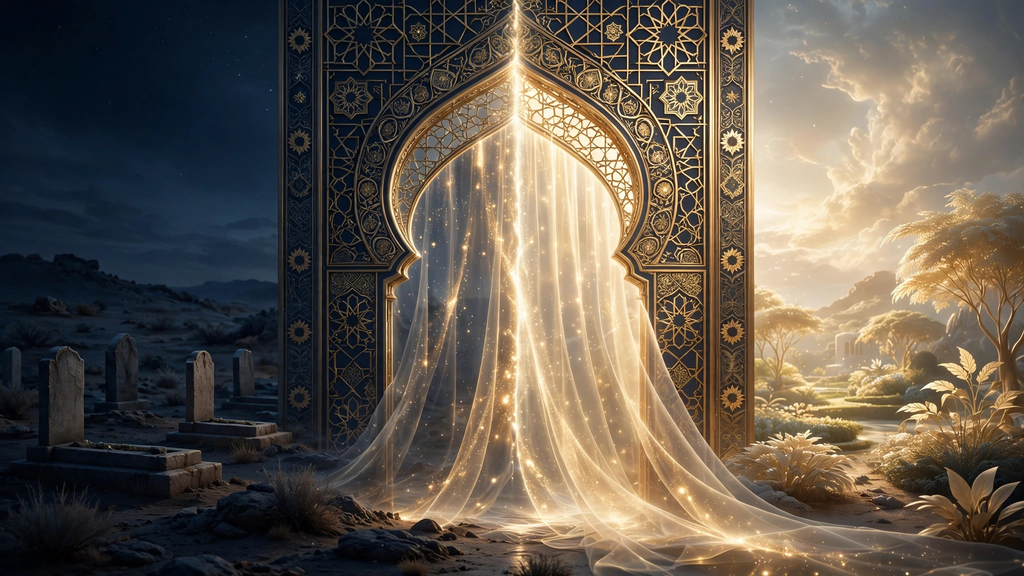
What Is Barzakh in Islam? Death ends our worldly life. But according to Islam, it does not end the journey.
What happens in the period between death and the Day of Judgment?
The Qur’an gives this period a name: Barzakh.
But Barzakh is often explained too simply. Some articles describe it as merely “life in the grave.” Others mix authentic Hadith with cultural stories and claims about souls that Islamic revelation does not actually establish.
A more careful approach is needed.
What does the Qur’an tell us? What does authentic Sunnah add? And what remains hidden from human knowledge?
That is the real mystery of Barzakh.
Table of Contents
🌙 Barzakh at a Glance
┌─────────────────────────────┐
│       WORLDLY LIFE          │
│                             │
│ Choices • Worship • Deeds   │
└──────────────┬──────────────┘
               │
               ▼
        ┌─────────────┐
        │    DEATH    │
        └──────┬──────┘
               │
               ▼
╔═════════════════════════════╗
║           BARZAKH           ║
║                             ║
║   Intermediate existence   ║
║   before resurrection      ║
╚══════════════╤══════════════╝
               │
               ▼
        ┌──────────────┐
        │ RESURRECTION │
        └──────┬───────┘
               │
               ▼
        ┌──────────────┐
        │   JUDGMENT   │
        └──────┬───────┘
               │
          ┌────┴────┐
          ▼         ▼
      PARADISE     HELL
The central Qur’anic reference is Surah Al-Mu’minun 23:99–100.
The passage describes a person reaching death, regretting what has passed, and asking to return to worldly life so that they can do good.
But the return is refused.
A Barzakh remains until the Day of Resurrection.
That single passage gives us the basic boundary:
Death separates a person from worldly life, while Barzakh separates death from resurrection.
What Does Barzakh Actually Mean?
The Arabic word barzakh (برزخ) carries the meaning of a barrier, separation, partition, or intervening boundary.
The Qur’an uses the word in more than one context.
For example, Qur’an 25:53 and Qur’an 55:19–20 mention a barrier associated with bodies of water.
But in Qur’an 23:100, the word appears in connection with death.
Here, Barzakh is the barrier that remains between the deceased and their return to worldly life until resurrection.
This gives the word an important idea:
Barzakh is a boundary.
It separates two stages of existence.
It is therefore better understood as an intermediate state between death and resurrection than as simply the name of a physical place.
📖 The Qur’anic Scene That Explains Barzakh
Imagine the moment described in Surah Al-Mu’minun.
A person’s worldly life has ended.
Regret appears.
They want another opportunity.
They ask to be sent back.
Why?
The Qur’an says they want to do righteousness with what they left behind.
Then comes the barrier.
They cannot return.
The dead may wish for another opportunity to act, but worldly action has ended.
This is more than a description of the unseen.
It is a warning to the living.
The opportunity that seems ordinary today may be the opportunity we desperately wish for tomorrow.
🧭 Where Does Barzakh Fit in the Journey?
The sequence is important because Barzakh is not the end of the story.
It comes before resurrection.
Is Barzakh the Same Thing as the Grave?
No, although the two ideas are closely connected.
A grave is a physical burial place.
Barzakh refers to the intermediate state between death and resurrection.
That distinction becomes particularly important when considering people whose bodies are not buried in an ordinary grave.
A person might die at sea.
A body might be destroyed.
Someone might never receive a conventional burial.
None of this makes death or the post-death state disappear.
So reducing Barzakh to “the place underneath the ground” makes the concept narrower than the Qur’anic description.
Think of it this way:
The grave concerns burial.
Barzakh concerns the state between death and resurrection.
The authentic Hadith about the grave give us important information about this post-death state, but Barzakh itself should not be reduced to a physical hole in the earth.
What Happens After Death?
The Qur’an and Sunnah do not give us a single detailed timeline describing every second after every person’s death.
But authentic Hadith provide important information.
One narration in Sahih al-Bukhari describes the deceased hearing the footsteps of those who leave after burial. The narration then describes angels questioning the deceased about Muhammad ﷺ. Sahih al-Bukhari 1374
This gives us an important insight.
Islam does not describe the deceased as simply disappearing until the Day of Judgment.
There is an intermediate existence.
But its exact nature belongs to the unseen.
And that distinction matters.
👁️ What Is the Questioning of the Grave?
The authentic narrations describe questioning after burial.
The deceased is questioned concerning their faith and their response to the message of the Prophet Muhammad ﷺ.
The narration describes different responses depending on the person’s condition. Sahih al-Bukhari 1374
This is commonly called the trial of the grave.
But there is a deeper point here.
The narration is not merely presenting a test of memorization.
It connects the person’s response to what they actually believed.
That makes the subject of Barzakh closely connected to something that begins much earlier:
the life a person chose to live.
⚖️ Is Barzakh the Same for Everyone?
No.
Islamic sources describe different conditions after death.
The post-death state is not presented as an identical experience for every human being.
Authentic Hadith describe both punishment and favor.
The Prophet ﷺ taught Muslims to seek Allah’s protection from the punishment of the grave. Sahih Muslim
At the same time, authentic narrations describe the believer being shown a place in Paradise. Sahih al-Bukhari 1374
So a balanced understanding is
The sources describe a favorable condition, including comfort and the showing of a place in Paradise.
Authentic sources describe questioning and punishment associated with the grave.
The subject should therefore inspire both accountability and hope.
🔥 What Does Qur’an 40:46 Add to the Picture?
Surah Ghafir contains another important passage.
Qur’an 40:46 describes Pharaoh’s people being exposed to the Fire morning and evening. It then mentions what happens when the Hour is established: they are ordered to enter the severest punishment. Qur’an 40:46
The sequence is striking:
              BEFORE THE HOUR
                     │
                     ▼
             Exposure to Fire
                     │
                     │
              THE HOUR BEGINS
                     │
                     ▼
              FINAL PUNISHMENT
This passage is important because it distinguishes a condition before the establishment of the Hour from the punishment associated with the final judgment.
It helps prevent a common mistake:
Death, Barzakh, resurrection, and final judgment are not one single event.
🕊️ What Happens to the Soul?
This is where we reach the boundary between knowledge and mystery.
Islam tells us that there is an existence after death.
The authentic Sunnah tells us about questioning, hearing in a specific circumstance, comfort, and punishment.
But revelation does not give us a complete physical diagram of the soul’s existence.
We are not told everything about:
- its exact location;
- its physical properties;
- how it experiences every moment;
- how its relationship with the deceased body works in every detail;
- or every event that takes place before resurrection.
This is why Barzakh should not be presented as though humans have secretly discovered its geography.
A useful rule:
Believe what revelation establishes. Do not turn unanswered questions into certainty.
🧠 What We Know & What We Don’t
This distinction is one of the most important parts of understanding Barzakh.
| We can affirm | We should not invent |
|---|---|
| Barzakh exists | A detailed physical map of Barzakh |
| It continues until resurrection | Exact coordinates of every soul |
| The deceased experience a post-death state | A scientific description of the soul |
| Questioning is described in authentic Hadith | Every detail of the questioning |
| Punishment is established in authentic Hadith | Sensational details unsupported by revelation |
| Believers can receive favor | A precise description of how that experience feels |
| Resurrection will occur | An exact timetable for the unseen |
This is not a limitation that needs to be “filled in.”
The limits of our knowledge are themselves part of the lesson.
⏳ Does Time Feel the Same in Barzakh?
This is a fascinating question.
But it is also a question where speculation can easily replace evidence.
We know that Barzakh continues until resurrection.
What we do not have is a revealed formula explaining exactly how every soul experiences the passage of time.
So statements such as:
“One year in Barzakh feels exactly like X years on Earth”
should not be presented as established Islamic teaching without reliable evidence.
The safest conclusion is much simpler:
Barzakh continues until resurrection.
How the experience of duration is perceived belongs to the unseen.
👂 Can the Dead Hear the Living?
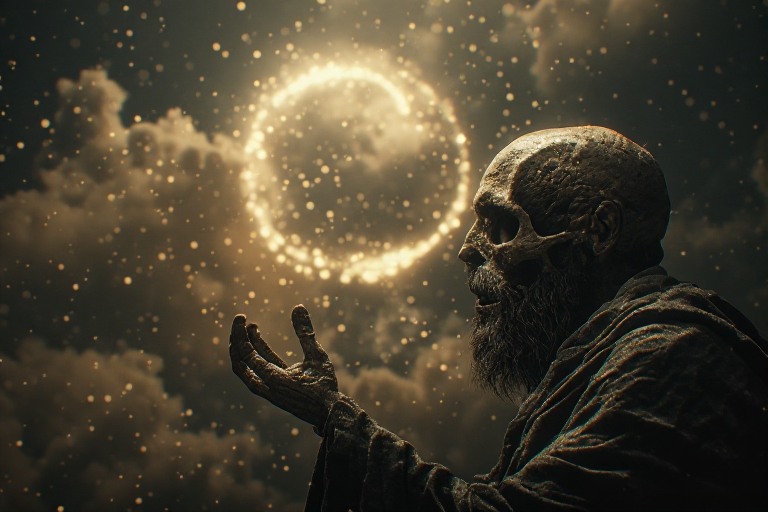
There is an authentic narration that the deceased hears the footsteps of those leaving after burial. Sahih al-Bukhari 1374
That is a specific piece of evidence.
But it should not automatically be expanded into a much broader claim that every deceased person continuously hears everything happening around their family.
There is an important difference between:
“A particular authentic narration establishes this.”
and
“Therefore, every possible version of this claim must be true.”
The first follows evidence.
The second goes beyond it.
👨👩👧 Do the Dead Know What Their Families Are Doing?
This is a popular question.
Many cultural traditions contain stories about deceased relatives watching their families.
But popularity is not evidence.
Islamic knowledge of the unseen comes from revelation.
Therefore, we should not confidently claim that every deceased person continuously observes everything their family does unless reliable Islamic evidence establishes that specific claim.
This is one of the places where a responsible article should resist the temptation to provide an exciting answer simply because readers want one.
Sometimes the correct Islamic answer is: we do not have enough evidence to say.
🌙 What About Dreams of Deceased Relatives?
Dreams involving people who have died can feel extremely real.
They can also be emotionally powerful.
But a dream does not automatically prove that a deceased person’s soul physically travelled from Barzakh to visit the dreamer.
That interpretation requires evidence.
A person can acknowledge the emotional significance of a dream without turning it into a theological certainty.
This is another important boundary:
A personal experience is not automatically revelation.
🚫 Can the Dead Return to the World?
The Qur’anic answer is clear in the passage about the person who asks to return.
The person wants another opportunity to do righteous deeds.
But the request is denied.
A Barzakh remains until resurrection. Qur’an 23:99–100
So ordinary worldly life does not simply continue after death.
The next universal transition is resurrection.
DEATH
  │
  ▼
BARZAKH
  │
  │  No return to worldly life
  │
  ▼
RESURRECTION
This is one of the clearest boundaries associated with Barzakh.
🌌 Is Barzakh a Physical Place Somewhere in the Universe?
We should be careful with this question.
Calling Barzakh a “place” can create the impression that it is simply another physical location that could theoretically be reached with the right technology.
That is not something revelation teaches.
Barzakh belongs to the unseen.
The Qur’an establishes its reality, and the Sunnah gives us information about aspects of the deceased’s condition.
But we are not given a physical map.
Therefore:
Barzakh is real without requiring us to imagine it as an ordinary geographical location.
🔬 Can Science Detect Barzakh?
Not in the way science studies ordinary physical objects.
Science investigates measurable physical phenomena.
Barzakh, in Islamic theology, belongs to the unseen.
This does not make the concept “unscientific” in the sense of being disproven by science.
It means the two questions are different.
Science can investigate what happens to a physical body after death.
It cannot, through physical measurement alone, establish the complete nature of a metaphysical reality that revelation describes as unseen.
This distinction prevents two opposite mistakes:
using science to claim that Barzakh has been scientifically discovered, and
using the limits of science as proof that the unseen cannot exist.
Neither conclusion follows.
🕯️ Why Does Islam Reveal Only Certain Details?
This may be the most overlooked question.
Why don’t we receive a complete description of Barzakh?
Because Islamic revelation does not promise human beings unlimited access to the unseen.
We are given enough information to understand:
- Death is real;
- Worldly action ends;
- An intermediate state follows;
- Resurrection is coming;
- Accountability is real.
But we are not given every mechanical detail.
That boundary encourages something important:
Humility. There is a difference between knowing and wanting to know. Barzakh teaches us to respect that difference.
🧩 The Three Layers of Knowledge About Barzakh
A useful way to understand the subject is to divide information into three levels.
                 BARZAKH KNOWLEDGE
                        │
        ┌───────────────┼───────────────┐
        ▼               ▼               ▼
   REVELATION       INTERPRETATION   SPECULATION
        │               │               │
        ▼               ▼               ▼
 Qur’an & authentic   Scholarly       Stories,
 Hadith evidence      conclusions     assumptions
        │               │               │
        ▼               ▼               ▼
    CERTAIN BASIS    HANDLE WITH      DO NOT PRESENT
                     CARE             AS FACT
This framework makes religious research much safer.
A statement should not become “Islamic teaching” merely because it appears on a website.
The question should always be:
Where did this claim come from?
⚖️ Barzakh vs Resurrection vs Final Judgment
These stages are sometimes blended together.
They should not be.
| Stage | Central idea |
|---|---|
| Worldly life | Human beings choose and act |
| Death | Worldly life ends |
| Barzakh | Intermediate state before resurrection |
| Resurrection | Humanity is raised |
| Judgment | Accountability takes place |
| Final destination | Paradise or Hell |
The Qur’an’s wording in 23:100 is especially important because Barzakh continues until resurrection.
Therefore:
Barzakh ≠ Resurrection
and
Barzakh ≠ Final Judgment
and
Barzakh ≠ simply another name for Paradise or Hell.
🌱 What Does Barzakh Teach the Living?
This is where the subject becomes practical.
Learning about Barzakh should not make us obsessed with trying to visualize the unseen.
It should make us more conscious of the life we are living now.
The person in Qur’an 23:99–100 wants to return because they recognize the value of righteous action.
But the opportunity has ended.
We still have ours.
You Still Have the Opportunity
🤲 You can still repent.
🕌 You can still pray.
❤️ You can still apologize.
⚖️ You can still return someone’s rights.
🌱 You can still change a harmful habit.
🤝 You can still help someone.
📖 You can still learn.
The living possess something the dead no longer possess: the ability to add new deeds to their worldly record.
That may be more important than knowing every detail of the unseen.
🛡️ How Should a Muslim Prepare?
Preparing for the Hereafter is not about trying to uncover secrets about Barzakh.
It is about using the life we have been given.
- Faith: Take belief seriously rather than treating it as a label.
- Worship: Protect the obligations Allah has commanded.
- Repentance: Do not assume there will always be another day.
- People’s Rights: Do not ignore debts, injustice, broken trusts, or harm caused to others.
- Good Deeds: Do good consistently, not only when a major event frightens you.
- Supplication: The Prophet ﷺ taught Muslims to seek Allah’s protection from the punishment of the grave. Sahih Muslim
The objective is not fear for its own sake.
It is readiness.
🌙 Barzakh Is a Mystery But Not a Mystery Without Boundaries
There are two bad ways to approach Barzakh.
The first is to dismiss it simply because it belongs to the unseen.
The second is to fill every unknown detail with imagination.
Islam offers a third approach:
Believe what revelation tells us. Think carefully about what it means. And stop where revelation stops.
That approach is especially important in an age when stories about death, souls, ghosts, dreams, and the afterlife spread rapidly online.
Not every fascinating claim is Islamic knowledge.
Not every personal experience is proof.
Not every dramatic description comes from the Qur’an or Sunnah.
| 🔍 Known With Confidence | ❓ Not Known With Confidence |
|---|---|
| Barzakh exists. | Its exact nature or location. |
| The dead cannot return to worldly life. | How every soul experiences time. |
| A post-death state exists. | Everything the dead can perceive. |
| Questioning is described in Hadith. | Whether every dream is a visitation. |
| Punishment and blessing are described. | Whether the dead continuously watch their families. |
| Resurrection comes after Barzakh. | Details based only on folklore or stories. |
Conclusion
Barzakh is mysterious. But perhaps the most important thing about it is not what we can imagine. It is what it tells us about now.
The Qur’an describes someone who has reached death and suddenly wants another chance to do good. They cannot go back. We can. Not forever. Not indefinitely. But right now.
- Every prayer.
- Every act of kindness.
- Every sincere repentance.
- Every wrong we correct.
- Every right we return.
- Every person we forgive.
- Every good deed performed without anyone seeing it.
These belong to the part of the journey in which we can still act. Barzakh reminds us that this opportunity has an ending. And when that boundary is reached, wishing for another chance will not reopen the door.
The Door Is Still Open
The unseen is ahead of us.
But the opportunity to act is still with us.
Use it before it becomes something you can only wish for.
Understanding Barzakh is only one part of understanding the Islamic view of the Hereafter. To explore what happens from the moment of death through resurrection and the final destination, read our guide on the journey of the soul after death. You can also explore the unseen world in Islam and learn how Islamic teachings distinguish revealed knowledge from speculation. Together, these topics provide a broader picture of life, death, and what comes after.
References
- Qur’an 23:99–100 — death, the request to return, and the Barzakh until resurrection.
Read Qur’an 23:99–100 - Qur’an 40:46 — Pharaoh’s people and the distinction between punishment before the Hour and the punishment associated with its establishment.
Read Qur’an 40:46 - Sahih al-Bukhari 1374 — questioning after burial and the deceased hearing footsteps.
Read Sahih al-Bukhari 1374 - Sahih Muslim — the Prophet ﷺ seeking protection from the punishment of the grave.
Read Sahih Muslim
Frequently Asked Questions
What is Barzakh in Islam?
Barzakh is the intermediate state or barrier between death and resurrection. Qur’an 23:99–100 describes a barrier remaining until the Day people are resurrected.
What does Barzakh mean?
The Arabic word refers to a barrier, separation, partition, or intervening boundary. In the context of death, it refers to the intermediate state before resurrection.
Is Barzakh mentioned in the Qur’an?
Yes. The clearest direct reference is in Qur’an 23:99–100.
Is Barzakh the same as the grave?
Not exactly. The grave is a physical burial place, while Barzakh refers to the intermediate state between death and resurrection.
What happens to a person in Barzakh?
Authentic Hadith describe questioning and different post-death conditions, including comfort and punishment. The complete nature of this existence remains unseen.
Can the dead return to this world?
The Qur’an describes the deceased asking to return but being prevented by a barrier until resurrection.
Can the dead hear the living?
An authentic Hadith describes the deceased hearing the footsteps of people leaving after burial. This should not automatically be expanded into the claim that every dead person hears everything happening in the world.
Can the dead see their families?
Claims that the dead continuously observe everything their families do are not established simply by the evidence discussed here. Such claims require specific evidence.
Do dreams prove that dead relatives visit us?
Not necessarily. A dream involving a deceased person should not automatically be treated as proof that the soul physically returned from Barzakh.
Is Barzakh Paradise?
No. Barzakh is the intermediate stage before resurrection and final judgment.
How long does Barzakh last?
The Qur’an describes the Barzakh as continuing until resurrection.
Does everyone experience Barzakh in the same way?
The authentic sources describe different conditions for different people, including comfort and punishment.
Can science prove or disprove Barzakh?
Science can investigate physical processes associated with death, but Barzakh belongs to the unseen. Its theological reality is not something that can be completely mapped through ordinary physical measurement.