
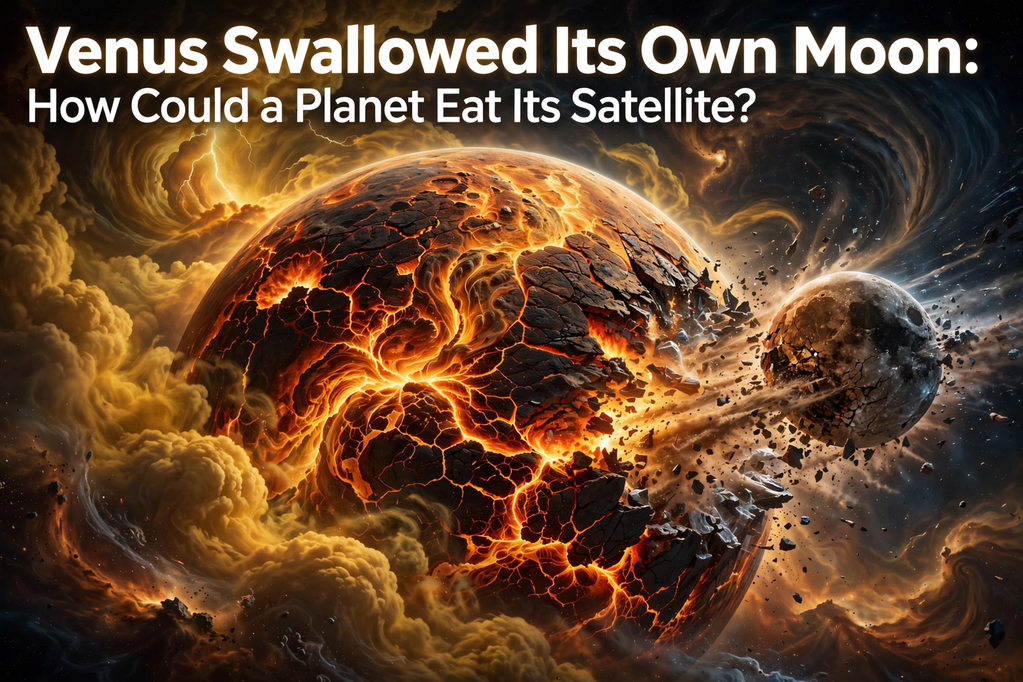
Venus Swallowed Its Own Moon: How Could a Planet Eat Its Satellite? Venus is one of the strangest planets in our Solar System. It is almost the same size as Earth, yet its surface is hidden beneath thick clouds, its rotation is unusually slow, and it has no natural moon.
Now, new research has explored an extraordinary possibility: what if Venus once had a moon and gradually destroyed it through gravity?
The idea is not that Venus suddenly crashed into its satellite. Instead, the proposed mechanism is much slower. Over immense periods of time, tidal forces could have changed the moon’s orbit, drawing it closer to Venus until the satellite was eventually disrupted.
But there is an important scientific distinction.
Researchers have not found proof that Venus actually had a moon. The study models what could happen if a moon had formed around Venus under different early conditions.
That makes the real mystery even more interesting:
If Venus once had a moon, could the planet’s own gravitational environment have erased the evidence?
Table of Contents
Venus Swallowed Its Own Moon
Today, Venus is moonless.
Earth has one large natural satellite. Mars has two small moons. The outer planets have extensive satellite systems. Venus, however, has none.
There is one object that sometimes causes confusion: Zoozve.
Zoozve is a quasi-satellite of Venus. It travels around the Sun rather than orbiting Venus as a gravitationally bound natural moon. So it does not count as Venus’s missing moon.
The absence of a moon raises an obvious question.
How did Venus end up this way?
There are several possibilities.
Venus might simply never have acquired a lasting moon. A moon could also have been removed by a collision or other gravitational event.
The new research introduces another possibility: a moon could have gradually spiraled inward because of tidal evolution.
That process is worth understanding because it reveals something surprising about how planetary systems change.
A Moon Is Not Permanently Locked in Place
It is easy to picture a moon as an object following a permanent circular track around its planet.
In reality, a moon’s orbit can change.
The planet rotates. The moon orbits. Both bodies exert gravity on each other, and each raises tides on the other.
Those tides are not perfectly static.
As the planet rotates beneath the tidal distortion, energy and angular momentum are transferred through the planet-moon system.
Over a short period, the change is tiny.
Over millions or billions of years, the cumulative effect can become enormous.
This is known as tidal evolution.
And it can send a moon either outward or inward depending on the system’s properties.
Earth’s Moon Shows Us the Outward Version
Earth provides a useful comparison.
Our planet rotates once in roughly 24 hours, while the Moon takes about 27 days to orbit Earth.
Because of Earth’s rotation and the tidal interaction between Earth and the Moon, angular momentum is gradually transferred into the Moon’s orbit.
The result?
The Moon is slowly moving away from Earth.
The present-day recession is approximately 3.8 centimeters per year.
That sounds insignificant.
But planetary science operates on timescales far beyond human experience.
A tiny change repeated over enormous periods can reshape an entire planetary system.
Venus provides a radically different example.
Venus Rotates in a Very Strange Way
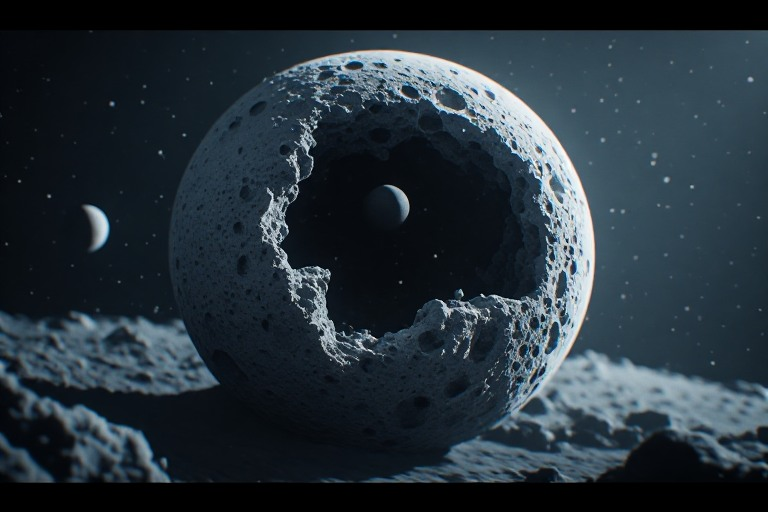
Venus takes about 243 Earth days to rotate once relative to the stars.
Its orbital period around the Sun is only about 225 Earth days.
In other words, a Venusian sidereal day is longer than a Venusian year.
The planet also rotates in the opposite direction from most planets.
This unusual rotation matters because tidal evolution depends strongly on the relationship between a planet’s spin and its satellite’s orbital motion.
A moon around rapidly rotating Earth can migrate outward.
Under particular conditions modeled for Venus, a moon can instead migrate inward.
That is the central piece of the new research.
How Could Venus Pull a Moon Inward?
Imagine an early Venus with a substantial moon.
At first, the moon could have a stable orbit.
But the planet’s rotation and the moon’s orbital motion would interact through tides.
If the system were in the right configuration, the moon would gradually lose orbital energy.
Its distance from Venus would decrease.
The process would not be dramatic from one year to the next.
There would be no visible plunge toward the surface.
Instead, the orbital distance would change incredibly slowly.
The sequence could look like this:
The important point is that gravity does not have to destroy a moon suddenly to remove it from a planetary system.
Time itself can become part of the mechanism.
The Roche Limit: Where the Moon Can Come Apart
As the satellite moves closer, another effect becomes important.
It is called the Roche limit.
A planet’s gravitational pull is slightly stronger on the side of a moon facing the planet than on the far side.
At ordinary distances, the difference is manageable.
At extremely close distances, the difference becomes much stronger.
Eventually, the planet’s tidal forces can overwhelm the satellite’s ability to remain intact.
The moon can then be stretched apart.
This means a hypothetical Venusian moon might not have reached Venus as one giant rocky object.
It could have been destroyed first.
The final stages might look more like:
Moon → tidal disruption → debris → inward material
rather than:
Moon → intact collision → Venus
That distinction is important when interpreting the phrase “Venus swallowed its moon.”
What the New Study Actually Investigated
The research, led by planetary scientist Stephen R. Kane and colleagues, examined the evolution of hypothetical moons around Venus.
The simulations varied several parameters rather than assuming one specific moon.
Among them were:
- Venus’s initial rotation period
- the moon’s mass
- orbital distance
- orbital eccentricity
- tidal properties
- long-term gravitational evolution
The modeled moon masses extended from roughly half the mass of Earth’s Moon to ten times the Moon’s mass.
The researchers also tested early Venus rotation periods ranging from approximately 5 hours to 100 hours.
That matters because today’s Venus is extremely slow, but the young planet may not have started with today’s rotation rate.
The Early Spin of Venus Could Have Changed Everything
One of the most interesting results is that a hypothetical moon’s fate depends strongly on how fast Venus was rotating in its early history.
If Venus began spinning rapidly enough, some hypothetical moons could remain stable for very long periods.
Under slower initial rotation conditions, however, tidal evolution can drive a moon inward.
Eventually, the satellite can reach a destructive region close to Venus.
So the story is not simply:
Venus had a moon, therefore Venus destroyed it.
It is more precise:
If Venus formed a moon and the early planet-moon system had particular characteristics, tidal evolution could have led to the moon’s destruction.
That difference separates a scientific model from a historical discovery.
Did Venus’s Moon Leave a Ring Behind?
Possibly, but this remains part of the broader scenario rather than an established observation.
When a satellite is torn apart by tidal forces, its fragments can spread along orbital paths.
Around some planets, such processes can contribute to ring systems.
A disrupted Venusian moon could therefore have produced a temporary debris structure.
Over time, much of that material might have moved inward and eventually become incorporated into Venus.
If such an event happened billions of years ago, however, there is no reason to expect an obvious ring to remain today.
Venus’s geological history is far too active for us to assume that an ancient debris structure would survive unchanged.
Why Finding the Evidence Would Be So Difficult
Suppose Venus really did lose a moon billions of years ago.
Where would we look?
Probably not for a giant piece of the missing satellite sitting on the surface.
Venus has undergone extensive geological modification, including widespread volcanic activity and resurfacing.
Ancient evidence could have been:
- buried beneath younger material,
- altered by geological processes,
- chemically transformed,
- mixed into the crust,
- or incorporated deeper into the planet.
This creates an unusual scientific problem.
The evidence for an ancient moon might not look like a moon at all.
Scientists may instead need to identify unusual geological, chemical or interior signatures that fit one evolutionary history better than another.
Could a Lost Moon Have Changed Venus?
Yes, in principle.
The relationship works in both directions.
Venus affects the moon through gravity and tides.
The moon also affects Venus.
A satellite can exchange angular momentum with its planet and influence the planet’s rotation.
That means a hypothetical moon would not simply be circling Venus while Venus remained unchanged.
The two bodies would form a coupled system.
Over immense periods, their interaction could alter both:
the moon’s orbit
and
Venus’s rotation.
This is one reason the new research is more interesting than the simple headline suggests.
The real subject is not a planet “eating” an object.
It is the long-term evolution of a planetary system.
Venus and Earth Started With Similar Ingredients But Not Similar Outcomes
Earth and Venus are often called planetary siblings.
They are similar in size and composition.
Yet their modern environments are radically different.
Their moons—or lack of moons—provide another example of how different planetary histories can become.
| Feature | Earth | Venus |
|---|---|---|
| Natural moon today | Yes | No |
| Rotation period | ~24 hours | ~243 Earth days |
| Rotation direction | Prograde | Retrograde |
| Current lunar behavior | Moon slowly recedes | No natural moon to observe |
| Tidal history | Strong Earth-Moon interaction | Different tidal environment |
| Hypothetical satellite fate | Outward migration possible | Inward migration possible under modeled conditions |
This comparison does not mean that Venus necessarily once resembled Earth in every respect.
It shows why planetary rotation is an important variable when scientists reconstruct the histories of moons.
A Moonless Planet Does Not Tell the Whole Story
When astronomers observe a planet without an obvious moon, there are several possible explanations.
It might never have formed a moon.
A moon might have been ejected.
A collision might have destroyed it.
Or tidal evolution might have removed it.
That means the present-day appearance of a planetary system is only the final frame of a much longer story.
This is especially important for exoplanet research.
Astronomers are searching for moons around planets orbiting other stars, but the survival of a moon depends on the history of the entire system.
A moon’s existence is therefore not just a question of formation.
It is also a question of survival.
What Does the Study Prove?
This is the part that should not get lost beneath the dramatic headline.
The research supports: A hypothetical moon around Venus can be driven inward by tidal evolution under certain initial conditions.
The research does not prove: Venus definitely had a moon.
There is currently no direct observation of an ancient Venusian moon.
There is also no confirmed piece of evidence showing that Venus absorbed one.
The study provides a physically modeled pathway, not a historical detection.
That distinction makes the result more credible, not less interesting.
What Could Future Venus Missions Reveal?
Future observations of Venus could help scientists reconstruct its history in much greater detail.
NASA’s DAVINCI mission is designed to investigate Venus’s atmosphere and descend through its clouds, while VERITAS is intended to map the planet and investigate its geological history and interior.
Better measurements of Venus’s surface, composition, gravity field and interior could help scientists test different evolutionary scenarios.
A future discovery would not necessarily be:
“We found Venus’s old moon.”
It could be much subtler.
Scientists might discover a geological or interior signature that is more consistent with one formation scenario than another.
Planetary history is often reconstructed this way.
The clues are indirect, but they can still be powerful.
The Bigger Mystery Behind Venus’s Empty Orbit
The most fascinating part of this story is not whether the word “swallowed” is literally correct.
It is the possibility that a planet’s present appearance can hide an ancient history that has almost completely disappeared.
Venus today looks moonless.
But if the new model describes what actually happened billions of years ago, then the planet’s empty orbit could be the final result of a long gravitational process.
A moon may have existed.
Its orbit may have changed.
The satellite may have approached the planet.
Tides may have broken it apart.
And eventually, the material may have become part of Venus.
All of that could have happened without leaving a simple, unmistakable marker.
Conclusion: Could Venus Have Eaten Its Own Moon?
Yes, the physics modeled in the study allows for that possibility.
But whether Venus actually had such a moon remains unknown.
The research gives scientists a mechanism that can explain how a hypothetical satellite could disappear: tidal evolution driven by the interaction between Venus’s rotation and the moon’s orbit.
That makes Venus more than a planet without a moon.
It makes Venus a reminder that planetary systems are dynamic.
Moons can migrate.
Planets can change their spin.
Orbits can evolve.
And an object that has circled a planet for billions of years can eventually become part of the planet itself.
The strange thing about Venus may therefore not be that it has no moon.
It may be that we do not yet know whether something once orbited there—and disappeared so completely that only physics can tell us what might have happened.
Venus is only one example of how dramatically planetary systems can evolve over time. If you’re curious about other strange discoveries in our Solar System, explore our article on the 10-sided shape observed on Saturn by Hubble. You can also read How Is a Baby Formed?, which explores the remarkable biological processes involved in the beginning of new life.
References
- Kane, S. R., Selsis, F., Leconte, J., & Raymond, S. N. — Tidal Demise: The Evolution and Fate of a Hypothetical Venus Moon, The Astrophysical Journal. Read the research paper on arXiv
- NASA — Venus NASA’s Venus overview provides information about the planet’s rotation, atmosphere, geological history and lack of a natural moon. NASA Venus Facts
- NASA — Venus Missions Information about NASA’s planned and active Venus exploration efforts. NASA Venus Missions
- NASA — Moon Background on Earth’s Moon, including its orbital and tidal relationship with Earth. NASA Moon Facts
- NASA/JPL — Solar System Dynamics Reference information about planetary satellites and orbital dynamics. NASA/JPL Solar System Dynamics
Frequently Asked Questions
Did Venus ever have a moon?
There is currently no direct evidence proving that Venus once had a natural moon. The recent study investigates whether a hypothetical moon could have been destroyed through tidal evolution.
Why doesn’t Venus have a moon?
The exact reason is unknown. Venus may never have retained a moon, or a possible satellite could have been removed through impacts or long-term orbital evolution.
How could Venus destroy a moon?
If a moon’s orbit evolved inward, Venus’s tidal forces could eventually become strong enough to disrupt the satellite. Its fragments could then move inward and potentially become incorporated into Venus.
What is the Roche limit?
The Roche limit is the region around a massive body where tidal forces can become strong enough to break apart a smaller orbiting object.
Is Zoozve a moon of Venus?
No. Zoozve is a quasi-satellite. It remains associated with Venus’s orbital neighborhood but is not a natural satellite orbiting Venus.
Is the Venus moon theory proven?
No. The existence of an ancient Venusian moon remains hypothetical. The study demonstrates that tidal destruction is a physically possible evolutionary pathway under certain conditions.