
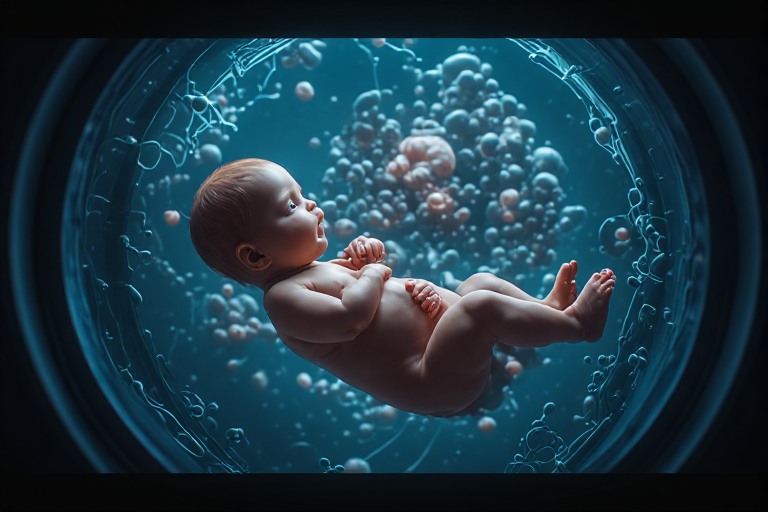
How is a baby formed? It is one of the most fascinating questions about human life, and both modern science and Islam offer important perspectives on human development. Modern embryology explains the biological journey in remarkable detail from the moment a sperm fertilizes an egg, forming a zygote, through cell division, the morula and blastocyst stages, implantation in the uterus, embryonic development, fetal growth, and finally birth.
The Qur’an also draws attention to the stages of human creation. Verses such as Surah Al-Mu’minun 23:12–14 and Surah Al-Hajj 22:5 describe human development using terms including nutfah, ‘alaqah, and mudghah, followed by further stages of development. These passages are part of a broader Islamic message about human origin, creation, dependence upon Allah, and the reality of resurrection.
In this article, we will explore how a baby develops according to modern science, step by step, and then examine what the Qur’an says about human creation. The comparison is presented carefully: modern embryology uses scientific and medical terminology based on observation and research, while the Qur’an uses its own Arabic descriptive and theological language. Therefore, Qur’anic terms should not automatically be treated as exact translations of modern embryological terms.
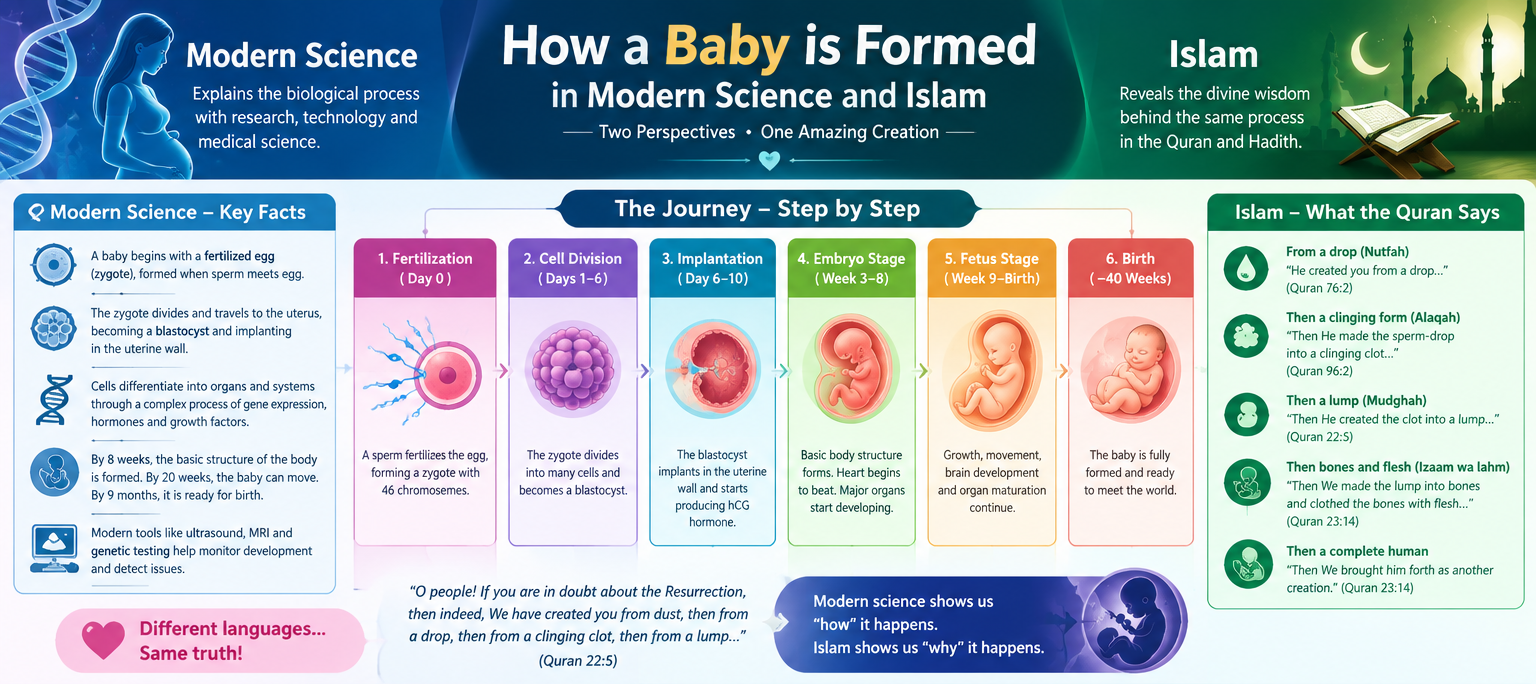
From fertilization to birth, this guide brings the two perspectives together in a simple visual flow, explaining the major stages of human development while providing references to reliable scientific and Qur’anic sources.
Understanding how a baby develops is one part of a much bigger question about human creation and the purpose of life. If you would like to explore the subject further, read our related guide on the secrets of the universe. For readers interested in Islamic teachings about human life, our The Complete Chronological Order Of Our Life In Islam article provides the complete chronological order of our life in Islam, which begins long before our birth.
How Is a Baby Formed? Modern Science and Islam Explained
A clear visual journey from fertilization to birth, followed by a careful explanation of how the Qur’an describes stages of human creation.
How Is a Baby Formed? — Quick Answer
According to modern biology, human development begins when a sperm and egg unite during fertilization, producing a zygote. The zygote divides into more cells and develops through stages including the morula and blastocyst. The blastocyst then implants in the uterine lining. Further development produces an embryo and later a fetus, which continues growing and maturing until birth.
The Qur’an describes human creation through successive stages, including nutfah, ‘alaqah and mudghah, particularly in Surah Al-Mu’minun 23:12–14.
Human Development in Modern Science: Complete Flowchart
Egg + Sperm
The egg and sperm are reproductive cells. When they successfully meet, fertilization can begin.
Fertilization
The sperm and egg unite to form a single cell called the zygote.
Zygote Begins Dividing
The zygote undergoes repeated cell divisions as the developing conceptus travels toward the uterus.
Morula
After several divisions, the cells become a compact cluster known as the morula.
Blastocyst
The developing structure forms a fluid-filled cavity and becomes a blastocyst, with an inner cell mass and outer cells.
Implantation
The blastocyst attaches to and embeds within the lining of the uterus.
Embryonic Development
Cells multiply, specialize and organize. Major body structures begin forming during this important period.
Fetal Development
The developing human is called a fetus after the embryonic period. Growth and maturation continue throughout pregnancy.
Birth
After continued growth and maturation, the baby is delivered and begins life outside the uterus.
The Science Behind Each Stage
Fertilization
Fertilization produces the zygote. The genetic material from the egg and sperm combines in this first cell of the developing conceptus.
Cell Division
The zygote divides repeatedly. These early divisions increase the number of cells while the overall conceptus remains very small.
Morula
The morula is a compact cluster of cells that develops before the blastocyst stage.
Blastocyst
The blastocyst contains an inner cell mass and outer cells. It prepares for implantation in the uterine lining.
Implantation
The blastocyst attaches to the uterine lining. This establishes the site where pregnancy continues to develop.
Embryonic Development
During early development, cells differentiate and major structures of the body begin taking shape.
Fetal Development
Growth and maturation continue. Organs and body systems become increasingly developed.
Birth
At delivery, the developing baby leaves the uterus and begins independent life outside the womb.
Final Maturation
Late pregnancy includes continued growth and maturation of systems such as the lungs, brain and musculoskeletal system.
Pregnancy Development: Simple Timeline
Fertilization
The egg and sperm unite and produce a zygote.
Early Cell Division
The zygote divides as the developing conceptus travels toward the uterus.
Morula
A compact cluster of cells forms.
Blastocyst
A more organized structure containing an inner cell mass and outer cell layer develops.
Implantation
The blastocyst embeds into the uterine lining.
Embryonic Period
Major structures begin developing. The brain, spine, early cardiac tissue and other structures develop during this period.
Fetal Period
Growth and maturation become the dominant features of development.
Baby Is Born
The pregnancy ends with delivery, after which the newborn begins life outside the uterus.
How Does Islam Describe Human Creation?
The Qur’an presents human creation as a sequence of stages and directs the reader toward reflection on human origin, creation and the power of Allah.
One of the best-known passages is Surah Al-Mu’minun 23:12–14. The passage describes creation from an extract of clay, followed by a sperm-drop in a secure place, then further stages including a clinging clot, a lump of flesh, bones, flesh and another creation.
The Qur’an describes a sequence involving nutfah, ‘alaqah, mudghah, bones and flesh, followed by “another creation.”
The passage ends by declaring the blessedness of Allah, “the best of creators.”
Another important passage describes human creation through successive stages and places this development within a wider argument about resurrection and the power of Allah.
Human Creation in the Qur’an: Visual Flowchart
Commonly translated as a drop or small quantity of fluid.
An Arabic term associated with meanings such as something that clings or is suspended. Translation depends on context.
Commonly translated with imagery such as a lump or morsel-like stage.
Surah Al-Mu’minun continues with a description involving bones and being covered with flesh.
The passage describes a further stage or transformation in human creation.
Human development continues until birth and subsequent life outside the womb.
Understanding the Qur’anic Terms
Nutfah
Nutfah is commonly rendered in English as a drop. The Qur’anic context places it within the beginning of human creation.
‘Alaqah
‘Alaqah has a range of Arabic meanings. It is therefore better to explain its linguistic possibilities than to force it into one modern scientific term.
Mudghah
Mudghah is commonly translated using imagery associated with a lump or morsel-like form.
Modern Science vs. Qur’anic Description
| Modern Science | Qur’anic Description |
|---|---|
| Explains development through cell biology, genetics, embryology, anatomy and observation. | Describes human creation through stages and uses those stages as part of a broader theological message. |
| Uses specialized terms such as zygote, morula, blastocyst, embryo and fetus. | Uses Arabic terms including nutfah, ‘alaqah and mudghah. |
| Explains cellular division, implantation, differentiation and organ development. | Draws attention to human origins, creation and dependence upon Allah. |
| Scientific knowledge is based on empirical investigation and is continually refined as evidence develops. | The Qur’an is a revealed religious text rather than a modern embryology textbook. |
Science + Islamic Perspective: One Visual Summary
Modern Science
Egg + Sperm → Fertilization → Zygote
Early Development
Cell Division → Morula → Blastocyst → Implantation
Continued Development
Embryo → Fetal Growth → Maturation → Birth
Qur’anic Perspective
Nutfah → ‘Alaqah → Mudghah → Bones/Flesh → Another Creation
Why Does the Qur’an Mention Human Creation?
The Qur’anic passages about human creation are not presented as a modern medical curriculum. They invite reflection on where human beings come from, how dependent human life is, and the power of the Creator.
In Surah Al-Hajj 22:5, the description of development is connected with an argument concerning resurrection. The subject therefore has a theological purpose in addition to its description of human development.
Key Facts at a Glance
01
Fertilization produces a zygote.
02
The zygote divides repeatedly during early development.
03
Morula formation occurs before the blastocyst stage.
04
The blastocyst implants into the uterine lining.
05
The embryonic period includes major early structural development.
06
The fetal period emphasizes continued growth and maturation.
07
The Qur’an describes human creation through successive stages.
08
Science and Qur’anic terminology should be compared carefully, not treated as identical vocabularies.
09
The Qur’anic discussion carries theological meaning beyond biology.
Frequently Asked Questions
How is a baby formed according to modern science?
Human development begins with fertilization, when sperm and egg unite to form a zygote. The zygote divides, develops into a morula and blastocyst, implants in the uterus, and continues through embryonic and fetal development until birth.
What does Islam say about baby formation?
The Qur’an describes human creation through successive stages, including nutfah, ‘alaqah and mudghah. Surah Al-Mu’minun 23:12–14 is one of the central passages discussing these stages.
What is a zygote?
A zygote is the single cell formed through the union of sperm and egg during fertilization.
What is a blastocyst?
A blastocyst is an early developmental structure formed after repeated cell divisions. It contains an inner cell mass and outer cells and prepares for implantation.
What is implantation?
Implantation occurs when the developing blastocyst attaches to and embeds within the uterine lining.
When does the embryo become a fetus?
ACOG describes the embryo as the developmental stage through eight weeks after fertilization and uses “fetus” from nine weeks after fertilization until birth.
Does the Qur’an use modern embryology terminology?
No. Qur’anic Arabic and modern embryological terminology are different systems. Parallels may be discussed, but terms such as nutfah, ‘alaqah and mudghah should not automatically be treated as exact technical equivalents of modern medical stages.
Conclusion: From One Cell to a Newborn
Modern embryology reveals a remarkably coordinated developmental process. Fertilization produces a zygote; the zygote divides and develops through the morula and blastocyst stages; implantation follows; then embryonic and fetal development continue until birth.
The Qur’an presents human creation through its own sequence of descriptive stages and uses those stages to encourage reflection on human origin and the Creator.
The most accurate way to present both perspectives is therefore not to claim that the Qur’an is a modern embryology textbook, but to understand what each source actually says and then examine possible points of correspondence carefully.
References and Reliable Sources
-
American College of Obstetricians and Gynecologists (ACOG)
— How Your Fetus Grows During Pregnancy.
ACOG pregnancy and fetal development guide
This source covers fertilization, implantation, embryo/fetus terminology, placenta and development throughout pregnancy. -
NCBI Bookshelf — Embryology, Week 1
NCBI Embryology: Week 1
Covers fertilization, cleavage, morula formation, blastocyst formation and implantation. -
PubMed / NCBI — Embryology, Week 1
PubMed reference
Provides a medical literature record for early human embryological development. -
Qur’an — Surah Al-Mu’minun 23:12–14
Read Surah Al-Mu’minun 23:12–14
This passage describes successive stages of human creation. -
Qur’an — Surah Al-Hajj 22:5
Read Surah Al-Hajj 22:5 -
Quranic Arabic Corpus
Quranic Arabic linguistic resource
Useful for examining Qur’anic Arabic vocabulary and morphology.