
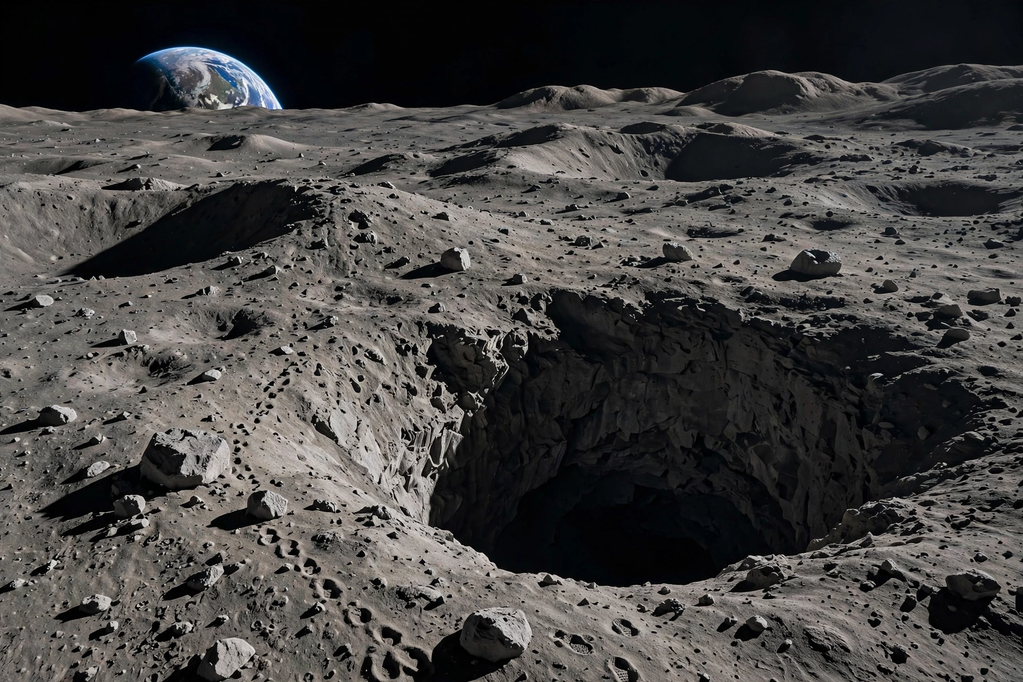
A dark opening in the lunar surface may lead to a hidden underground world. Scientists are preparing a new investigation to discover what lies beneath the Moon and the answer could change how future astronauts explore it.
The Moon looks like a silent, barren world. Its surface is covered with craters, ancient volcanic plains, steep cliffs, and mountains shaped over billions of years. But what if part of its most interesting landscape lies out of sight?
Scientists are preparing to investigate a mysterious opening called the Marius Hills Pit, a lunar depression that could provide access to a much larger underground structure. The proposed investigation, known as GIMLI, aims to determine whether a cave-like passage extends beneath the surface.
The idea is more than a science-fiction possibility. Researchers have already found evidence that another lunar pit connects to an underground conduit. Now, scientists want to learn more about what may be hidden beneath a different part of the Moon.
If a substantial underground cavity exists, it could reveal how ancient lunar volcanoes worked. It might also offer future astronauts something the Moon’s exposed surface cannot easily provide: a naturally sheltered environment.
But there is an important question to answer first. Is there really a giant cave beneath this particular lunar opening, or are scientists looking at a smaller geological feature?
The investigation is designed to find out.
Table of Contents
1. The mysterious opening that caught scientists’ attention
The Marius Hills Pit lies in the Marius Hills region, an area of the Moon associated with extensive volcanic activity.
Unlike an ordinary impact crater, a lunar pit can have steep walls, overhangs, or a floor that appears to continue into a deeper opening. Such features interest planetary scientists because they may reveal underground spaces that would otherwise remain hidden beneath lunar rock and dust.
The Marius Hills Pit was identified in observations from Japan’s Kaguya lunar orbiter in 2009. Subsequent orbital observations have helped scientists examine its shape and surrounding geology.
The opening is commonly described in recent reporting as roughly 300 feet (about 90 metres) across and potentially around 150 feet (about 45 metres) deep. These figures describe estimates of the pit, not a confirmed measurement of an entire underground cave.
That distinction matters.
An opening in the ground does not automatically mean a huge chamber lies beneath it. The depression could connect to a tunnel, lead into a smaller cavity, or end in a way that does not permit access to an extensive underground system.
Scientists need measurements of the material below and around the opening to determine which explanation best fits the evidence.
Research context: The Planetary Science Institute announced the GIMLI investigation in October 2026. Its purpose is to investigate whether an underground cave or lava tube extends from the Marius Hills Pit.
Primary source: Planetary Science Institute — GIMLI lunar cave investigation
2. How could a cave form on the Moon?
To understand the mystery, we need to look back to the Moon’s volcanic past.
Billions of years ago, volcanic activity reshaped large portions of the lunar surface. Molten rock spread across the landscape, filling low areas and forming extensive plains of solidified lava.
Under the right conditions, flowing lava can create a tunnel-like structure.
Imagine a stream of molten rock moving across the ground. The exposed surface begins to cool and harden, forming a crust. Meanwhile, hotter lava continues flowing beneath that crust. If the molten material eventually drains away, it can leave an empty passage behind.
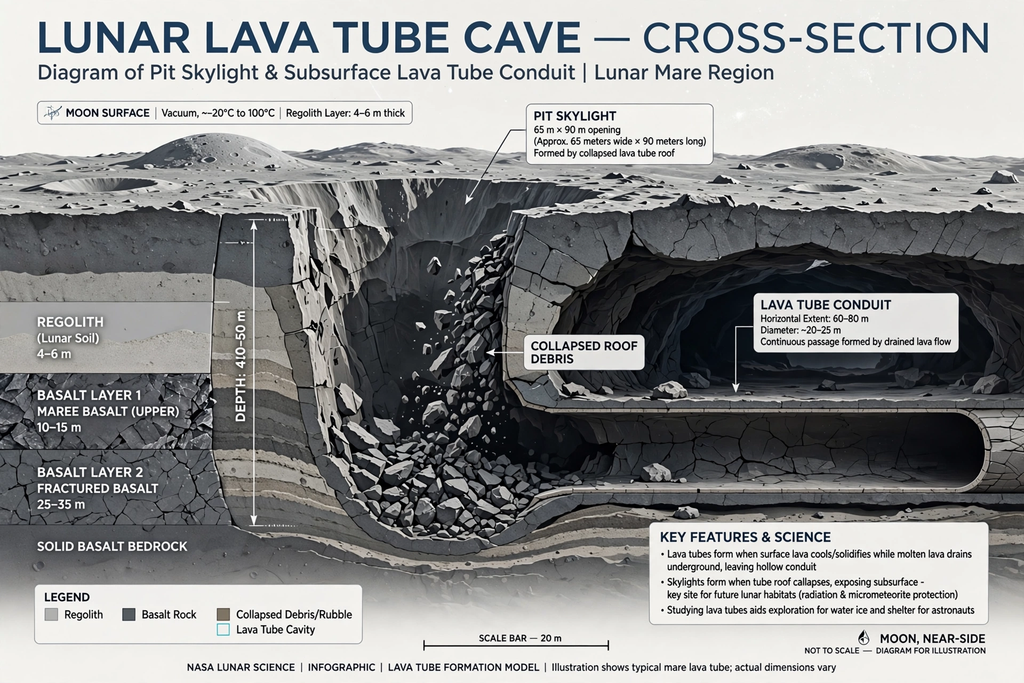
These structures are known as lava tubes.
Lava tubes exist on Earth, and scientists have good geological reasons to investigate whether similar structures formed on the Moon. The Moon’s lower gravity and different volcanic conditions may allow some lunar lava tubes to develop different dimensions from their terrestrial counterparts.
A tunnel may remain buried until part of its roof collapses. That collapse can create an opening known as a skylight, providing a potential entrance to the structure below.
This is one explanation for certain lunar pits.
However, not every pit is necessarily the entrance to a long lava tube. Scientists must establish how a particular feature formed rather than assuming that every dark opening leads to a vast underground network.
That is what makes the Marius Hills investigation scientifically valuable: it can test a geological explanation using measurements rather than appearances alone.
3. NASA’s GIMLI investigation: How will scientists search underground?
In October 2026, the Planetary Science Institute announced that NASA had selected its GIMLI proposal through the agency’s Payloads and Research Investigations on the Surface of the Moon, or PRISM, program.
GIMLI stands for Geophysical Instruments for Marius Lunar pit Investigation.
The project is intended to examine the Marius Hills Pit from the lunar surface. Instead of relying exclusively on images taken from orbit, the investigation plans to combine several types of scientific measurements to study what lies beneath the opening.
Here is how the instruments can help.
Ground-penetrating radar
Radar can help researchers investigate structures below the surface. When radar signals interact with boundaries between different materials, some energy may be reflected back to an instrument.
By examining those reflections, scientists can look for changes in the subsurface that may indicate a buried passage or cavity.
The Norwegian Space Agency is participating in the project and will provide the ground-penetrating radar.
Radar does not simply photograph an underground cave. Its signals must be interpreted, and the results depend on factors such as the material, geometry, and measurement conditions.
Seismic sensors
Seismic instruments measure vibrations and how they travel through the ground.
Scientists can use seismic waves to investigate the structure of rock beneath the surface. Different materials and empty spaces can affect how those waves travel and reflect.
GIMLI plans to use an active-source seismic method, in which a controlled source generates signals that instruments can measure.
These observations could help researchers determine whether the ground beneath the pit contains a substantial void.
A gravimeter
Gravity measurements offer another way to investigate hidden structures.
A gravimeter measures variations in the local gravitational field. A large underground cavity contains less mass than the solid rock that would otherwise occupy the same space, potentially producing a measurable gravity anomaly.
The challenge is that other geological variations can also influence gravity. Scientists would therefore interpret these measurements alongside radar, seismic observations, and geological images.
Cameras and surface observations
Cameras will document the pit and its exposed walls. Those images can reveal layers of lunar material, rock structures, and evidence of past geological processes.
Combining the different instruments is important because each method has limitations. If the measurements support the same interpretation, researchers can build a stronger picture of the underground environment.
The goal is not merely to take a photograph of a mysterious hole. It is to work out what lies beneath it, how the feature formed, and whether a substantial underground passage exists.
Source: Planetary Science Institute’s official GIMLI announcement.
4. Scientists have already found evidence of a lunar cave
The Marius Hills investigation is not the first time researchers have found evidence of an underground passage on the Moon.
In July 2024, a research team published a paper in Nature Astronomy examining the Mare Tranquillitatis Pit, another opening on the lunar surface.
The researchers analysed radar observations collected in 2010 by the Mini-RF instrument aboard NASA’s Lunar Reconnaissance Orbiter.
Their analysis identified radar reflections consistent with an underground cave conduit extending from the pit. The researchers concluded that the feature likely leads to an accessible cave passage tens of metres long.
This was an important result because it went beyond simply identifying a dark opening. The radar analysis provided evidence for a structure continuing beneath the lunar surface.
Nevertheless, the study examined the Mare Tranquillitatis Pit—not the Marius Hills Pit. The two features should not be confused, and the results from one cannot automatically establish the size or existence of a cave at the other.
That is why the new investigation matters. Scientists now have an opportunity to examine another promising site using instruments designed to investigate the subsurface directly.
Read the original scientific paper:
Carrer and colleagues, Radar evidence of an accessible cave conduit on the Moon below the Mare Tranquillitatis pit, Nature Astronomy (2024).
5. Why would an underground cave matter to future astronauts?
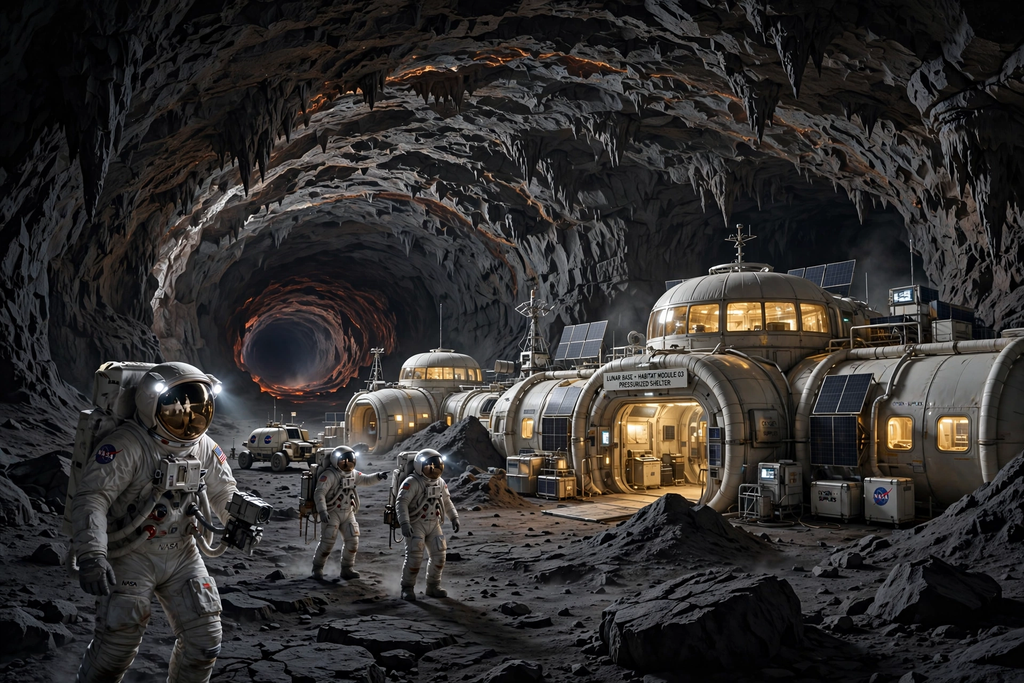
A lunar cave would be valuable for more than its scientific mystery. It could help address some of the biggest challenges involved in exploring and eventually living on the Moon.
Protection from radiation
The Moon lacks the kind of thick atmosphere and global magnetic protection that helps shield Earth’s surface from much of the space environment.
Astronauts outside a protected habitat face exposure to radiation from the Sun and from cosmic sources.
A sufficiently thick layer of lunar rock above an underground shelter could reduce exposure to some of this radiation. The actual protection would depend on the depth, surrounding material, and the design of any habitat.
A cave would not automatically make radiation a solved problem, but it could provide a valuable natural shield.
More stable temperatures
The lunar surface experiences severe temperature changes between sunlight and darkness. This creates challenges for equipment, power systems, and human habitats.
An underground environment shielded from direct sunlight may experience smaller temperature swings than the exposed surface. That could reduce some of the demands on future habitat systems.
Scientists would still need to measure the actual thermal conditions inside any cave before determining whether it is suitable for people.
Protection from micrometeorites
Small space rocks continually strike the Moon. Without a substantial atmosphere to burn them up, many reach the surface.
A natural roof of rock could shield astronauts and equipment from direct impacts by small meteorites. This is another reason planetary scientists are interested in underground structures.
A different approach to building a Moon base
Transporting construction materials from Earth is expensive and technically difficult. If astronauts could use an existing cavity, it might reduce the amount of protective material they would need to bring or manufacture.
But an underground lunar base would still require engineering work, including access routes, lighting, power, communications, life-support systems, and structural assessments.
Scientists would first have to establish whether a cave exists, map its dimensions, examine the stability of its roof and walls, and determine whether robots or astronauts could enter safely.
For now, lunar caves are a potential resource—not ready-made homes.
6. What if the cave does not exist?
A negative result would not make the investigation a failure.
If the Marius Hills Pit does not lead to a substantial underground passage, the instruments could still reveal valuable information about the pit’s origin and the geology beneath the surrounding landscape.
The exposed walls contain layers of lunar material that are usually buried. Examining those layers could help scientists reconstruct the history of volcanic activity in the region.
Researchers may learn how lava moved across the surface, how different deposits formed, and how the Moon’s geological landscape changed over time.
The measurements could also help scientists improve methods for detecting underground structures at other locations.
In other words, the investigation has two important questions to answer: Does a substantial cave extend from the pit, and what can the site teach us about the Moon’s history?
Either answer could advance lunar science.
7. Could lunar caves help us search for life?
The discovery of underground structures naturally raises another question: could caves on the Moon contain life?
There is currently no confirmed evidence that lunar caves host living organisms or that the Moon has ever supported life.
Earth’s caves can provide shelter from harsh surface conditions, and some terrestrial underground environments support specialised organisms. But Earth’s geology, atmosphere, water availability, and biological history differ greatly from those of the Moon.
A lunar lava tube is not evidence of an ecosystem.
The strongest immediate reasons to investigate these structures are geological research and future exploration. Scientists may also consider whether protected underground environments could preserve useful records of the lunar environment, but that is different from claiming that life has been found.
Keeping those questions separate helps distinguish a fascinating possibility from a scientific discovery.
8. What happens next?
The GIMLI project is a selected investigation intended to study the Marius Hills Pit. Selection and planning do not mean the cave has already been confirmed, nor do they mean a spacecraft has completed the investigation.
The project is expected to use a lander and rover delivered through NASA’s Commercial Lunar Payload Services initiative. The instruments will collect data intended to characterise the subsurface and assess the potential for an underground lava tube.
The results will need to be analysed before scientists can determine whether the pit connects to a substantial cave and, if so, estimate its dimensions.
Several questions remain open:
- Does the Marius Hills Pit connect to an underground lava tube?
- If a passage exists, how far does it extend?
- Is the roof stable enough for further robotic exploration?
- Could the structure offer meaningful protection from radiation and extreme temperatures?
- What do the pit and its surrounding rock layers reveal about ancient lunar volcanism?
The answers could influence how future missions choose landing sites, investigate lunar geology, and plan long-duration exploration.
For reliable updates, follow the Planetary Science Institute’s official project announcement and NASA’s Commercial Lunar Payload Services program.
9. A reflection on the vastness of creation
The possibility of hidden structures beneath the Moon invites us to reflect on how much remains unknown about the universe.
A world that appears familiar from Earth can still hold geological features that scientists have only recently begun to investigate. Modern instruments can reveal evidence invisible to the naked eye, yet each discovery may lead to new questions.
For Muslim readers, the exploration of the heavens can be an opportunity to reflect on the signs of Allah’s creation while appreciating the value of observation, learning, and careful reasoning.
The Qur’an invites people to contemplate the heavens and the Earth. In Surah Al-Imran, Allah describes people who remember Him and reflect on the creation of the heavens and the Earth (Qur’an 3:190–191).
Read Qur’an 3:190–191 at Quran.com.
This reflection does not mean that the possible lunar cave proves a particular religious claim. Rather, it reminds us that scientific investigation and spiritual contemplation can inspire different but meaningful forms of curiosity.
The discovery of an underground cave would be a geological finding. Its deeper personal significance may lie in how it encourages us to learn, think carefully, and recognise the limits of our present knowledge.
Conclusion: A hidden world beneath the Moon?
The Marius Hills Pit may open into an underground lava tube, but scientists have not yet established that a giant cave lies beneath it.
What makes the investigation exciting is the opportunity to move beyond speculation. By combining radar, seismic measurements, gravity data, and images, researchers aim to determine what is actually hidden beneath the lunar surface.
The possible rewards extend beyond a dramatic discovery. An underground passage could offer a new window into the Moon’s volcanic past and, one day, help engineers plan safer environments for astronauts.
Even if no large cave is found, the measurements may reveal important details about how the Moon formed and evolved.
For now, the mystery remains open. The next chapter will depend not on what the dark opening looks like from above, but on what the scientific evidence reveals below it.
One thing is clear: the Moon still has geological secrets waiting to be investigated.
The Moon is not the only celestial body hiding extraordinary mysteries. Across the Solar System, scientists continue to investigate unusual formations and unexplained-looking phenomena that challenge our understanding of space.
From Saturn’s mysterious 10-sided shape, an unusual atmospheric pattern observed by Hubble, to the galaxy with no stars, which raises fascinating questions about how galaxies form, the universe still holds many surprises.
Researchers are also testing strange ideas about possible alien technology in Moon dust, while the search for life beyond Earth continues to inspire scientific debate. For a broader look at these questions, explore our guide to aliens in Islam.
✦ Asma ul Husna Stories ✦
Discover the beautiful Names of Allah through illustrated Islamic stories.
Explore the Stories →You can also explore our Islamic Tools to learn about important dates and Islamic months, or read our guide to performing Umrah for a practical introduction to this important act of worship. Each resource offers another way to deepen your knowledge of Islam and reflect on its teachings in everyday life.
References
- Planetary Science Institute — October 2026
- Nature Astronomy — July 15, 2024
- NASA — Commercial Lunar Payload Services
- The Qur’an — Surah Al-Imran, 3:190–191
Frequently asked questions
Is there really a giant cave beneath the Moon?
Scientists have found radar evidence of a cave-like conduit beneath the Mare Tranquillitatis Pit. A separate investigation aims to determine whether a substantial underground passage extends from the Marius Hills Pit.
How do caves form on the Moon?
Some lunar caves may be lava tubes left behind when the outer surface of flowing lava hardened while molten rock continued moving beneath it. Later roof collapses can expose openings called skylights.
Could astronauts live inside a lunar cave?
Potentially, if a cave is accessible, stable, and suitable for a habitat. Underground rock could reduce exposure to radiation, micrometeorites, and temperature extremes, but extensive engineering and safety assessments would still be required.
Has NASA explored the Marius Hills cave yet?
The GIMLI project was selected for investigation in October 2026. Its selection does not mean the cave has already been confirmed or explored.