

The Journey of the Soul After Death is a significant topic in Islam, as stated in the Qur’an and the Sunnah of Prophet Muhammad ﷺ. Everyone dies, regardless of riches, power, age, or status. Allah says everyone will die and cannot escape their fate. Death is not the end in Islam. It marks the start of a new life that leads to the Day of Judgement and eternal life in Paradise or Hell. Islamic believers prepare for the Hereafter via faith, repentance, righteous deeds, and devotion to Allah by understanding the soul’s journey after death.
Every life has a predetermined time known only to Allah. The designated time is ajal. Nobody dies before or after Allah’s time. That moment cannot be delayed by doctors, medicine, or loved ones. People have several chances to return to Allah before death. Sincere repentance is accepted till the soul reaches the throat; thus, believers should always repent. The Qur’an advises against postponing repentance till death. This urges Muslims to ask Allah for forgiveness daily, not tomorrow.
Table of Contents
Journey of the Soul After Death
Before going to the eternal destination, there are many stages of life. Allah orders the Angel of Death to take the soul at the designated hour. Dying people see things others cannot. According to the Qur’an, the spirit reaches the neck while family members watch helplessly. Meanwhile, other angels descend. Righteous believers receive peace, mercy, and Paradise news from angels. They reassure believers of Allah’s pardon and eternal reward. Angels warn disbelievers of retribution and the repercussions of their actions.
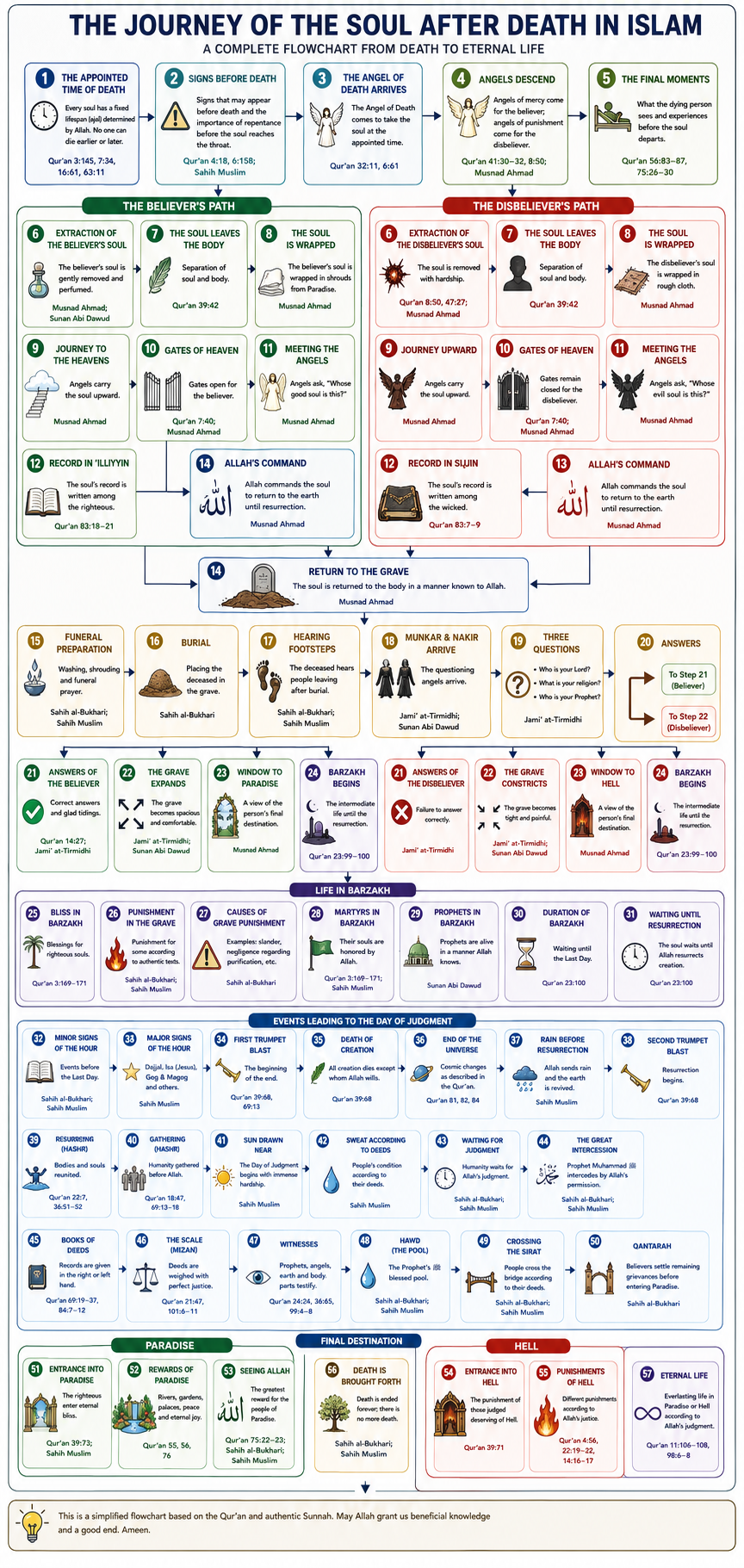
Islam divides the soul’s journey after death into two ways. Genuine hadith states that believers’ souls depart the body peacefully, like water from a vessel. Jannah-scented shrouds from Paradise cover it. The soul ascends through the heavens on angels, who greet it and ask about the excellent soul. The believer enters heaven and is listed among the virtuous in ‘Illiyyin. Allah tells the angels to return the soul to Earth because humanity was created there and will return till the Resurrection.
The disbeliever’s soul travels differently. Authentic accounts mention its difficult removal. Though wrapped in rough material and carried higher, heaven’s gates remain closed. This is recorded in Sijjin, the wicked’s registry. Returned to Earth, the soul begins its next life. These descriptions remind Muslims that religion and good deeds have eternal repercussions.
Families prepare the body for burial when the soul returns. After washing and wrapping the body, Muslims pray the funeral prayer (Salat al-Janazah). We carefully bury the body in the grave. According to genuine hadith, the departed hear their footsteps as they leave. The angels Munkar and Nakir then question the person.
Islam considers the grave questioning a crucial part of the soul’s journey after death. Three questions are asked to everyone: Your Lord? What religion are you? Who is your prophet? True believers answer confidently because faith is lifelong. Allah strengthens believers in this test. They claim Allah as their Lord, Islam as their religion, and Muhammad ﷺ as their Prophet. A window to Paradise opens as the grave expands and fills with light. A Christian finds calm waiting for the Last Day. Those who deny reality answer incorrectly. As a warning, their tomb narrows, and they see their spot in Hell.
The gap between death and resurrection is called Barzakh. Islamic Barzakh is a real life stage stated in the Qur’an. Allah’s kindness comforts and blesses pious believers during this time. People who refuse to repent may be punished in the grave. Slander and disregarding cleanliness after relieving oneself are examples of authentic hadith. Allah also honors martyrs. Their souls are gifted uniquely, and only Allah knows how the Prophets are alive in Barzakh.
Barzakh persists till Allah ends the universe. Before Judgement Day, numerous minor and large indications will arise. The Dajjal, Prophet Isa’s return, Gog and Magog, and other authentic hadith occurrences are key indications. Then Angel Israfil shall blow the Trumpet. The initial blow kills all life except Allah’s chosen. As described in the Qur’an, heaven and earth change. Mountains collapse, stars fall, seas rise, and the universe transforms.
After a time only Allah knows, He sends rain. Human bodies are resurrected with the second Trumpet blast. This is another major step in Islam’s afterlife journey. Every soul resurrects with its body. All humanity gathers before Allah on Judgement Day. People suffer differently depending on their deeds when the sun approaches. They eagerly await judgement till Allah grants Prophet Muhammad ﷺ the great intercession.
Each person’s deeds are then shown. Right-handed book recipients exult, whereas left-handed recipients regret. Allah’s immaculate scale, the Mizan, balances every conduct fairly. Even tiny actions are remembered. Angels, prophets, the planet, and even a person’s body record everything that transpires on the planet. After drinking from the Prophet ﷺ’s blessed Hawd, Muslims cross the Sirat bridge across Hell. People cross by faith and deed. Some cross quickly; others struggle.
Purified believers enter Paradise, where they enjoy infinite gardens, flowing rivers, gorgeous dwellings, serenity, happiness, and the highest reward—seeing Allah, according to the Qur’an and authentic Sunnah. Allah’s flawless justice sends Hell-deserving people to Hell. Death emerges and is extinguished forever.
Death stops after that. Paradise dwellers rejoice forever, but Hell dwellers suffer Allah’s judgment. In Islam, the soul’s journey after death teaches that this worldly life is transient. Every word, deed, and purpose counts. The greatest investment a person can make is in real faith, frequent worship, excellent character, repentance, and obedience to Allah, for everlasting life begins when this temporary existence ends.
Summary
The following is the summary list to understand the journey of the soul better. Expand the topics for further detail.
1. THE APPOINTED TIME OF DEATH (AJAL)
- Every soul has a fixed lifespan decreed by Allah.
- No one can delay or hasten death.
- References: Qur’an 3:145, 7:34, 16:61, 63:11
2. SIGNS BEFORE DEATH
- Opportunity for repentance remains until the soul reaches the throat.
- Certain signs may appear before death.
- References: Qur’an 4:18, 6:158; Sahih Muslim
3. ANGEL OF DEATH ARRIVES
- Angel of Death comes at the exact appointed time.
- References: Qur’an 32:11, 6:61
4. ANGELS DESCEND
- Believer → Angels of Mercy
- Disbeliever → Angels of Punishment
- References: Qur’an 41:30–32, 8:50
5. FINAL MOMENTS
- The dying person begins witnessing the unseen.
- References: Qur’an 56:83–87, 75:26–30
6. SOUL LEAVES THE BODY
BELIEVER’S PATH
- Gentle extraction and perfumed
- Soul leaves body
- Wrapped in heavenly shroud
- Journey through heavens
- Gates of Heaven open
- Angels praise the soul by asking, “Whose good soul is this?”
- Record in ‘Illiyyin
- References: Qur’an 83:18-21, 7:40, 39:42
DISBELIEVER’S PATH
- Painful extraction
- Soul leaves body
- Wrapped in rough cloth
- Journey upward
- Gates remain closed
- Angels condemn the soul by asking, “Whose evil soul is this?”
- Record in Sijjin
- References: Qur’an 7:40, Qur’an 83:7-9
7. ALLAH’S COMMAND
- Allah commands the soul to return to the earth until resurrection.
- References: Musnad Ahmad
8. RETURNS TO THE GRAVE
- The soul is returned in a manner known to Allah.
- References: Musnad Ahmad
9. FUNERAL PREPARATION
- Washing → Shrouding → Janazah Prayer
- References: Sahih al-Bukhari; Sahih Muslim
10. BURIAL
- Placing the deceased in the grave.
- References: Sahih al-Bukhari
11. HEARS FOOTSTEPS
- The deceased hears people leaving after burial.
- References: Sahih al-Bukhari; Sahih Muslim
12. MUNKAR & NAKIR
- The questioning angels arrive.
- References: Jami’ at-Tirmidhi; Sunan Abi Dawud
13. THREE QUESTIONS
- Who is your Lord?
- What is your religion?
- Who is your Prophet?
- References: Jami’ at-Tirmidhi
14. ANSWERS GIVEN
Believer
- Correct answers
- Grave expands
- Window to Paradise
- References: Qur’an 14:27; Jami’ at-Tirmidhi, Musnad Ahmad, Sunan Abi Dawud
Disbeliever
- Cannot answer
- Grave constricts
- Window to Hell
- References: Qur’an 14:27; Jami’ at-Tirmidhi, Musnad Ahmad, Sunan Abi Dawud
15. BARZAKH BEGINS
- Intermediate life until Resurrection
- References: Qur’an 23:99–100
16. LIFE IN BARZAKH
- Blessings for righteous people.
- Punishment in the grave because of slander and negligence regarding purification.
- Martyrs are specially honored.
- Prophets are alive in Barzakh.
- Waiting until the day of Resurrection.
- References: Qur’an 3:169–171, Sahih al-Bukhari; Sahih Muslim, Sunan Abi Dawud
17. EVENTS LEADING TO THE DAY OF JUDGMENT
- Minor and Major Signs of the Hour
- First Trumpet Blast – The beginning of the end of the world.
- Death of Creation – All creation dies except whom Allah wills
- End of the Universe – Cosmic changes described in the Qur’an.
- Rain Before Resurrection – Allah sends rain and bodies are recreated.
- Second Trumpet Blast – Resurrection begins
- Resurrection – Bodies and souls reunited.
- Gathering (Hashr) – Humanity gathered before Allah.
- Sun Drawn Near – The Day of Judgment begins with immense hardship.
- Sweat According to Deeds – People’s condition according to their deeds.
- Waiting for Judgment – Humanity waits for Allah’s judgment.
- The Great Intercession – Prophet Muhammad ﷺ intercedes by Allah’s permission.
- Books of Deeds – Records are given in the right or left hand.
- The Scale (Mizan) – Deeds are weighed.
- Witnesses – Prophets, angels, earth, and body parts testify.
- Hawd (The Pool) – The Prophet’s ﷺ blessed pool.
- Crossing the Sirat – People cross according to their deeds.
- Qantarah – Believers settle remaining grievances before entering Paradise.
- References: Qur’an 23:100, 39:68, 69:13, 81:1–14, 82:1–5, 84:1–5, 22:7, 36:51–52, 18:47, 69:13–18, 69:19–37, 84:7–12, 21:47, 101:6–11, 24:24, 36:65, 99:4–8, Sahih al-Bukhari, Sahih Muslim,
18. FINAL DESTINATION
PARADISE
- The righteous enter eternal bliss.
- Rewards of Paradise – Rivers, gardens, palaces, peace, and eternal joy.
- Seeing Allah – The greatest reward for the people of Paradise.
- References: Qur’an 39:73, 55, 56, 76, 75:22–23, Sahih al-Bukhari, Sahih Muslim
HELL
- Entrance into Hell – The punishment of those judged deserving of Hell.
- Punishments of Hell – Different punishments according to Allah’s justice.
- References: Qur’an 4:56, 22:19–22, 14:16–17, 39:71
19. DEATH IS BROUGHT FORTH
- Death is slaughtered—there will never be death again.
- References: Sahih al-Bukhari; Sahih Muslim
20. ETERNAL LIFE
- Paradise → Eternal Bliss
- Hell → Eternal Punishment for those whom Allah decrees
- References: Qur’an 11:106–108, 98:6–8
Conclusion
Islam’s Journey of the Soul After Death reminds us that this worldly life is temporary and leads to eternity. From death to Barzakh, the resurrection, the Day of Judgment, and Paradise or Hell, Allah’s perfect plan and justice are present at every stage. Understanding the Islamic afterlife shouldn’t just scare you.
It promotes hope, faith, repentance, worship, and virtue. On Judgment Day, every prayer, act of kindness, word, and deed will be counted. No good deed is too small for Allah, and no sin should prevent us from repenting.
The journey of the soul is closely connected with Islamic teachings about death, the Hereafter, Paradise, Hell, and the final destiny of humanity. To understand this larger journey, explore the chronological order of our life in Islam, Paradise in Islam, and Hell in Islam.