What Are the Signs of Qiyamat in Islam?What will happen before the Day of Judgment? Will the world experience extraordinary events? What did Prophet Muhammad ﷺ tell us about the signs that would appear before the end of this world?
In Islam, Qiyamat refers to the Day of Resurrection and Judgment, when Allah will resurrect humanity and hold every soul accountable for its deeds. The period preceding the Last Hour is described in the Quran and the teachings of Prophet Muhammad ﷺ through signs that include moral and social changes, great trials, and extraordinary events involving the natural world.
These teachings are not merely stories about a distant future. They remind believers that earthly life is temporary, that human actions have consequences, and that the unseen realities of the Hereafter deserve serious reflection.
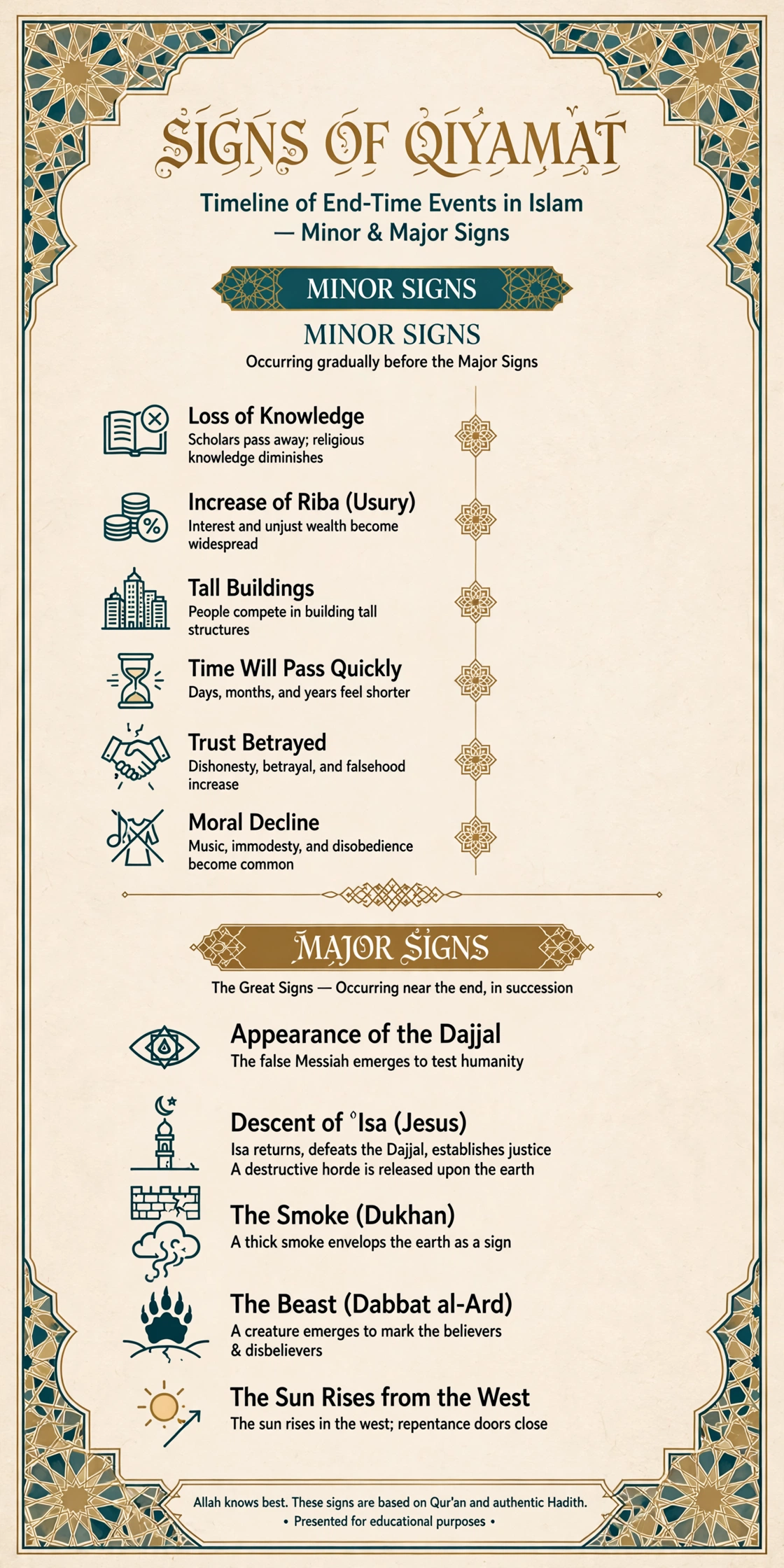
Islamic scholars commonly classify the signs into two broad categories:
Minor signs of Qiyamat: Signs that precede the Last Hour and include social changes, trials, and historical events.
Major signs of Qiyamat: Extraordinary events that will occur near the end of the world’s present order.
There is no single universally agreed list containing every minor sign. Scholars have compiled different lists from numerous narrations, and they differ in how they classify some events. However, the ten major signs are famously mentioned together in an authentic Hadith in Sahih Muslim.
This guide explains the principal signs, their scriptural evidence, and what Muslims should—and should not—infer from them.
Table of Contents
1. Does the Quran Tell Us When Qiyamat Will Happen?
Before studying the signs, one essential question must be answered: Can anyone calculate the exact date of Qiyamat?
The Quran gives a clear answer.
In Surah Al-A’raf, Allah says that knowledge of the Hour belongs to Him alone and that it will come unexpectedly.
They ask you ˹O Prophet˺ regarding the Hour, “When will it be?” Say, “That knowledge is only with my Lord. He alone will reveal it when the time comes. It is too tremendous for the heavens and the earth and will only take you by surprise.” They ask you as if you had full knowledge of it. Say, “That knowledge is only with Allah, but most people do not know.”
This verse establishes an important distinction: knowing that the Hour has signs is not the same as knowing when it will occur.
In the famous Hadith of Jibril, the angel asks Prophet Muhammad ﷺ about the Hour. The Prophet explains that the one being asked does not know more about its timing than the one asking. The Hadith then discusses some of its signs.
Should it so happen that we come into contact with one of the Companions of the Messenger of Allah (peace be upon him) we shall ask him about what is talked about taqdir (Divine Decree). Accidentally we came across Abdullah ibn Umar ibn al-Khattab, while he was entering the mosque. My companion and I surrounded him. One of us (stood) on his right and the other stood on his left. I expected that my companion would authorize me to speak. I therefore said: Abu Abdur Rahman! There have appeared some people in our land who recite the Qur’an and pursue knowledge. And then after talking about their affairs, added: They (such people) claim that there is no such thing as Divine Decree and events are not predestined. He (Abdullah ibn Umar) said: When you happen to meet such people tell them that I have nothing to do with them and they have nothing to do with me. And verily they are in no way responsible for my (belief). Abdullah ibn Umar swore by Him (the Lord) (and said): If any one of them (who does not believe in the Divine Decree) had with him gold equal to the bulk of (the mountain) Uhud and spent it (in the way of Allah), Allah would not accept it unless he affirmed his faith in Divine Decree. He further said: My father, Umar ibn al-Khattab, told me: One day we were sitting in the company of Allah’s Apostle (peace be upon him) when there appeared before us a man dressed in pure white clothes, his hair extraordinarily black. There were no signs of travel on him. None amongst us recognized him. At last he sat with the Apostle (peace be upon him) He knelt before him placed his palms on his thighs and said: Muhammad, inform me about al-Islam. The Messenger of Allah (peace be upon him) said: Al-Islam implies that you testify that there is no god but Allah and that Muhammad is the messenger of Allah, and you establish prayer, pay Zakat, observe the fast of Ramadan, and perform pilgrimage to the (House) if you are solvent enough (to bear the expense of) the journey. He (the inquirer) said: You have told the truth. He (Umar ibn al-Khattab) said: It amazed us that he would put the question and then he would himself verify the truth. He (the inquirer) said: Inform me about Iman (faith). He (the Holy Prophet) replied: That you affirm your faith in Allah, in His angels, in His Books, in His Apostles, in the Day of Judgment, and you affirm your faith in the Divine Decree about good and evil. He (the inquirer) said: You have told the truth. He (the inquirer) again said: Inform me about al-Ihsan (performance of good deeds). He (the Holy Prophet) said: That you worship Allah as if you are seeing Him, for though you don’t see Him, He, verily, sees you. He (the enquirer) again said: Inform me about the hour (of the Doom). He (the Holy Prophet) remarked: One who is asked knows no more than the one who is inquiring (about it). He (the inquirer) said: Tell me some of its indications. He (the Holy Prophet) said: That the slave-girl will give birth to her mistress and master, that you will find barefooted, destitute goat-herds vying with one another in the construction of magnificent buildings. He (the narrator, Umar ibn al-Khattab) said: Then he (the inquirer) went on his way but I stayed with him (the Holy Prophet) for a long while. He then, said to me: Umar, do you know who this inquirer was? I replied: Allah and His Apostle knows best. He (the Holy Prophet) remarked: He was Gabriel (the angel). He came to you in order to instruct you in matters of religion.
Consequently, claims that Qiyamat will occur in a particular year, or that a specific modern event proves the final Hour is imminent, should not be presented as established Islamic knowledge.
2. Minor Signs of Qiyamat in Islam
Minor signs are mentioned in numerous authentic narrations. Some describe events that occurred during the Prophet’s lifetime or in early Islamic history; others describe recurring social conditions or developments that precede the Hour.
The following are among the principal signs found in well-known Hadith collections. This is a substantial guide to the major reported categories, rather than a claim that every minor sign discussed by every scholar is included.
Sign 1: The Sending of Prophet Muhammad ﷺ
The sending of the final Messenger is itself connected with the nearness of the Hour.
The Prophet ﷺ indicated the close relationship between his mission and the Last Hour by comparing his arrival and the Hour to two adjacent fingers.
Allah’s Messenger (ﷺ) said, “I have been sent and the Hour (is at hand) as these two (fingers).
This sign is significant because it places the question of the Last Hour within the prophetic message itself. Muslims believe that Muhammad ﷺ is the final prophet and that no new prophet will come after him.
Sign 2: The Passing Away of Religious Knowledge
The Prophet ﷺ taught that religious knowledge would be taken away through the death of knowledgeable scholars. As authentic knowledge becomes less accessible, people may turn to unqualified individuals for religious guidance.
The concern is not simply that people will possess less information. It is that ignorance may be mistaken for scholarship, allowing false religious judgments to mislead communities.
I heard Allah’s Messenger (ﷺ) saying, “Allah does not take away the knowledge, by taking it away from (the hearts of) the people, but takes it away by the death of the religious learned men till when none of the (religious learned men) remains, people will take as their leaders ignorant persons who when consulted will give their verdict without knowledge. So they will go astray and will lead the people astray.”
This Hadith also offers a practical lesson: Muslims should preserve reliable knowledge, study carefully, and distinguish qualified scholarship from unsupported claims.
Sign 3: The Spread of Religious Ignorance
The Prophet ﷺ listed the spread of ignorance among the signs of the Hour.
Allah’s Messenger (ﷺ) said, “From among the portents of the Hour are (the following): -1. Religious knowledge will be taken away (by the death of Religious learned men). -2. (Religious) ignorance will prevail. -3. Drinking of Alcoholic drinks (will be very common). -4. There will be prevalence of open illegal sexual intercourse.
This sign is closely connected to the loss of religious knowledge, but the two ideas are not identical. The death of scholars is one mechanism described in the Hadith; the spread of ignorance is a resulting condition.
For contemporary readers, the lesson is to seek sound religious education rather than relying on sensational videos, unattributed quotations, or claims that cannot be traced to authentic sources.
Sign 4: Widespread Alcohol Consumption and Open Immorality
Sahih al-Bukhari 80 mentions the prevalence of alcohol consumption and unlawful sexual relations among the signs of the Hour.
These descriptions concern moral and social conditions. They should not be used to condemn entire populations or to claim that every individual in a particular society behaves in the same way.
The ethical message is to protect personal conduct, uphold modesty, and maintain accountability regardless of what becomes socially accepted.
Sign 5: The Appearance of False Claimants to Prophethood
The Prophet ﷺ foretold that numerous impostors would appear, each claiming to be a messenger of Allah.
Sahih al-Bukhari reports that approximately thirty such liars would emerge.
Allah’s Messenger (ﷺ) said, “The Hour will not be established (1) till two big groups fight each other whereupon there will be a great number of casualties on both sides and they will be following one and the same religious doctrine, (2) till about thirty Dajjals (liars) appear, and each one of them will claim that he is Allah’s Messenger (ﷺ), (3) till the religious knowledge is taken away (by the death of Religious scholars) (4) earthquakes will increase in number (5) time will pass quickly, (6) afflictions will appear, (7) Al-Harj, (i.e., killing) will increase, (8) till wealth will be in abundance —- so abundant that a wealthy person will worry lest nobody should accept his Zakat, and whenever he will present it to someone, that person (to whom it will be offered) will say, ‘I am not in need of it, (9) till the people compete with one another in constructing high buildings, (10) till a man when passing by a grave of someone will say, ‘Would that I were in his place (11) and till the sun rises from the West. So when the sun will rise and the people will see it (rising from the West) they will all believe (embrace Islam) but that will be the time when: (As Allah said,) ‘No good will it do to a soul to believe then, if it believed not before, nor earned good (by deeds of righteousness) through its Faith.’ (6.158) And the Hour will be established while two men spreading a garment in front of them but they will not be able to sell it, nor fold it up; and the Hour will be established when a man has milked his she-camel and has taken away the milk but he will not be able to drink it; and the Hour will be established before a man repairing a tank (for his livestock) is able to water (his animals) in it; and the Hour will be established when a person has raised a morsel (of food) to his mouth but will not be able to eat it.”
Islamic belief holds that Muhammad ﷺ is the final prophet. Claims of new prophethood after him therefore conflict with this foundational teaching.
This sign also highlights the importance of examining religious claims against established scripture rather than accepting a charismatic personality’s assertions without scrutiny.
Sign 6: Frequent Earthquakes
Earthquakes are mentioned among the signs of the Hour in Sahih al-Bukhari.
The Prophet (ﷺ) said, “The Hour (Last Day) will not be established until (religious) knowledge will be taken away (by the death of religious learned men), earthquakes will be very frequent, time will pass quickly, afflictions will appear, murders will increase and money will overflow amongst you.”
An important qualification is necessary: earthquakes also have natural geological causes. The occurrence of an earthquake does not establish that it is a specific end-times event or prove that the Last Hour is about to begin.
The Hadith records a sign; it does not provide a method for dating Qiyamat by counting natural disasters.
Sign 7: Time Seeming to Pass Quickly
The Prophet ﷺ described a time when the passage of time would seem accelerated.
Scholars have discussed possible interpretations of this description, including a loss of blessing in time or a change in how time is experienced. Modern expressions such as “time flies” should not automatically be treated as proof of a particular interpretation.
The text should be respected without pretending that one speculative explanation is definitively established.
Sign 8: An Increase in Tribulations and Killing
The Prophet ﷺ warned of increasing tribulations and killing before the Hour.
The Prophet (ﷺ) said, “Time will pass rapidly, good deeds will decrease, miserliness will be thrown (in the hearts of the people) afflictions will appear and there will be much ‘Al-Harj.” They said, “O Allah’s Apostle! What is “Al-Harj?” He said, “Killing! Killing!”
The Arabic term harj is explained in the narrations as killing. These reports remind Muslims of the seriousness of bloodshed and the dangers of social disorder.
Wars, violence, and political instability have occurred throughout history. Identifying a particular conflict as the final fulfillment of this sign requires evidence that ordinary observers generally do not possess.
Sign 9: Abundance of Wealth
Sahih al-Bukhari 1036 mentions wealth becoming so abundant that it overflows among people. Another narration describes a wealthy person offering zakat but finding nobody willing to accept it.
This is not simply a prediction that every person will become rich. The narrations describe a condition of extraordinary abundance.
They also invite reflection on the relationship between wealth, generosity, social responsibility, and the spiritual dangers of becoming attached to material possessions.
Sign 10: Competition in Constructing Tall Buildings
One of the most widely discussed signs appears in the Hadith of Jibril. Among the signs described is that barefoot, poorly clothed, destitute shepherds would compete in constructing tall buildings.
The narration is often discussed in relation to dramatic changes in wealth and status, particularly among people who had previously lived in poverty.
Modern skyscrapers may remind readers of this Hadith, but the existence of a tall building by itself does not prove that a specific prophecy has been completely fulfilled. The narration should be considered in its full wording and context.
Sign 11: The Increase of Wealth and the Desire for Material Security
The narrations about wealth and social change also mention intense attachment to possessions and changing economic conditions.
Sahih al-Bukhari 7061 connects the approach of the Hour with a decline in good deeds, increasing miserliness, the spread of tribulations, and killing.
This is a reminder that material prosperity alone is not a measure of spiritual success. Wealth can be a blessing, but Islam also emphasizes charity, justice, and responsible use of what one possesses.
Sign 12: The Emergence of Major Historical Conflicts
Sahih al-Bukhari 7121 describes two large groups fighting one another, resulting in substantial casualties despite sharing the same religious affiliation.
Because this narration describes a particular conflict, it should not be applied casually to every modern war or political dispute. Its precise historical fulfillment and identification require careful scholarly analysis.
Other Minor Signs Discussed in Islamic Literature
Scholars also discuss signs derived from other narrations, including changes in social relationships, the loss of trust, the spread of dishonesty, and other moral or social developments.
Some signs are reported in multiple authentic narrations; others depend on reports whose authenticity or interpretation requires further assessment. The lists in popular books and online articles therefore do not always match.
For a comprehensive study, it is better to trace each claimed sign to its original narration than to reproduce an unverified list as though every item has equal evidentiary status.
3. The Ten Major Signs of Qiyamat
The major signs are extraordinary events described in Islamic scripture as preceding the Last Hour.
In Sahih Muslim 2901, Hudhayfah ibn Usayd al-Ghifari reports that the Prophet ﷺ mentioned ten signs. The list includes the Dajjal, the descent of Jesus son of Mary, Gog and Magog, the Smoke, the Beast, the rising of the sun from the west, three major land collapses, and a fire that drives people toward their gathering place.
Allah’s Messenger (ﷺ) came to us all of a sudden as we were (busy in a discussion). He said: What do you discuss about? They (the Companions) said. We are discussing about the Last Hour. Thereupon he said: It will not come until you see ten signs before and (in this connection) he made a mention of the smoke, Dajjal, the beast, the rising of the sun from the west, the descent of Jesus son of Mary (Allah be pleased with him), the Gog and Magog, and land-slides in three places, one in the east, one in the west and one in Arabia at the end of which fire would burn forth from the Yemen, and would drive people to the place of their assembly.
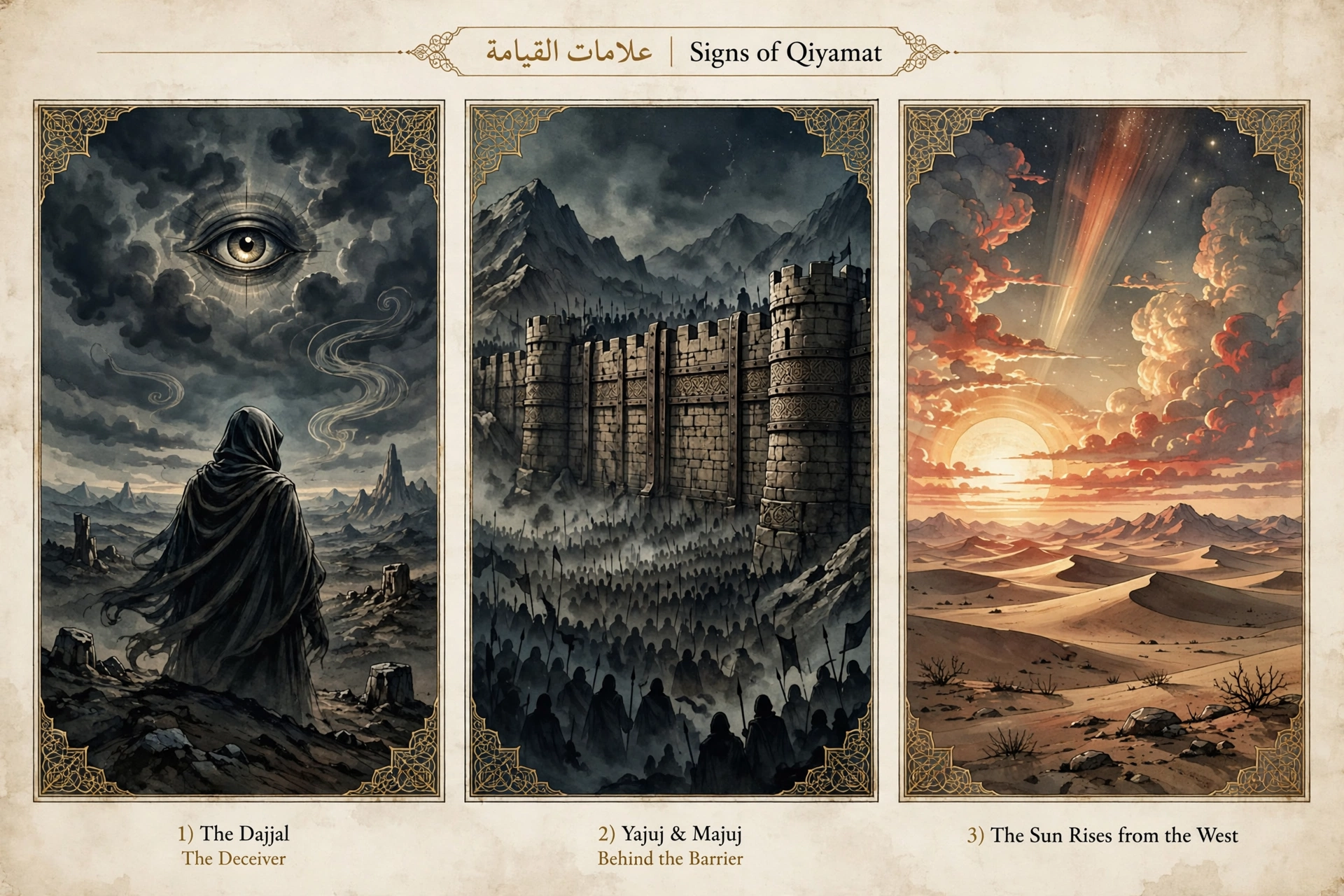
Dajjal is described in Islamic Hadith as a great deceiver who will subject humanity to an extraordinary trial.
The narrations concerning Dajjal emphasize the danger of deception, the need for steadfast faith, and the importance of seeking Allah’s protection.
Dajjal should not be identified with a modern political leader, celebrity, technology company, or public figure merely because someone considers that person deceptive. Such claims require evidence and should not be presented as established Islamic teaching.
Major Sign 2: The Return of Isa (Jesus), Peace Be Upon Him
Islam teaches that Isa ibn Maryam (Jesus, son of Mary) will descend near the end of time.
The Quran describes Jesus as a messenger of Allah, while authentic Hadith provide further details concerning his return and role in the events preceding the Last Hour.
Allah’s Messenger (ﷺ) said, “By Him in Whose Hands my soul is, surely (Jesus,) the son of Mary will soon descend amongst you and will judge mankind justly (as a Just Ruler); he will break the Cross and kill the pigs and there will be no Jizya (i.e. taxation taken from non Muslims). Money will be in abundance so that nobody will accept it, and a single prostration to Allah (in prayer) will be better than the whole world and whatever is in it.” Abu Huraira added “If you wish, you can recite (this verse of the Holy Book): — ‘And there is none Of the people of the Scriptures (Jews and Christians) But must believe in him (i.e Jesus as an Apostle of Allah and a human being) Before his death. And on the Day of Judgment He will be a witness Against them.”
This belief is distinct from Christian interpretations of the Second Coming, even though the two traditions share the expectation of Jesus’ return.
Major Sign 3: The Emergence of Ya’juj and Ma’juj (Gog and Magog)
The Quran mentions Ya’juj and Ma’juj in connection with a barrier and describes their emergence as part of events associated with the approach of the Hour.
What is the matter with you? We said: Allah’s Messenger, you made a mention of the Dajjal in the morning (sometimes describing him) to be insignificant and sometimes very important, until we began to think as if he were present in some (near) part of the cluster of the date-palm trees. Thereupon he (ﷺ) said: I harbor fear in regard to you in so many other things besides the Dajjal. If he comes forth while I am among you, I shall contend with him on your behalf, but if he comes forth while I am not amongst you, a man must contend on his own behalf and Allah would take care of every Muslim on my behalf (and safeguard him against his evil). He (Dajjal) would be a young man with twisted, contracted hair, and a blind eye. I compare him to Abd-ul-Uzza b. Qatan. He who amongst you would survive to see him should recite over him the opening verses of Sura Kahf (xviii). He would appear on the way between Syria and Iraq and would spread mischief right and left. O servant of Allah! adhere (to the path of Truth). We said: Allah’s Messenger, how long would he stay on the earth? He (ﷺ) said: For forty days, one day like a year and one day like a month and one day like a week and the rest of the days would be like your days. We said: Allah’s Messenger, would one day’s prayer suffice for the prayers of day equal to one year? Thereupon he (ﷺ) said: No, but you must make an estimate of time (and then observe prayer). We said: Allah’s Messenger, how quickly would he walk upon the earth? Thereupon he (ﷺ) said: Like cloud driven by the wind. He would come to the people and invite them (to a wrong religion) and they would affirm their faith in him and respond to him. He would then give command to the sky and there would be rainfall upon the earth and it would grow crops. Then in the evening, their pasturing animals would come to them with their humps very high and their udders full of milk and their flanks stretched. He would then come to another people and invite them. But they would reject him and he would go away from them and there would be drought for them and nothing would be left with them in the form of wealth. He would then walk through the waste land and say to it: Bring forth your treasures, and the treasures would come out and collect (themselves) before him like the swarm of bees. He would then call a person brimming with youth and strike him with the sword and cut him into two pieces and (make these pieces lie at a distance which is generally) between the archer and his target. He would then call (that young man) and he will come forward laughing with his face gleaming (with happiness) and it would be at this very time that Allah would send Jesus, son of Mary, and he will descend at the white minaret in the eastern side of Damascus wearing two garments lightly dyed with saffron and placing his hands on the wings of two Angels. When he would lower his head, there would fall beads of perspiration from his head, and when he would raise it up, beads like pearls would scatter from it. Every non-believer who would smell the odor of his self would die and his breath would reach as far as he would be able to see. He would then search for him (Dajjal) until he would catch hold of him at the gate of Ludd and would kill him. Then a people whom Allah had protected would come to Jesus, son of Mary, and he would wipe their faces and would inform them of their ranks in Paradise and it would be under such conditions that Allah would reveal to Jesus these words: I have brought forth from amongst My servants such people against whom none would be able to fight; you take these people safely to Tur. And then Allah would send Gog and Magog and they would swarm down from every slope. The first of them would pass the lake of Tiberias and drink out of it. And when the last of them would pass, he would say: There was once water there. Jesus and his companions would then be besieged here (at Tur, and they would be so much hard pressed) that the head of the ox would be dearer to them than one hundred dinars and Allah’s Apostle, Jesus, and his companions would supplicate Allah, Who would send to them insects (which would attack their necks) and in the morning they would perish like one single person. Allah’s Apostle, Jesus, and his companions would then come down to the earth and they would not find in the earth as much space as a single span which is not filled with their putrefaction and stench. Allah’s Apostle, Jesus, and his companions would then again beseech Allah, Who would send birds whose necks would be like those of Bactrian camels and they would carry them and throw them where God would will. Then Allah would send rain which no house of clay or (the tent of) camels’ hairs would keep out and it would wash away the earth until it could appear to be a mirror. Then the earth would be told to bring forth its fruit and restore its blessing and, as a result thereof, there would grow (such a big) pomegranate that a group of persons would be able to eat that, and seek shelter under its skin and milch cow would give so much milk that a whole party would be able to drink it. And the milch camel would give such (a large quantity of) milk that the whole tribe would be able to drink out of that and the milch sheep would give so much milk that the whole family would be able to drink out of that and at that time Allah would send a pleasant wind which would soothe (people) even under their armpits, and would take the life of every Muslim and only the wicked would survive who would commit adultery like asses and the Last Hour would come to them.
Their exact modern geographical identification is not established by these passages. Claims that a particular nation, ethnic group, or contemporary population is Ya’juj and Ma’juj should therefore be treated with caution.
Major Sign 4: The Appearance of the Smoke (Ad-Dukhan)
The Quran describes a visible smoke associated with a warning.
Allah says in Surah Ad-Dukhan:
“Then watch for the Day when the sky will bring a visible smoke.” Quran 44:10, translation of the meaning.
The interpretation of these verses has been discussed by early scholars. Some narrations and interpretations connect the smoke with events experienced by the people of Makkah during the Prophet’s lifetime, while the ten-sign Hadith lists the Smoke among the major signs before the Hour.
This is an important example of why readers should distinguish the Quranic wording, the different Hadith reports, and scholarly interpretation rather than presenting every interpretive question as settled.
The Smoke described in the major-sign narration should not automatically be equated with wildfire smoke, industrial pollution, volcanic ash, or another ordinary atmospheric event.
Major Sign 5: The Beast of the Earth (Dabbat al-Ard)
The Quran states that when a particular decree comes to pass, Allah will bring forth a creature from the earth that will speak to people.
Allah’s Messenger (ﷺ) came to us all of a sudden as we were (busy in a discussion). He said: What do you discuss about? They (the Companions) said. We are discussing about the Last Hour. Thereupon he said: It will not come until you see ten signs before and (in this connection) he made a mention of the smoke, Dajjal, the beast, the rising of the sun from the west, the descent of Jesus son of Mary (Allah be pleased with him), the Gog and Magog, and land-slides in three places, one in the east, one in the west and one in Arabia at the end of which fire would burn forth from the Yemen, and would drive people to the place of their assembly.
The Quranic verse does not provide a detailed biological description of the creature. Popular stories often add specific physical features, locations, or abilities that should not be accepted without checking their sources.
The sound approach is to affirm what the authentic texts establish while avoiding invented details.
Major Sign 6: The Sun Rising from the West
Among the most striking signs is the rising of the sun from the west rather than its usual direction.
Allah’s Messenger (ﷺ) said, “The Hour will not be established till the sun rises from the west, and when it rises (from the west) and the people see it, then all of them will believe (in Allah). But that will be the time when ‘No good it will do to a soul to believe then. If it believed not before..”‘ (6.158) The Hour will be established (so suddenly) that two persons spreading a garment between them will not be able to finish their bargain, nor will they be able to fold it up. The Hour will be established while a man is carrying the milk of his she-camel, but cannot drink it; and the Hour will be established when someone is not able to prepare the tank to water his livestock from it; and the Hour will be established when some of you has raised his food to his mouth but cannot eat it.”
The Prophet ﷺ mentioned this event in authentic Hadith. The narrations also explain its spiritual significance: when the sign occurs, a person’s previously unexpressed faith will no longer benefit them in the same way if they had not believed before or had not earned good through their faith.
This is a major sign described in Islamic revelation, not an ordinary astronomical phenomenon that scientists have predicted will occur in the near future.
The central lesson is the urgency of sincere faith and repentance before the opportunity has passed.
Major Signs 7, 8, and 9: Three Great Land Collapses
Sahih Muslim mentions three major events in which the earth will collapse or swallow up an area:
These are counted as three distinct signs in the ten-sign list.
Earthquakes, sinkholes, landslides, and other geological events occur naturally. Their occurrence does not establish that one of these particular major signs has taken place.
The Hadith does not supply a modern map or coordinates for identifying the three locations, so assigning exact contemporary locations without reliable evidence would be speculative.
Major Sign 10: A Fire That Drives People to Their Gathering Place
The final sign in the narration is a fire emerging from the direction of Yemen that will drive people toward the place of their gathering.
This fire is described as an extraordinary event in the prophetic account. It should not be casually equated with an ordinary wildfire or volcanic eruption.
The gathering of humanity is connected with the wider Islamic teaching that every person will ultimately face Allah’s judgment.
A Note on the Mahdi
Many Islamic scholars also discuss the appearance of the Mahdi, a righteous leader associated with events near the end of time.
The Prophet (ﷺ) said: If only one day of this world remained. Allah would lengthen that day (according to the version of Za’idah), till He raised up in it a man who belongs to me or to my family whose father’s name is the same as my father’s, who will fill the earth with equity and justice as it has been filled with oppression and tyranny (according to the version of Fitr). Sufyan’s version says: The world will not pass away before the Arabs are ruled by a man of my family whose name will be the same as mine.
Reports about the Mahdi appear in collections including Sunan Abi Dawud and Jami’ at-Tirmidhi, and scholars have assessed the relevant narrations in different ways. The Mahdi is not one of the ten signs explicitly enumerated in Sahih Muslim 2901a, so it is important not to misrepresent that particular Hadith.
4. What Happens When the World as We Know It Ends?
The signs of Qiyamat are part of a broader Quranic description of the end of the present world and the beginning of the Hereafter.
The Quran describes profound changes involving the sun, stars, mountains, seas, and the structure of the heavens.
Surah At-Takwir describes the sun being folded up, stars losing their light, mountains being set in motion, and other events associated with the Last Day.
These passages portray the Day of Judgment as a fundamental transformation of the present order. They are not simply predictions about ordinary natural disasters; they form part of the Quran’s wider teaching about resurrection, accountability, and the Hereafter.
5. Are Today’s Events Proof That Qiyamat Is Near?
Wars, earthquakes, extreme weather, new technologies, economic instability, and the construction of enormous buildings often lead people to ask whether the signs of Qiyamat are unfolding before their eyes.
The responsible answer requires distinguishing three things:
First, what the source explicitly says. If an authentic Hadith mentions frequent earthquakes, the text can be cited as evidence that earthquakes are among the reported signs.
Second, what can be established historically or scientifically. A specific earthquake, war, or technological development should be described accurately using relevant evidence.
Third, what remains interpretation or speculation. Claiming that a current event definitively fulfills a particular prophecy is a separate assertion and may not be supported by the source.
For example, the Hadith about competition in constructing tall buildings is authentic. However, pointing to a skyscraper and announcing that it proves the final Hour is imminent goes beyond what the narration itself establishes.
Similarly, a war should not automatically be labelled the final prophesied conflict, and an unusual astronomical event should not be declared a major sign without sound evidence.
This distinction protects readers from misinformation and helps preserve the seriousness of Islamic teachings.
6. What Should Muslims Do When Learning About the Signs of Qiyamat?
The purpose of studying the signs is not to live in constant fear or to speculate about dates. Islamic teachings direct attention toward faith, responsibility, and preparation for the Hereafter.
Strengthen faith and worship
Maintain prayer, remember Allah, read the Quran, and seek to understand its teachings. Faith is not simply an expectation that dramatic events will happen; it shapes everyday conduct.
Repent sincerely
The Quran repeatedly calls people toward repentance and righteousness. Rather than waiting for a dramatic sign, a believer should turn toward Allah while the opportunity remains.
Seek authentic knowledge
Verify Quranic verses and Hadith references before sharing claims. A popular quotation is not necessarily authentic, and a genuine narration may still be misunderstood when taken out of context.
Avoid declaring the date of Qiyamat
Quran 7:187 explicitly places knowledge of the Hour with Allah. No social media prediction, numerical calculation, or speculative interpretation can override this teaching.
Practice justice, mercy, and good character
Preparing for the Hereafter includes fulfilling obligations toward other people, returning what is owed, avoiding injustice, and helping those in need.
Conclusion: The Signs Are a Reminder, Not a Calendar
The signs of Qiyamat form an important part of Islamic teachings about the end of the present world and the coming of the Hereafter. The Quran describes the transformation of the heavens and earth, while authentic Hadith provide details about minor signs, extraordinary trials, and the ten major signs preceding the Last Hour.
Yet one principle remains central: knowledge of the exact time belongs to Allah.
Studying these signs responsibly means examining authentic sources, acknowledging differences in interpretation, and resisting the temptation to turn every frightening headline into a prophecy.
The most meaningful response is not to guess the date of the end, but to consider how we live today. Are we acting with honesty? Are we fulfilling our responsibilities? Are we seeking knowledge, showing mercy, and preparing for accountability before Allah?
The future is unseen, but the opportunity to do good exists now.
Allah knows best.
✦ Asma ul Husna Stories ✦
Discover the beautiful Names of Allah through illustrated Islamic stories.
You can also explore our Islamic Tools to learn about important dates and Islamic months, or read our guide to performing Umrah for a practical introduction to this important act of worship.
References
The following primary sources provide a foundation for further research and verification.
There is no single universally agreed total for all minor signs because scholars compile different lists from numerous narrations. However, Sahih Muslim 2901a explicitly enumerates ten major signs.
What are the ten major signs of Qiyamat?
The ten signs in the well-known narration are the Dajjal, the descent of Isa ibn Maryam, Ya’juj and Ma’juj, the Smoke, the Beast of the Earth, the rising of the sun from the west, three great land collapses in the east, west, and Arabian Peninsula, and the fire that drives people toward their gathering place.
Are all minor signs of Qiyamat already fulfilled?
Not every reported sign can be confidently classified as fulfilled. Some relate to historical events, some describe recurring conditions, and others have interpretations that remain debated. Each sign should be evaluated through its original source and scholarly explanation.
Does the Quran give a date for Qiyamat?
No. Quran 7:187 states that knowledge of the Hour belongs to Allah and that it will come unexpectedly.
Is the construction of skyscrapers a sign of Qiyamat?
The Hadith of Jibril mentions destitute shepherds competing in constructing tall buildings. Modern skyscrapers are often discussed in relation to this narration, but their existence alone does not establish the exact fulfillment or timing of the Last Hour.
Is Dajjal alive today?
The authentic texts describe Dajjal and his future trial, but ordinary claims identifying a present-day individual as Dajjal are not established by those texts. Such identifications should not be presented as facts.
Is Ya’juj and Ma’juj a modern nation?
The Quran and Hadith describe Ya’juj and Ma’juj within the Islamic account of the end times. Identifying a specific modern nation or ethnic group as them without sound evidence is speculative and can unfairly stigmatize real communities.
What is the most important lesson of the signs of Qiyamat?
The signs remind believers that worldly life is temporary, that the Last Hour is certain within Islamic belief, and that human beings should prepare through sincere faith, good deeds, repentance, and justice rather than attempting to calculate the date.