
The Ghost Particles From Antarctica That Won a Nobel Prize. Millions of invisible particles are passing through your body right now. Most will travel through the entire Earth without stopping. But deep beneath the Antarctic ice, scientists have built a telescope designed to catch the rare few that don’t.
On October 6, 2026, the Royal Swedish Academy of Sciences awarded the Nobel Prize in Physics to Francis Halzen for his decisive contributions to the IceCube Neutrino Observatory and the discovery of high-energy neutrinos of astrophysical origin.
The prize may sound like a story about an obscure particle.
It isn’t.
It is a story about a completely different way of looking at the universe.
For centuries, astronomy has largely meant collecting light. Telescopes have watched stars, galaxies, explosions, and black holes through visible light, radio waves, X-rays and gamma rays.
IceCube added something radically different to that picture.
It listens for particles.
And its telescope isn’t floating in space.
It is buried more than a mile beneath the South Pole.
Astronomy is increasingly revealing that the universe does not always behave the way our familiar images suggest. Hubble’s study of Cloud-9, the strange galaxy-like object with almost no stars offers another example of how modern observatories are uncovering unusual structures that challenge conventional ideas about how cosmic objects form and evolve.
Table of Contents
The particles that almost never stop
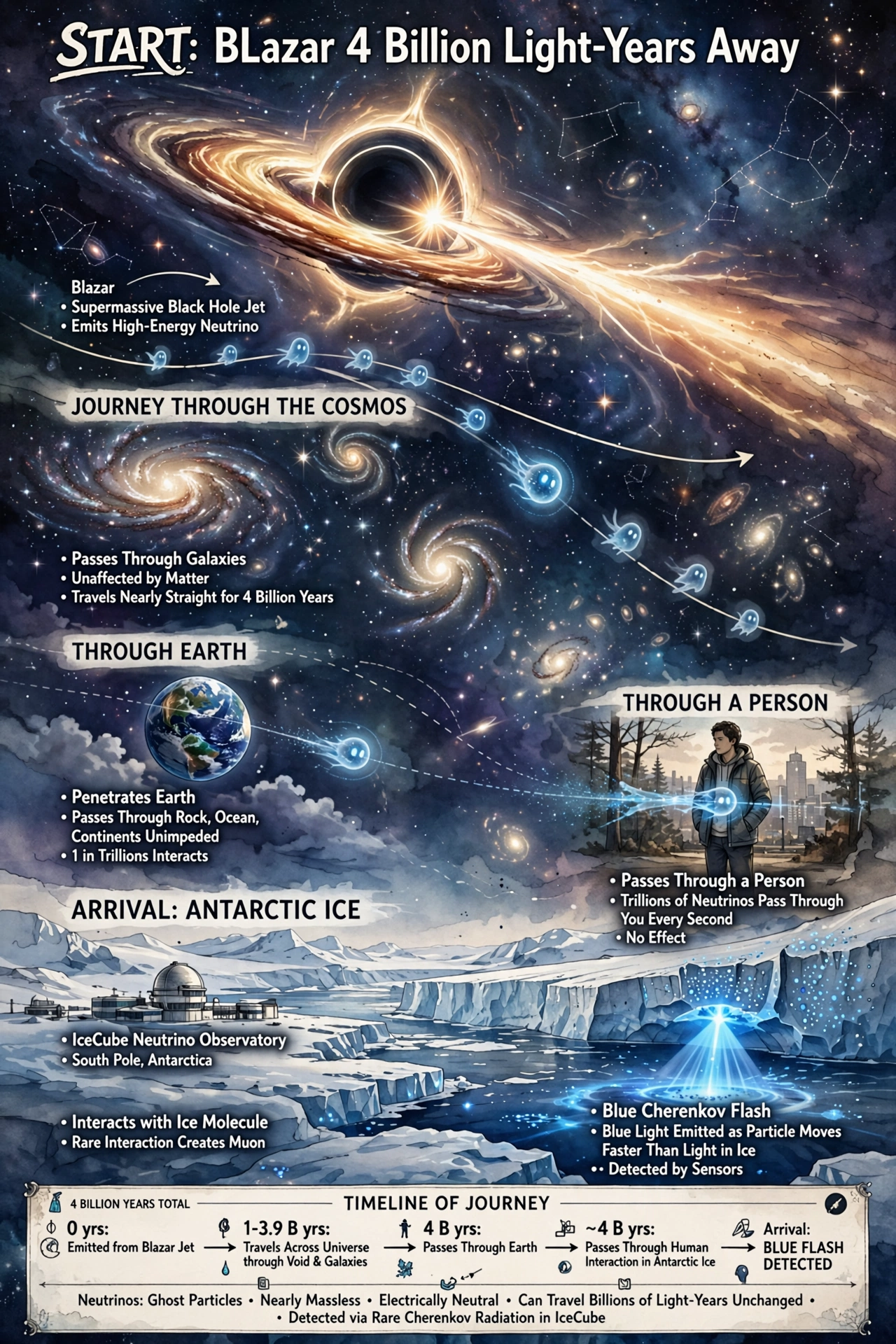
Neutrinos are elementary particles with no electric charge and extremely small mass. Their most extraordinary characteristic is not what they are made of, but how little they interact with ordinary matter.
A neutrino can cross enormous amounts of material without being absorbed or deflected.
In fact, neutrinos are passing through Earth and through you right now.
The Sun alone produces an enormous flux of neutrinos. NASA notes that these particles surround us constantly, while CERN explains that a typical neutrino can travel through extraordinary amounts of matter without interacting.
That sounds like an advantage.
For scientists, it is both an advantage and a nightmare.
A particle that rarely interacts is incredibly difficult to detect.
And that is exactly why neutrinos can be so valuable.
Why scientists wanted to catch a “ghost”
Imagine a gigantic cosmic accelerator somewhere billions of light-years away.
Perhaps it is associated with a supermassive black hole.
It launches particles across space at astonishing energies.
Charged cosmic rays can reach Earth, but there is a problem: magnetic fields bend the paths of charged particles as they travel through space. Their arrival direction therefore does not necessarily point straight back toward their birthplace.
Neutrinos are different.
Because they carry no electric charge, magnetic fields do not bend their trajectories in the same way.
They can travel almost directly from their source toward Earth.
That makes them something extraordinary:
cosmic messengers that can preserve information about where they came from.
IceCube explains that this is one reason neutrinos are so useful for studying the extreme environments that accelerate cosmic rays.
But there was a problem.
How do you build a detector large enough to catch something that almost never interacts?
Francis Halzen had an unusual answer.
Don’t build the entire detector. Use the ice.
The strange idea that began in 1988
The story of IceCube did not begin with the giant observatory we see today.
It began with an idea.
In 1988, Francis Halzen proposed using the enormous volume of Antarctic ice as a natural neutrino detector. The concept was audacious because the detector would have to be enormous.
Ordinary laboratory detectors could not provide enough material.
But Antarctica already contained billions of tons of frozen water.
The challenge was figuring out whether the ice was good enough.
Early experiments eventually led to AMANDA—the Antarctic Muon and Neutrino Detector Array, the predecessor to IceCube.
Tests were performed in Greenland in 1990, and the results helped demonstrate that deep ice could indeed be used as a neutrino detection medium.
By 1999, the IceCube collaboration had submitted a proposal for a cubic-kilometer detector at the South Pole.
The idea that once sounded almost impossible was becoming an engineering project.
Antarctica became the telescope
IceCube’s telescope does not look like the telescopes most people imagine.
There is no giant mirror.
No rotating dish.
No camera pointing toward a distant galaxy.
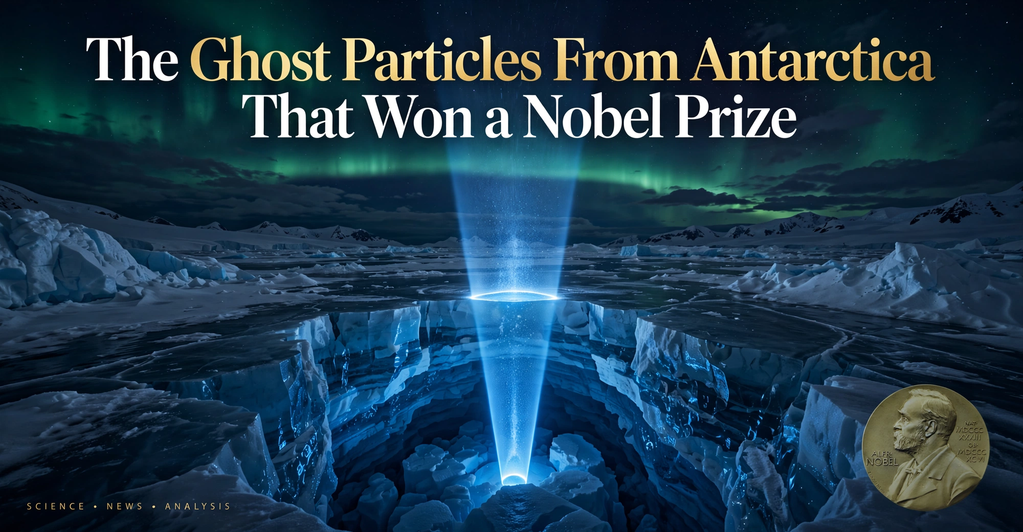
Instead, thousands of sensitive optical detectors are frozen deep inside Antarctic ice.
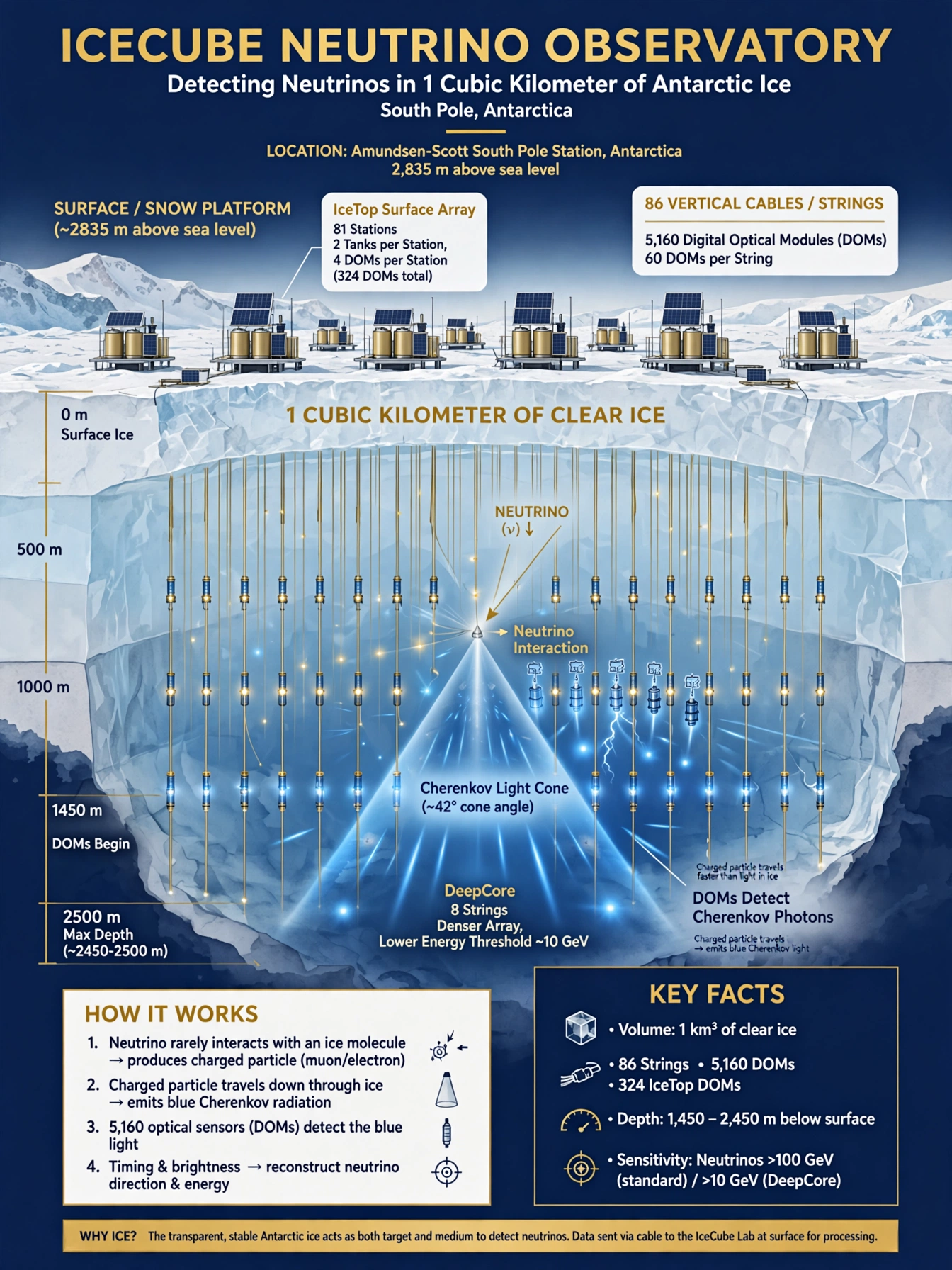
IceCube contains 5,160 digital optical modules on 86 strings, with the sensors positioned approximately 1,450 to 2,450 meters below the surface. The instrumented volume is roughly one cubic kilometer.
Construction took seven years.
From 2004 onward, crews could work only during the short Antarctic summer season. They drilled enormous holes into the ice using hot water, lowered detector strings into them, and allowed the holes to refreeze around the equipment.
The final string was lowered into the ice in December 2010, completing the main detector after seven Antarctic construction seasons.
It is difficult to overstate how strange this instrument is.
The telescope is the ice.
The sensors are simply the eyes buried inside it.
Neutrinos are giving astronomers an entirely different way to investigate the cosmos, but traditional telescopes continue to reveal extraordinary phenomena of their own. Hubble’s observations of Saturn’s mysterious 10-sided atmospheric shape show how even a familiar planet can reveal unexpected structures when scientists observe it closely.
How do you actually see a neutrino?
This is where the story becomes almost counterintuitive.
IceCube does not photograph neutrinos.
Most neutrinos simply pass through the detector.
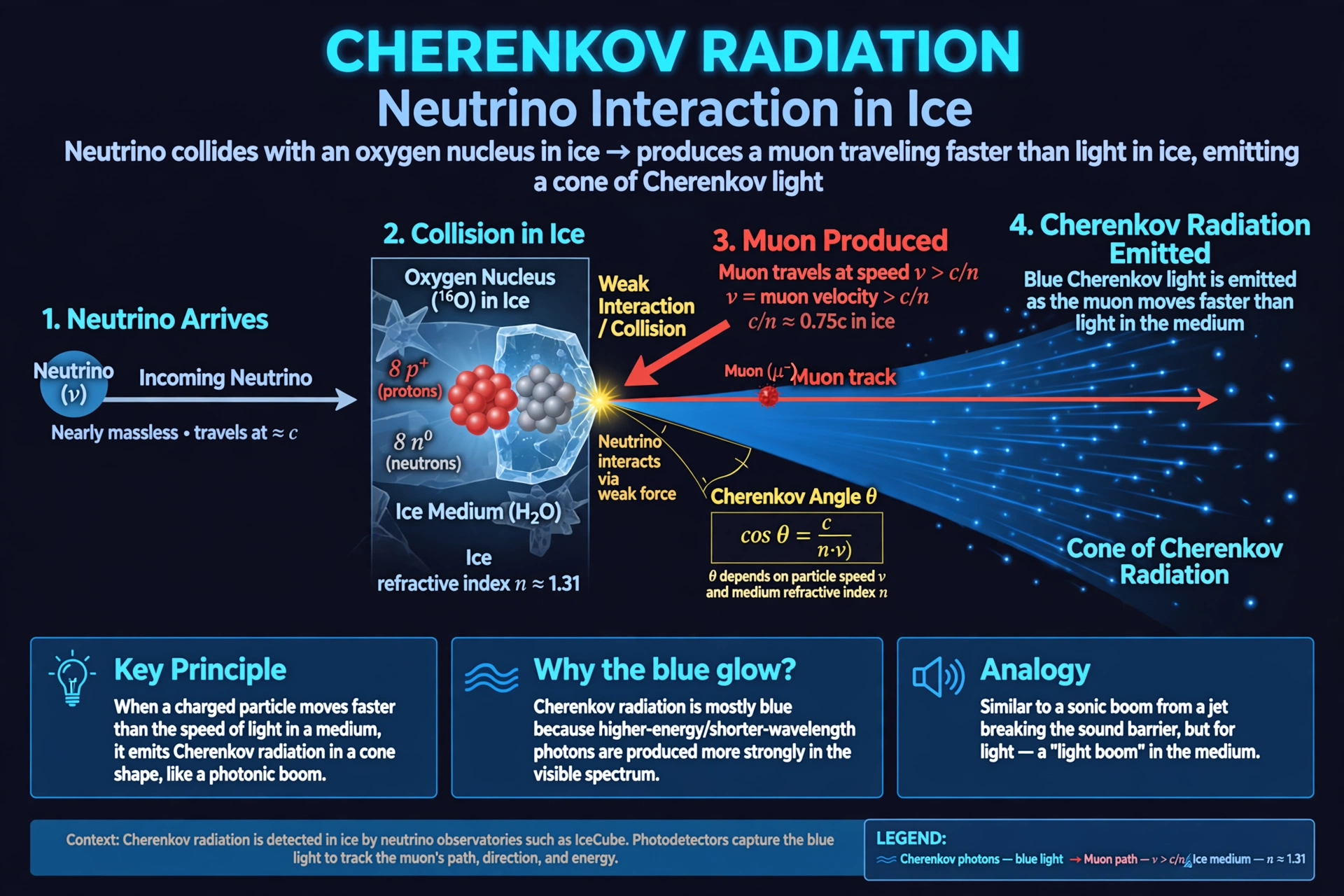
But occasionally, one interacts with the nucleus of an atom in or near the instrumented ice.
That collision can create a charged secondary particle.
The secondary particle travels through the ice faster than light can travel through that medium, producing a faint flash called Cherenkov radiation.
The optical sensors detect that flash.
By measuring when and where the light arrives, scientists reconstruct information about the original neutrino including its approximate energy and direction.
So the chain is:
Neutrino → rare collision → charged particle → blue Cherenkov light → optical sensors → reconstructed cosmic event
The detector is therefore not really “seeing” the ghost particle.
It is seeing the trace left behind when the ghost finally interacts.
The first great breakthrough came in 2013
For years, scientists had been searching.
Then IceCube began finding something extraordinary.
In 2013, researchers reported evidence for a population of high-energy neutrinos that could not be explained simply by ordinary atmospheric backgrounds. The analysis included 28 events, including two exceptionally energetic events that had originally drawn attention. The combined data rejected a purely atmospheric explanation at the 4-sigma level.
The two famous early events had estimated energies of about 1.04 and 1.14 petaelectronvolts.
That is enormous by particle-physics standards.
These events became known informally as Bert and Ernie.
The discovery established that IceCube could detect neutrinos arriving from beyond our immediate cosmic neighborhood and opened the door to high-energy neutrino astronomy.
But there was still a huge unanswered question:
Where were these particles coming from?
Finding the neutrinos was only the beginning.
The real prize was identifying their cosmic accelerators.
Then a neutrino pointed toward a black hole
On September 22, 2017, IceCube detected an exceptionally energetic neutrino.
The event was designated IC-170922A.
This time, scientists had a way to act almost immediately.
IceCube sent an alert to astronomers around the world.
Telescopes turned toward the region of sky indicated by the neutrino.
They found something interesting.
A distant object known as TXS 0506+056, a type of active galaxy called a blazar, was undergoing a powerful gamma-ray flare. NASA’s Fermi Gamma-ray Space Telescope and other observatories detected the activity.
The connection became one of the landmark events in modern multimessenger astronomy.
Why?
Because scientists were no longer simply saying:
“We detected a mysterious neutrino.”
They could begin saying:
“We detected a neutrino and have evidence pointing toward a particular cosmic accelerator.”
IceCube’s later examination of archived data also revealed an earlier excess of neutrino events from the same direction in 2014–2015.
The universe had effectively sent astronomers a message.
And this time, they had an address.
Why neutrinos changed astronomy
Traditional astronomy mostly asks:
What can we learn from light?
Neutrino astronomy asks a different question:
What can particles tell us about the engines producing the universe’s most extreme energies?
That distinction matters.
Cosmic rays are charged.
Neutrinos are not.
Cosmic rays can be bent by magnetic fields.
Neutrinos largely preserve their direction.
And because neutrinos interact so weakly, they can escape environments that may be opaque to electromagnetic radiation.
This means neutrinos can act as a complementary messenger.
Light tells us one part of the story.
Neutrinos can tell us another.
That is why IceCube helped open what scientists now describe as a new window on the universe.
The Milky Way appeared in a completely new way
The story didn’t end with distant galaxies.
In 2023, IceCube produced the first evidence for high-energy neutrino emission from the Milky Way and created a neutrino-based image of our galaxy.
This was remarkable for another reason.
Humans have photographed the Milky Way in visible light for generations.
We have mapped it in radio waves.
We have observed it in infrared, X-rays and gamma rays.
But now there was another version of the galaxy:
a map made from neutrinos.
IceCube’s analysis used around 60,000 neutrino events collected over a decade, together with improved event reconstruction and machine-learning methods.
The resulting picture was not a conventional photograph.
It was a statistical map showing where high-energy neutrino emission was emerging.
And it demonstrated something profound:
The same galaxy can look different depending on what messenger you use to observe it.
Neutrino astronomy is only one part of humanity’s expanding toolkit for studying the universe. NASA’s Nancy Grace Roman Space Telescope is designed to survey enormous regions of the sky in infrared light, giving astronomers another powerful way to investigate galaxies, black holes, dark matter and dark energy.
The strange history behind the “ghost particle”
The Nobel story actually stretches much further back than IceCube.
The neutrino was not discovered because someone saw one.
It was first proposed because physics appeared to be missing something.
In 1930, Wolfgang Pauli suggested the existence of an extremely elusive neutral particle to account for missing energy and momentum in beta decay. It was, in his own description, a desperate solution to a troubling problem.
Enrico Fermi later developed the theory of beta decay and gave the particle its name: neutrino, meaning roughly “little neutral one.”
Then came the experimental hunt.
In 1956, Clyde Cowan and Frederick Reines detected neutrinos produced by a nuclear reactor.
Decades later, Reines received half of the 1995 Nobel Prize in Physics for the detection of the neutrino.
The scientific story then expanded.
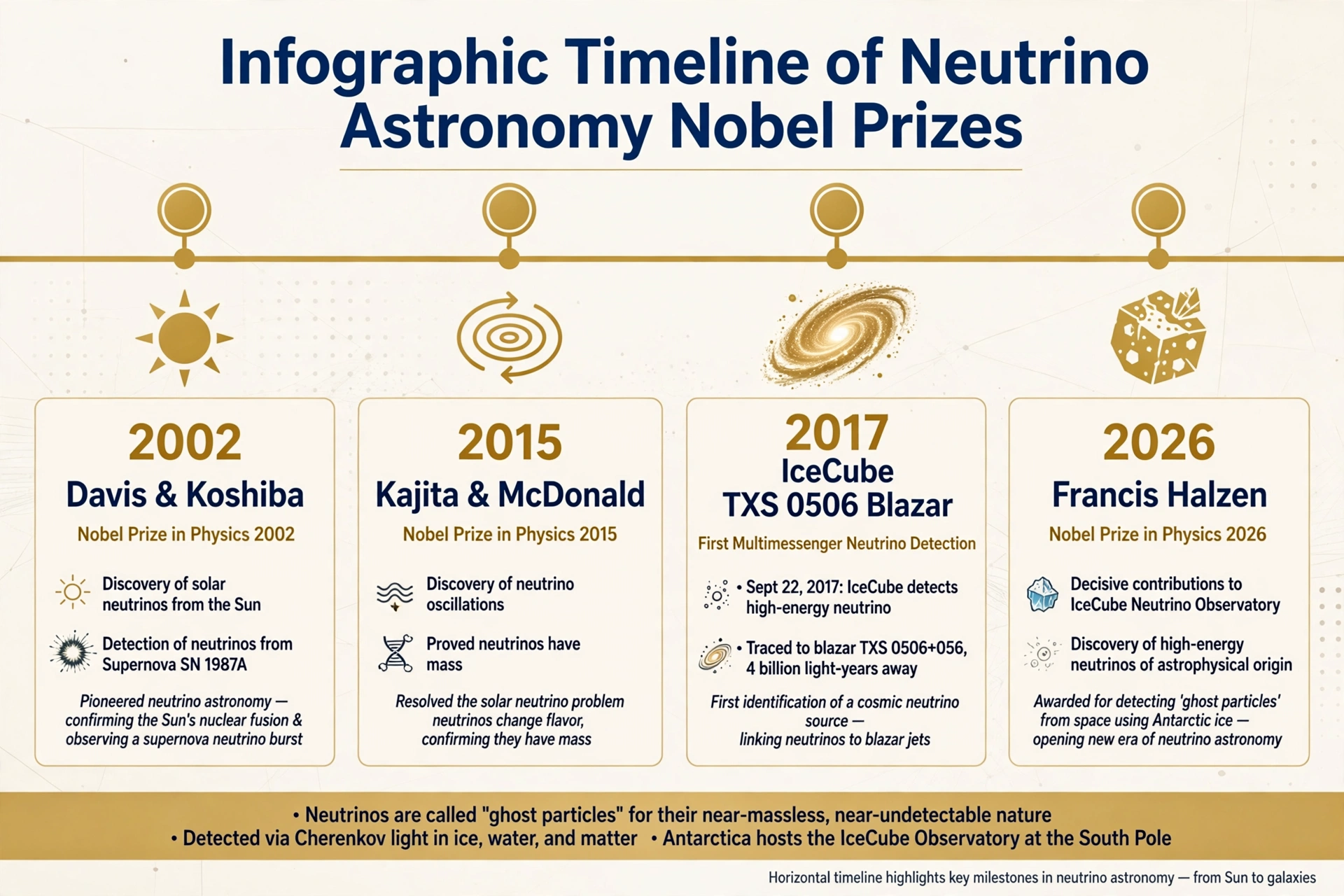
Neutrinos were detected from the Sun.
In 1987, detectors observed neutrinos from Supernova 1987A, demonstrating that exploding stars could be studied through neutrinos.
In 1998, Super-Kamiokande provided decisive evidence for neutrino oscillation—the phenomenon in which neutrinos change between different types as they travel. Because oscillation requires neutrinos to have mass, the discovery showed that the particles were not exactly what the simplest Standard Model picture had suggested.
By the time IceCube arrived, neutrino science was already a mature field.
But IceCube pushed it into a different energy regime.
Why IceCube needed to be so enormous
The reason is simple:
Neutrinos are extraordinarily difficult to catch.
A detector can wait for thousands, millions or even billions of particles to pass through it, and most will do nothing.
So the solution is not necessarily to make the neutrino interact more.
The solution is to make the detector much bigger.
IceCube surrounds its optical sensors with approximately a cubic kilometer of Antarctic ice.
It is an enormous natural target.
And even that is not enough to make every neutrino visible.
Most still pass through.
That is precisely what makes a successful detection so valuable.
The South Pole is not just a dramatic setting
It is tempting to think Antarctica was chosen because it makes for a spectacular story.
But the location has a scientific reason.
Deep Antarctic ice provides a huge, stable detection medium with very low levels of light contamination.
At sufficient depth, the ice is exceptionally clear.
IceCube’s sensors therefore operate inside a vast volume of naturally occurring material rather than requiring scientists to construct an equivalent detector from scratch.
There is also another advantage.
By looking for neutrinos that have traveled through Earth before reaching the detector, IceCube can use the planet itself as part of its filtering strategy for certain observations.
Earth becomes something like a giant shield.
The detector sits beneath the ice.
And the planet helps separate some of the signals scientists want from the enormous background of particles arriving from the atmosphere.
IceCube also became a physics laboratory
Although its most famous story is cosmic astronomy, IceCube is not only interested in distant galaxies.
The detector can investigate neutrino properties, atmospheric neutrinos and fundamental particle physics.
In 2016, for example, IceCube detected an event associated with the Glashow resonance, a phenomenon predicted decades earlier by physicist Sheldon Glashow. The observation provided another test of the Standard Model at extremely high energies.
That is one reason IceCube is more than a telescope.
It is simultaneously:
- an astronomical observatory,
- a particle detector,
- a neutrino laboratory,
- a cosmic-ray observatory,
- and a testbed for fundamental physics.
And the experiment is not finished
Perhaps the most interesting part of the 2026 Nobel story is that IceCube is still evolving.
In 2025–2026, the collaboration completed the deployment of the IceCube Upgrade, the observatory’s first major expansion since its original construction.
The upgrade added more than 600 new and enhanced optical sensors and calibration instruments across five new strings.
The new instrumentation is designed to improve measurements of neutrino properties, better characterize the Antarctic ice and improve reconstruction of neutrino events.
The collaboration expects science data from the upgraded detector later in 2026.
And beyond that lies an even more ambitious proposal:
IceCube-Gen2.
The proposed next-generation observatory could have an optical array with roughly eight times the instrumented volume of the existing detector and could incorporate radio detection techniques for even higher-energy neutrinos.
So the Nobel Prize is not necessarily the conclusion of the story.
It may be the point where the wider world finally notices how far the story has already come.
What did Francis Halzen actually win the Nobel Prize for?
The official wording matters.
The Royal Swedish Academy of Sciences awarded Francis Halzen the 2026 Nobel Prize in Physics:
“for decisive contributions to the IceCube Neutrino Observatory and the discovery of high-energy neutrinos of astrophysical origin.”
The prize is therefore not simply for discovering a new particle.
Neutrinos were known long before IceCube.
And Halzen did not work alone.
IceCube is an international collaboration involving hundreds of scientists and many institutions. The collaboration says it includes more than 450 scientists from 58 institutions in 14 countries.
The Nobel recognized Halzen’s decisive scientific leadership and contributions to making the extraordinary IceCube concept a working observatory and to the discoveries that followed from it.
That distinction is important.
The Nobel story is really about turning an improbable idea into a new instrument for understanding nature.
From a missing particle to a new view of the universe
There is something almost poetic about the history of the neutrino.
In 1930, physicists proposed an invisible particle because something appeared to be missing from an equation.
In 1956, they finally detected one.
In 1987, neutrinos carried information from a dying star.
In 1998, they revealed that they could change identity.
In 2013, IceCube showed that extremely energetic neutrinos were arriving from beyond the solar system.
In 2017, one helped point astronomers toward a distant active galaxy.
In 2023, neutrinos revealed the Milky Way in a new way.
And in 2026, the scientist whose work helped turn Antarctic ice into a giant neutrino telescope received the Nobel Prize in Physics.
The remarkable part is not simply that we learned how to catch these particles.
It is what happened after we caught them.
We gained another way to ask the universe where its most powerful events are happening.
The telescope that doesn’t look at the sky
The next time you look at an image of the night sky, remember that it represents only one version of the universe.
There is the universe seen in visible light.
There is the universe seen in radio waves.
There is the universe revealed by X-rays and gamma rays.
And now there is another universe mapped by particles that can travel through planets.
Deep below the South Pole, IceCube waits in darkness.
A neutrino may pass through it.
Usually, nothing happens.
But occasionally, after traveling across an unimaginable distance, one of these nearly invisible particles collides with matter and creates a tiny flash of blue light.
Thousands of sensors notice.
Scientists reconstruct the event.
And suddenly, something that began billions of years ago becomes a piece of information on a computer screen.
The ghost has left a trace.
And that tiny trace can tell us where to look.
That is the real story behind the 2026 Nobel Prize in Physics.
Not simply a particle.
Not simply a telescope.
But a new way of listening to the universe.
A simple timeline of the ghost-particle story
| Year | What happened | Why it mattered |
|---|---|---|
| 1930 | Wolfgang Pauli proposes the neutrino | Solved a mystery in beta decay |
| 1934 | Fermi develops beta-decay theory | Established the theoretical framework |
| 1956 | Cowan and Reines detect neutrinos | The particle becomes experimentally real |
| 1987 | Neutrinos detected from Supernova 1987A | Neutrino astronomy proves its power |
| 1988 | Halzen proposes using Antarctic ice | A radically different detector concept |
| 1990–1991 | Early ice-detector tests | Demonstrated the feasibility of the approach |
| 1999 | IceCube proposal submitted | The cubic-kilometer vision takes shape |
| 2004–2010 | IceCube constructed | A huge detector is embedded in Antarctic ice |
| 2013 | High-energy astrophysical neutrinos detected | A new era of neutrino astronomy begins |
| 2017 | IC-170922A points toward TXS 0506+056 | Neutrinos become part of multimessenger astronomy |
| 2022 | NGC 1068 identified as a neutrino source | Another major cosmic accelerator emerges |
| 2023 | Milky Way detected through neutrinos | Our galaxy gets a new kind of map |
| 2025–2026 | IceCube Upgrade deployed | The detector gains new capabilities |
| 2026 | Francis Halzen receives Nobel Prize in Physics | Neutrino astronomy reaches a historic milestone |
Conclusion
What This Means For You: We Have New Eyes
We used to have only one way to look at the universe: light.
Then we got gravitational waves in 2015, we could hear black holes collide.
Now we have neutrinos, we can feel through walls. Light gets trapped inside a supernova or a black hole jet. Neutrinos escape in seconds, carrying the recipe of what happened inside.
Halzen called it opening “a window on the universe”.
The next step is already being built: IceCube-Gen2 – 8x bigger, ∼8 cubic kilometers of ice. Plus KM3NeT in the Mediterranean, which in 2025 saw a 220 PeV event – the most energetic neutrino ever, still unexplained.
Smithsonian called Halzen “Neutrino Man” in 2014 and even made a comic about him: How One Physicist’s Pursuit of the Cosmos Took Off in Antarctica.
He was right all along. The most silent place on Earth was the best place to listen to the loudest events in the universe.
Humanity has always looked upward for clues about the cosmos, from naked-eye observations of eclipses to modern detectors buried beneath Antarctic ice. Even a seemingly familiar event such as a deep partial lunar eclipse can reveal the precise geometry of the Earth–Moon–Sun system.
Sources and further reading
- Nobel Prize — 2026 Physics Prize announcement
- Nobel Prize — Popular information on the 2026 Physics Prize
- NSF — 2026 Nobel Prize in Physics and IceCube
- IceCube — Observatory and research overview
- IceCube — Historical timeline
- IceCube — 2018 neutrino source and TXS 0506+056
- IceCube — First neutrino image of the Milky Way
- IceCube — 2026 Upgrade
- CERN — The puzzle of neutrinos, seventy years on
- NASA — You’re Always Surrounded by Neutrinos
- 2013 IceCube scientific paper — Evidence for High-Energy Extraterrestrial Neutrinos
Frequently Asked Questions
What are the “ghost particles” in Antarctica?
The phrase refers to neutrinos, electrically neutral elementary particles that interact extremely weakly with matter. Their ability to pass through enormous amounts of material makes them difficult to detect but extremely useful as astronomical messengers.
Why is IceCube buried under Antarctic ice?
IceCube uses the naturally occurring Antarctic ice as its detection medium. When a neutrino occasionally interacts in the ice, the resulting charged particles can produce Cherenkov light that IceCube’s optical sensors detect.
Who won the 2026 Nobel Prize in Physics?
Francis Halzen won the 2026 Nobel Prize in Physics for decisive contributions to the IceCube Neutrino Observatory and the discovery of high-energy neutrinos of astrophysical origin.
When did IceCube discover astrophysical neutrinos?
IceCube reported evidence for high-energy astrophysical neutrinos in 2013, following observations that included exceptionally energetic events and a larger sample inconsistent with a purely atmospheric origin.
Did IceCube discover where neutrinos come from?
IceCube has identified evidence for neutrino emission from particular astrophysical sources, including TXS 0506+056 and NGC 1068, while continuing to investigate the broader population of cosmic neutrino sources.
Can neutrinos pass through Earth?
Yes. Because neutrinos interact so weakly with matter, enormous numbers can travel through Earth without interacting. That same property is what makes them so difficult to detect.
What comes after IceCube?
The existing observatory has now received the IceCube Upgrade, while scientists are also developing plans for a proposed IceCube-Gen2 observatory with a substantially larger instrumented volume.