

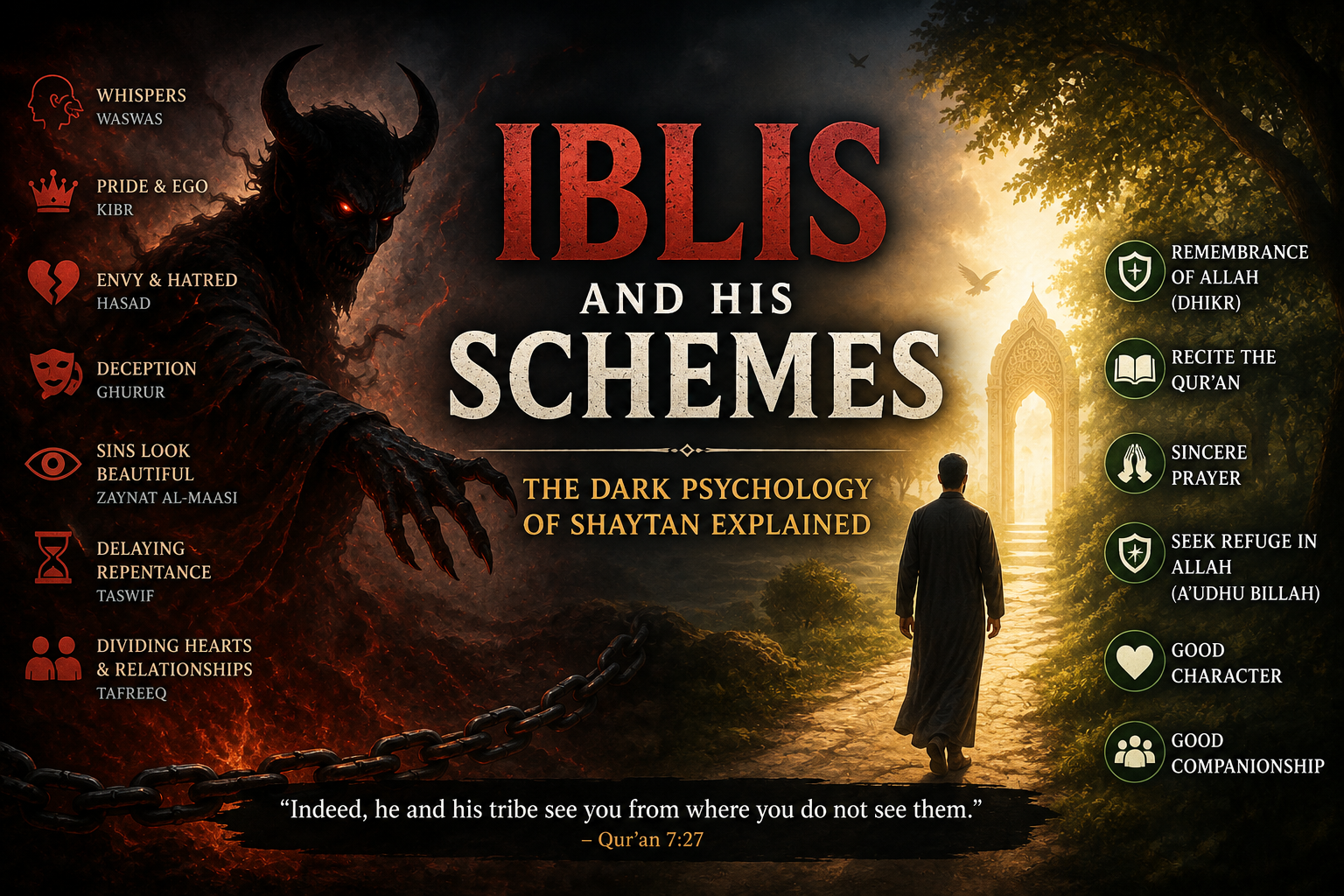
Iblis and His Schemes have been a source of warning for humanity since the creation of Prophet Adam (AS). The Qur’an presents Iblis (Shaytan) not merely as an enemy but as a master deceiver whose mission is to lead people away from the worship of Allah through whispers, pride, temptation, and false promises.
His methods are subtle, often targeting the heart and mind before influencing a person’s actions.
Understanding Iblis and His Schemes is essential for every Muslim because the Qur’an repeatedly warns believers to remain vigilant against his deception.
This article explores the authentic teachings of the Qur’an and Sunnah to explain the dark psychology of Shaytan, the strategies he uses to mislead humanity, his limitations, and the powerful ways Allah has provided to protect believers from his influence. By recognizing his tactics, Muslims can strengthen their faith, guard their hearts, and remain steadfast on the straight path.
Table of Contents
The Past Story of Iblis

The past story of Iblis marks the beginning of one of the greatest warnings in the Qur’an and lays the foundation for understanding Iblis and his schemes. Iblis and His Schemes became a reality for all of humanity, as he vowed to mislead the descendants of Adam through whispers, deception, pride, and temptation until the Day of Judgment.
Iblis was not an angel. It was a jinn creature made from smokeless fire.
Allah says:
“And ˹remember˺ when We said to the angels, “Prostrate before Adam,” so they all did—but not Iblîs, who was one of the jinn, but he rebelled against the command of his Lord. Would you then take him and his descendants as patrons instead of Me, although they are your enemy? What an evil alternative for the wrongdoers ˹to choose˺!”
Allah created Adam from clay and breathed into him the soul He created.
Allah then commanded the angels to prostrate to Adam—not as worship, but as a sign of respect and obedience to Allah.
All obeyed except Iblis. Iblis became arrogant.
He said:
Allah asked, “What prevented you from prostrating when I commanded you?” He replied, “I am better than he is: You created me from fire and him from clay.”
His sins were:
- Pride (kibr)
- Envy (hasad)
- Disobedience
- Arguing against Allah’s command
Because of this, Allah expelled him from His mercy.
Instead of repenting, Iblis asked Allah to allow him to live until the Day of Resurrection.
Allah granted him respite.
Then Iblis declared:
“He said, “For leaving me to stray I will lie in ambush for them on Your Straight Path.'”
Iblis said he would attack humans from every direction.
Allah says:
“I will approach them from their front, their back, their right, their left, and then You will find most of them ungrateful.”
His mission is to lead as many people as possible away from Allah.
Real-life examples of his Schemes

Understanding Iblis and his schemes becomes easier when we recognize how they appear in everyday life. According to the Qur’an and authentic Sunnah, Shaytan rarely invites people directly to major sins. Instead, he uses gradual deception, whispers (waswas), and false promises to make wrongdoing seem acceptable.
For example, he may encourage someone to delay prayer by saying, “You can pray later,” tempt a person to envy another’s success, or convince someone that a “small lie” or a single dishonest act is harmless. He also exploits anger, pride, greed, and despair, causing conflicts within families, friendships, and communities.
These real-life examples of Iblis and his schemes demonstrate that his goal is to distance people from the remembrance of Allah step by step. Recognizing these tactics allows believers to remain vigilant, strengthen their faith, and seek Allah’s protection through sincere worship, repentance, and regular remembrance (dhikr).
1. The Story of Pride – The First Sin
Allah told the angels to bow down to Prophet Adam (AS) when He made him. Iblis said no.
“I’m better than him,” he said. “You made me out of fire and him out of clay.”
Because he was cocky, Allah kicked him out of His grace.
Lesson
Being proud can make it hard to accept the truth.
Someone in the class won’t say they were wrong because they believe they are smarter than everyone else. They refuse to believe it even when they see clear proof, just because they are proud. This shows the same kind of pride that made Iblis disobey Allah.
2. The Story of Adam and Hawwa (Eve)
Allah allowed Adam and Hawwa to enjoy Paradise but instructed them not to eat from one specific tree.
Iblis whispered to them: “Your Lord only forbade you this tree lest you become angels or become of the immortal.”
He swore he was giving sincere advice.
They ate from the tree, realized their mistake, and immediately repented.
Allah accepted their repentance.
Lesson
Shaytan often disguises temptation as good advice.
Someone says:
“Everyone cheats on exams. You’ll only do it once.”
The act is presented as harmless, but it remains wrong.
3. The Story of Envy (Hasad)
Iblis envied Adam because Allah honored him.
His jealousy became hatred.
Lesson
Envy can destroy a person’s faith and judgment.
A coworker receives a promotion. Instead of congratulating them, another employee spreads false rumors out of jealousy.
4. The Story of the Promise
After being expelled, Iblis said, “I will surely mislead them all, except Your sincere servants.”
This remains his mission until the Day of Judgment.
His arrogance and anger made him make the worst decision, and surely he will be punished and will be thrown in Hell.
Lesson
Two sisters are happy with each other. Elder sister likes her dress and wears her dress without the younger sisters’s permission. The younger sister becomes angry over the elder one. Although it was a little reason, that made her angry, but she took the wrong decision. She broke the trophies and medals of her elder sister. This fight becomes more intense and never ending. Both got the price for her wrong decision.
5. The Story of Waswas (Whispers)
Allah describes Shaytan as “the whisperer who withdraws.”
He repeatedly plants sinful thoughts and doubts.
Lesson
Someone intends to pray on time.
A thought comes:
- “You still have plenty of time.”
- “Watch one more video.”
- “Pray later.”
The delay continues until the prayer time passes.
6. The Story of Separating Families
The Prophet Muhammad ﷺ said that Iblis places his throne upon water and sends his followers among people. When one succeeds in causing separation between husband and wife, Iblis praises that devil. This narration is found in Sahih Muslim.
Lesson
A person repeatedly spreads lies between spouses, creating suspicion and arguments until the marriage breaks down.
7. The Story of Anger
The Prophet ﷺ taught that anger is a doorway Shaytan uses and advised believers to seek refuge in Allah when angry.
Lesson
A small disagreement escalates into shouting, insults, and broken family ties because neither person pauses to control their anger.
8. The Story of Gradual Sin
Allah says: “Do not follow the footsteps of Satan.”
Notice the word “footsteps.” Shaytan often leads people step by step rather than all at once.
Lesson
A person begins by telling “small” lies, then becomes comfortable with larger lies, and eventually starts committing fraud.
9. The Story of False Promises
Allah says, “Satan makes them promises and makes them want things.” But Satan doesn’t promise them anything but lies.
Lesson
Someone thinks that I’ll enjoy the forbidden things now. Then turn back to Allah when I’m old.”
Life is uncertain, and delaying repentance is itself a deception.
10. The Story on the Day of Judgment
After everyone is judged, Shaytan will say to those who followed him, “I had no power over you except that I invited you and you responded.”
He will deny responsibility for their choices.
Lesson
Shaytan can tempt, but he cannot force anyone to sin. Every person remains accountable for their own decisions.
The Main Schemes of Iblis
The Qur’an and authentic Sunnah clearly explain Iblis and his schemes, revealing that his mission is to mislead humanity through deception rather than force. One of the most dangerous aspects of Iblis and his schemes is that they often begin with small compromises before leading to greater acts of disobedience.
According to the Qur’an and authentic Sunnah, his recurring strategies are:
- Pride and arrogance.
- Envy and jealousy.
- Whispering sinful thoughts (waswas).
- Making sins appear attractive.
- Encouraging delay in repentance.
- Distracting people from prayer and remembrance of Allah.
- Creating anger and conflict.
- Spreading doubts about faith.
- Dividing families and communities.
- Leading people into sin gradually rather than suddenly.
These stories and examples stay grounded in authentic Islamic teachings while using everyday situations to illustrate how the Qur’an and Sunnah describe Shaytan’s methods.
The Psychology of Iblis
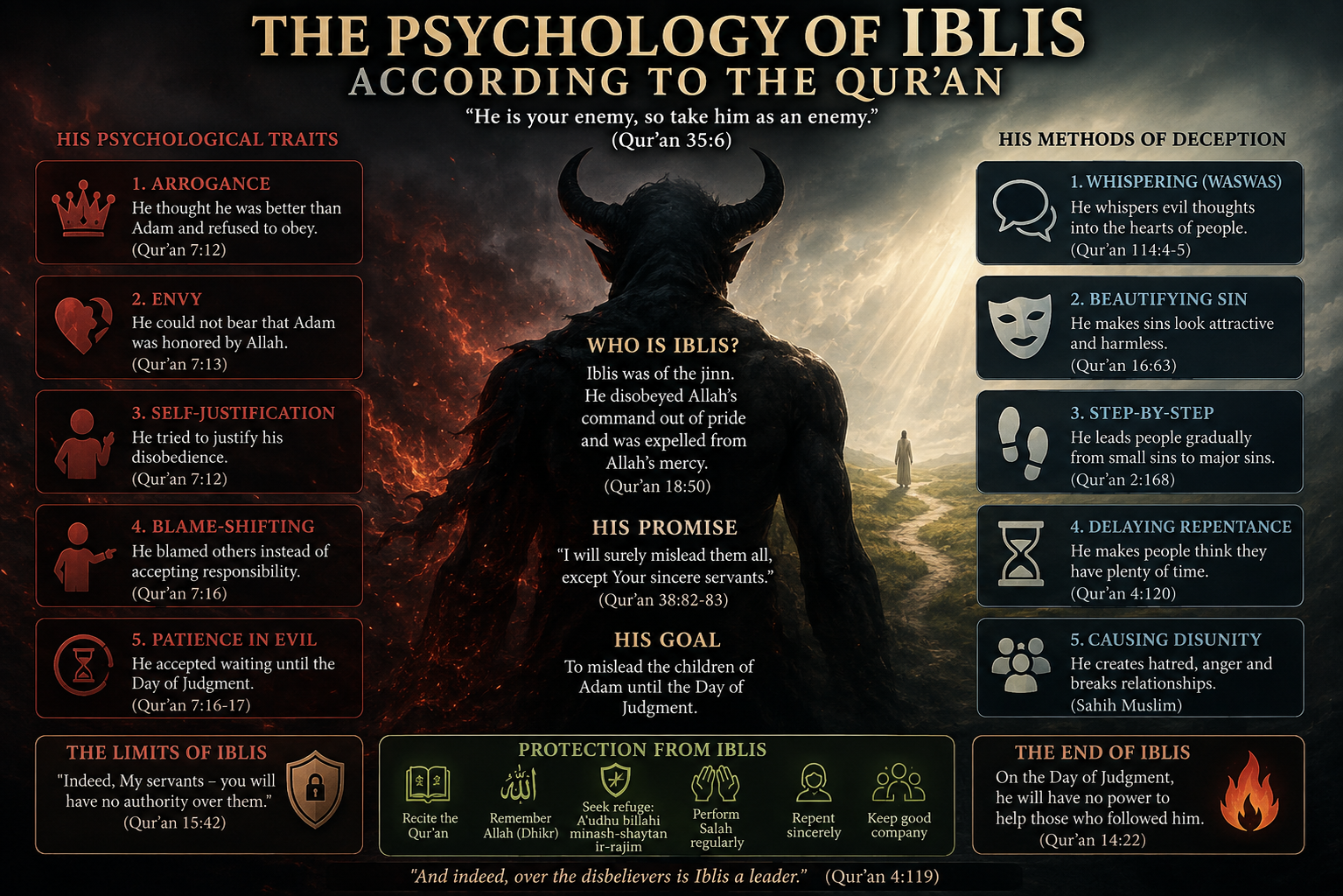
Understanding the psychology behind Iblis and his schemes reveals that Shaytan’s greatest weapons are arrogance, deception, envy, and manipulation. Today, Iblis and his schemes continue to target the same human weaknesses by encouraging people to feel superior to others, make excuses for their sins, delay repentance, and follow their desires instead of divine guidance.
The Qur’an does not simply tell us who Iblis is. It reveals how he thinks.
His story is not only about a jinn who rebelled against Allah. It is also a study of destructive psychological traits: arrogance, envy, self-deception, blame-shifting, manipulation, and persistence in evil.
By understanding the mindset of Iblis, believers can recognize the same traps within themselves and avoid the path that led to his downfall.
1. Arrogance: “I Am Better”
The first words that expose Iblis’s psychology are:
He replied, “I am better than he is: You created me from fire and him from clay. ”
(Qur’an 38:76)
Notice that Iblis did not deny Allah’s command. Instead, he judged the command by his own standards.
He believed his opinion was superior to Allah’s wisdom.
Psychological Lesson
Arrogance begins when a person thinks:
- “I know better.”
- “The rules don’t apply to me.”
- “I’m superior because of my background, knowledge, wealth, or status.”
Pride blinds a person to truth.
2. The Trap of Comparison
Iblis compared himself with Adam instead of focusing on obeying Allah.
His attention shifted from worship to competition.
Comparison produced jealousy, and jealousy became rebellion.
Psychological Lesson
Constant comparison with others often leads to:
- Envy.
- Bitterness.
- Ingratitude.
- Resentment.
The Qur’an teaches believers to seek Allah’s pleasure rather than measure themselves against other people.
3. Self-Justification
After disobeying Allah, Iblis never admitted:
“I was wrong.”
Instead, he tried to justify himself.
This is one of the most dangerous psychological habits.
Psychological Lesson
People often defend mistakes by saying:
- “Everyone does it.”
- “I had no choice.”
- “It’s not that serious.”
The Qur’an teaches that sincere believers admit their mistakes and repent instead of making excuses.
4. Blaming Others
Iblis said:
“He said, “For leaving me to stray I will lie in ambush for them on Your Straight Path.”
(Qur’an 7:16)
Rather than accepting responsibility, he shifted blame.
Psychological Lesson
Blame-shifting prevents growth.
A believer asks:
- “How can I improve?”
The mindset of Iblis asks:
- “Whose fault is this?”
5. Turning Envy Into Hatred
Iblis did not simply dislike Adam.
He wanted to destroy Adam and all of his descendants.
This shows how unchecked envy can grow into lasting hatred.
Psychological Lesson
The Qur’an encourages believers to purify their hearts from jealousy before it turns into resentment and injustice.
6. Manipulation Instead of Force
When Adam and Hawwa lived in Paradise, Iblis did not force them to eat from the forbidden tree.
Instead, he used persuasive language.
He promised:
- Immortality.
- Higher status.
- Better opportunities.
He even swore that the advice he was giving was real.
Psychological Lesson
Temptation often appears attractive, reasonable, or beneficial before its consequences become clear.
7. Beautifying Sin
Allah repeatedly tells us that Shaytan makes evil deeds appear beautiful.
He rarely says:
“Do something evil.”
Instead, he whispers:
- “It’s harmless.”
- “You’ll repent later.”
- “It’s only once.”
Psychological Lesson
Most major sins begin with small compromises that are made to seem acceptable.
8. Playing the Long Game
One remarkable feature of Iblis’s psychology is patience.
He accepted waiting until the Day of Judgment to pursue his mission.
He is willing to tempt people gradually over years rather than seeking immediate results.
Psychological Lesson
Shaytan often works step by step, encouraging small acts of disobedience that can eventually lead to larger ones.
9. Exploiting Human Weakness
The Qur’an shows that Iblis targets common human vulnerabilities:
- Pride.
- Desire.
- Fear.
- Anger.
- Greed.
- Forgetfulness.
He adapts his whispers to the individual rather than using the same approach with everyone.
Psychological Lesson
Knowing our own weaknesses helps us guard against them through remembrance of Allah and sincere self-reflection.
10. His Greatest Weapon Is Forgetfulness
One of Shaytan’s most effective strategies is not always dramatic temptation.
Sometimes it is simply making people forget Allah.
When remembrance fades, sins become easier and repentance is delayed.
The Qur’an warns about those whom Satan caused to forget the remembrance of Allah (see Qur’an 58:19).
Psychological Lesson
Regular dhikr and recitation of the Qur’an keep the heart spiritually awake.
11. His Greatest Weakness
Despite all his schemes, Iblis has a limit that he cannot cross.
Allah says:
“you will certainly have no authority over My servants, except the deviant who follow you,”
(Qur’an 15:42)
He cannot force anyone to sin.
He whispers.
He invites.
He deceives.
But every human being remains responsible for their own choices.
Protection From Shaytan
The strongest defense against Iblis and his schemes is a sincere connection with Allah through faith, worship, and obedience. Avoiding sinful environments, keeping the company of righteous people, and repenting sincerely after committing a sin also weaken Iblis and his schemes.
Allah has not left believers defenseless. The Qur’an and Sunnah teach many ways to seek protection:
- Worship Allah sincerely.
- Perform the five daily prayers.
- Read the Qur’an regularly.
- Recite Ayat al-Kursi.
- Recite Surah Al-Ikhlas, Surah Al-Falaq, and Surah An-Nas every morning, evening, and before sleeping.
- Remember Allah frequently (dhikr).
- Say: “A’udhu billahi min ash-shaytan ir-rajim” whenever tempted.
- Repent quickly after committing a sin.
- Keep the company of righteous people.
The Contrast Between Adam and Iblis
One of the deepest lessons in the Qur’an is the contrast between these two responses to sin to understand Iblis and his schemes.
Adam (AS):
- Made a mistake.
- Admitted it.
- Repented.
- Sought Allah’s forgiveness.
- Was forgiven.
Iblis:
- Disobeyed.
- Justified himself.
- Blamed others.
- Refused to repent.
- Persisted in rebellion.
The difference was not that one sinned and the other did not. The difference was their response after sinning.
Conclusion
The Qur’an presents Iblis as more than an enemy of humanity. It presents him as a warning about the dangers of arrogance, envy, self-justification, and manipulation. Understanding Iblis and his schemes is essential for every Muslim who wishes to remain steadfast on the straight path.
His story teaches that the greatest battles are often internal. Every believer faces moments of pride, jealousy, anger, or forgetfulness. By recognizing Iblis and his schemes and responding with humility, obedience, and trust in Allah, Muslims can resist his deception, strengthen their faith, and strive for success in this life and the Hereafter.
The psychology of Iblis is ultimately a mirror. It does not invite us to study him out of fascination but to recognize the seeds of these traits within ourselves and replace them with sincerity, humility, gratitude, and obedience to Allah.
Understanding the story of Iblis also helps explain broader Islamic teachings about temptation, human weakness, and the unseen world. You may also want to explore the detailed world of Jinn in Islam, the concept of angels in Islam, and the mysteries surrounding Ya’juj and Ma’juj.