

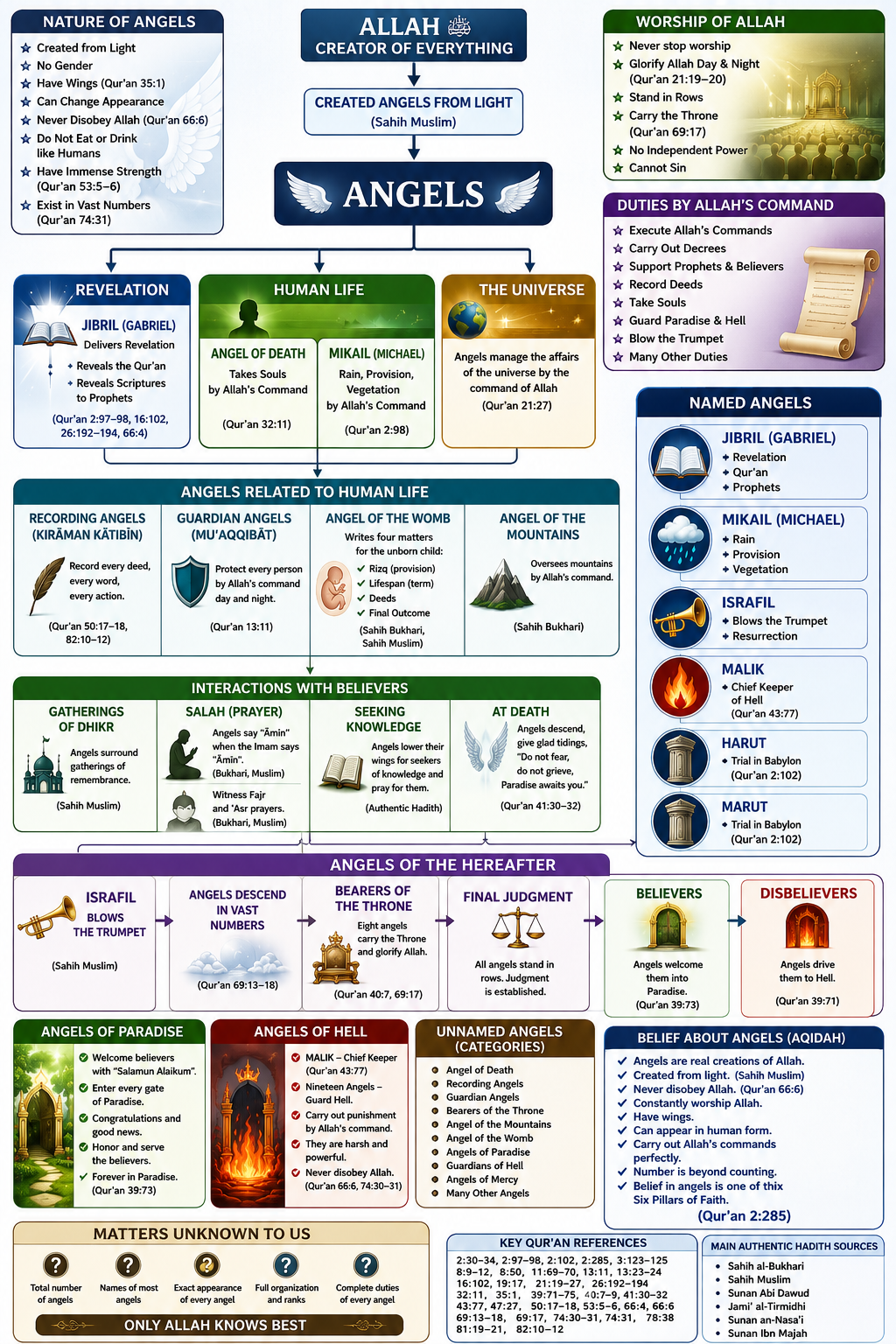
Angels (Malāʾikah) are one of Allah’s creations. They belong to the unseen world (al-ghayb) and were created to worship Allah and carry out His commands. The Arabic terms “Malāʾikah” (plural) and “Malak” (singular) refer to “angel.” They speak about Allah’s submissive servants and messengers who obey His orders.
The Qur’an frequently uses this term when describing revelation, worship, and divine commands. Belief in angels is one of the six pillars of iman (faith). Rejecting belief in angels is considered disbelief in a fundamental article of faith. (Surah Al-Baqarah 285)
Table of Contents
Introduction to Angels in Islam
- Normally, humans cannot see angels. Allah may allow them to appear in a visible form for specific purposes, as happened with several prophets. Once Jibril appeared as a man when teaching the companions.
- Angels are part of the unseen world. Knowledge about them comes only through revelation, not speculation. Muslims affirm only what Allah and His Messenger ﷺ have revealed.
- Allah created angels to worship Him, glorify Him, carry revelation, record deeds, protect by His permission, and carry out many other tasks.
- Angels never disobey Allah and always fulfill His commands perfectly.
- Angels glorify Allah day and night without becoming tired or bored.
- Only Allah knows the total number of angels. They are beyond human counting.
- Angels pray for believers, record deeds, protect people by Allah’s permission, attend gatherings of remembrance, and welcome the righteous into Paradise. Angels interact with humans only as Allah commands.
Why Allah Created Angels
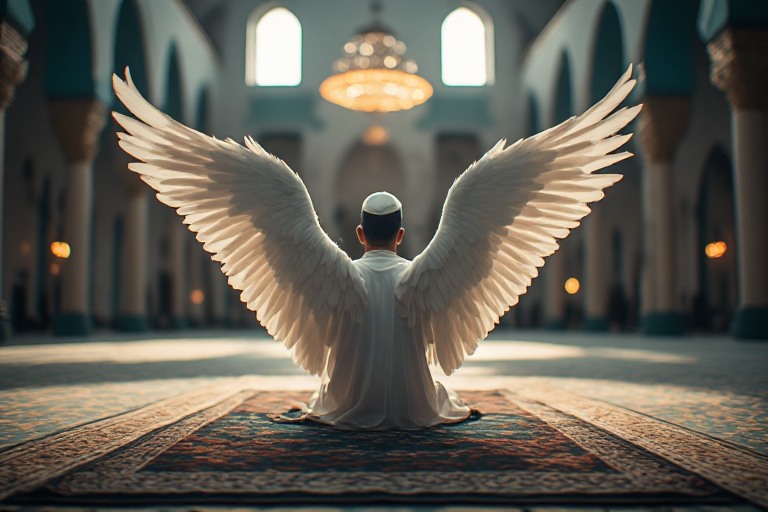
The Qur’an and Sunnah explain the purpose (wisdom) behind the creation of angels and the duties Allah assigned to them. However, they do not state the exact time when angels were created or describe the process of their creation.
- Allah Created Angels by His Will: Allah creates whatever He wills. Angels are among His greatest creations and exist solely by His command and wisdom. (16:49–50, 35:1)
- To Worship Allah: The primary purpose of angels is to worship, glorify, praise, and obey Allah continuously. Their worship never stops, and they never become tired. (21:19–20, 39:75, 42:5)
- To Obey Every Command: Angels carry out every command of Allah immediately and perfectly. They never refuse or delay His commands. (66:6, 16:49–50)
- To Deliver Revelation: Allah chose Jibril (Gabriel) to bring revelation to His prophets, including the Qur’an to Prophet Muhammad ﷺ.
- To Carry Allah’s Decrees: Angels carry out Allah’s commands throughout creation, but they possess no independent power. They act only by His permission. (79:5, 21:26–27)
- To Record Human Deeds: Two angels are assigned to every person to record every statement and action. (50:17–18, 82:10–12)
- To Protect Human Beings: Allah appoints angels to guard people according to His decree until the time Allah has ordained. (13:11)
- To Take Souls at Death: Allah appointed the Angel of Death to take souls when their appointed time arrives. (32:11)
- To Question People in the Grave: Angels question the deceased regarding their Lord, religion, and prophet after burial.
- To Carry the Throne of Allah: Certain mighty angels carry Allah’s Throne and pray for the forgiveness of believers .(40:7, 69:17)
- To Guard Paradise: Angels welcome the righteous at the gates of Paradise with greetings of peace. (13:23–24, 39:73)
- To Guard Hell: Allah appointed stern and mighty angels over Hell who never disobey Him.(66:6, 74:30–31, 43:77)
- To Support the Believers: Allah sent angels to strengthen and assist the believers in the Battle of Badr (3:123–125, 8:9–12)
- To Attend Gatherings of Dhikr: Angels travel throughout the earth seeking gatherings where Allah is remembered. They surround such gatherings with mercy.
- To Pray for Believers: Angels ask Allah to forgive believers, especially those who repent and follow His path. (40:7–9)
- To Descend on Laylat al-Qadr: On the Night of Decree, Jibril and many angels descend with Allah’s commands and blessings. (97:4)
The Nature of Angels
The creation of angels belongs to the unseen (al-Ghayb). Muslims believe only what Allah revealed in the Qur’an and what the Prophet Muhammad ﷺ authentically taught. We do not speculate about matters for which there is no authentic evidence.
- Allah alone created the angels. Allah simply creates by His command: “Be,” and it is.
- The Prophet ﷺ clearly stated that angels were created from light (nūr). But it does not explain the nature of that light.
- There is no evidence that angels have parents, reproduce, or are born. They are directly created by Allah. The Qur’an does not describe angels as male or female.
- Angels are created beings and will die when Allah wills.
- Angels have a real created existence. They have wings (Qur’an 35:1), can carry out actions, and can appear in human form by Allah’s permission. However, the exact nature of their bodies is not described.
Comparison of the Three Major Creations
| Nature | Angels | Humans | Jinn |
|---|---|---|---|
| Created From | Light | Clay/Earth | Smokeless fire |
| Evidence | Sahih Muslim | Qur’an 15:26, 38:71 | Qur’an 15:27, 55:15 |
| Belong to the Unseen | Yes | No | Yes |
| Free Will | They are described as always obeying Allah. | Yes | Yes |
| Can Sin | The Qur’an describes them as not disobeying Allah. | Yes | Yes |
| Receive Revelation | Jibril delivers revelation by Allah’s command. | Prophets receive revelation. | No (except hearing messages before being prevented, as described in the Qur’an). |
| Need Food | No authentic evidence they eat. | Yes | Yes |
| Need Sleep | No explicit authentic evidence; the Qur’an describes uninterrupted worship. | Yes | Yes |
| Die | Yes, as created beings. | Yes | Yes |
Types of Angels in Islam?
Allah has given different angels different levels of honor, responsibilities, and authority. They are not all equal in status or duty. Some angels are described as being near Allah (al-Muqarrabūn), constantly glorifying Him. Certain mighty angels carry Allah’s Throne and pray for the believers.
Named angels are as follows:
| Angel | Primary Duty | Qur’an References |
|---|---|---|
| Jibril | Delivering revelation to the prophets. The greatest and most honored angel mentioned by name. | 2:97–98, 16:102, 26:192–195, 53:5–18 |
| Mikail | Responsible for rain, vegetation, and provision by Allah’s command. Mentioned alongside Jibril in the Qur’an. | 2:98 |
| Israfil | Will blow the Trumpet before the Resurrection. Israfil’s name is established in authentic hadith. The Qur’an mentions the Trumpet but not Israfil by name | (39:68, 69:13) |
| Angel of Death | Takes souls by Allah’s command. The Qur’an calls him “the Angel of Death”; it does not name him “Azra’il.” | 32:11 |
| Malik | Chief guardian of Hell | 43:77 |
| Harut & Marut | Mentioned in the account of Babylon; Muslims affirm only what the verse states and avoid unsupported stories. | 2:102 |
| Munkar & Nakir | Questions the deceased in the grave | Sunan Abi Dawud |
Unnamed Angels Mentioned in the Qur’an and Sunnah are as follows:
| Type of Angel | Main Responsibility | Evidence |
|---|---|---|
| Angels of Revelation | Bringing Allah’s revelation to prophets | Qur’an 2:97; 16:102 |
| Angel of the Womb | Writes Four Matters (Rizq, Lifespan, Deeds and Final Outcome) | |
| Recording Angels (Kirāman Kātibīn) | Recording deeds | Qur’an 50:17–18; 82:10–12 |
| Guardian Angels | Protecting people by Allah’s permission | Qur’an 13:11 |
| Bearers of the Throne | Carrying Allah’s Throne and praying for believers | Qur’an 40:7; 69:17 |
| Angels Around the Throne | Glorifying Allah constantly | Qur’an 39:75 |
| Angels of Paradise | Greeting and welcoming believers | Qur’an 13:23–24; 39:73 |
| Angels of Hell | Guarding Hell and carrying out Allah’s punishment | Qur’an 66:6; 74:30–31 |
| Angels of Death | Taking souls | Qur’an 32:11 |
| Angels of the Grave | Questioning the deceased | Authentic hadith in Sunan Abi Dawud and Jami’ at-Tirmidhi |
| Angels of Laylat al-Qadr | Descending with Allah’s decrees | Qur’an 97:4 |
| Angels of Battle | Assisting believers by Allah’s command | Qur’an 3:123–125; 8:9–12 |
| Angels Seeking Gatherings of Dhikr | Attending gatherings where Allah is remembered | Sahih al-Bukhari; Sahih Muslim |
| Angels Sending Blessings for Believers | Praying for the forgiveness of believers | Qur’an 40:7–9 |
Good Deeds That Attract Angels
Islam teaches us to do good deeds. It attracts angels. The Bearers of the Throne pray for the believing men and women. Angels say, “O Allah, forgive him. O Allah, have mercy on him for those who remain after prayer. The angels invoke blessings upon those who stand in the front rows of prayer.
| Action | Evidence | Explanation |
|---|---|---|
| Seeking knowledge | Sunan Ibn Majah (authentic in meaning through other narrations) | Angels lower their wings for the seeker of knowledge out of approval. |
| Sitting in gatherings of dhikr | Sahih Muslim | Angels surround these gatherings with mercy. |
| Reciting the Qur’an | Sahih Muslim | Tranquility descends, mercy covers the gathering, and angels surround it. |
| Sending blessings upon the Prophet ﷺ | Sunan Abi Dawud | Angels convey the believers’ greetings to the Prophet ﷺ. |
| Waiting for prayer in purity | Sahih al-Bukhari; Sahih Muslim | Angels ask Allah to forgive the person as long as they remain in their place of prayer without breaking ablution or causing harm. |
Actions That Cause Angels to Refrain
The hadith about dogs and images refers to the angels of mercy. It does not mean that the recording angels abandon a person, because they continue recording deeds by Allah’s command.
| Action / Condition | Evidence | Explanation |
|---|---|---|
| Keeping a dog (without a valid Sharīʿah reason) | Sahih al-Bukhari; Sahih Muslim | The angels of mercy do not enter a house containing a dog kept without a recognized need. |
| Displaying images of animate beings | Sahih al-Bukhari; Sahih Muslim | Authentic hadith mention that angels of mercy do not enter a house containing certain images. Scholars discuss the details and exceptions based on the type of image. |
| Foul speech and sinful behavior | General Islamic teachings | While recording angels remain with every person, sinful behavior deprives a believer of many angelic blessings and mercy. |
Angels and the Major Prophets
| Prophet | Purpose | Qur’an References |
|---|---|---|
| Adam (AS) | Allah commanded the angels to prostrate to Adam as an act of honor (not worship). | 2:30–34, 7:11, 15:28–31, 17:61, 18:50, 20:116, 38:71–74 |
| Ibrāhīm (AS) | Angels gave glad tidings of Ishāq (Isaac) and informed him about the destruction of the people of Lūṭ. | 11:69–76, 15:51–60, 51:24–34 |
| Lūṭ (AS) | Angels protected him and announced the punishment of his people. | 11:77–83, 15:61–66 |
| Zakariyyā (AS) | Angels announced the birth of Yaḥyā (John). | 3:39, 19:7–15 |
| Maryam (AS) | Jibrīl announced the miraculous birth of ʿĪsā (Jesus). | 19:16–21, 3:42–47 |
| ʿĪsā (AS) | Jibrīl strengthened by the Holy Spirit (understood by the majority of scholars as Jibrīl). | 2:87, 2:253, 5:110 |
| Muhammad ﷺ | Jibrīl brought the Qur’an and revelation throughout his prophethood. | 2:97, 16:102, 26:192–194, 53:5–18, 81:19–23 |
Angels Giving Glad Tidings
| Recipient | Good News | Reference |
|---|---|---|
| Ibrāhīm (AS) | Birth of Ishāq | 11:71, 51:28–30 |
| Sarah | Birth of Ishāq and Yaʿqūb | 11:71–72 |
| Zakariyyā (AS) | Birth of Yaḥyā | 3:39 |
| Maryam | Birth of ʿĪsā | 19:19–21, 3:45–47 |
Can Humans See Angels?
Human beings normally cannot see angels in their true form. However, Allah may allow certain people—especially His prophets—to see angels, either in their original form or in a human form, according to His wisdom.
| Event | Evidence | Explanation |
|---|---|---|
| Jibrīl came as a man to teach Islam | Sahih Muslim (Hadith of Jibrīl) | Jibrīl appeared as an unknown man wearing very white clothes and very black hair. |
| Maryam (Mary) saw Jibrīl as a perfect man | 19:17 | Allah caused Jibrīl to appear in human form. |
| The angels visited Ibrāhīm (Abraham) as guests | 11:69–70, 51:24–30 | They appeared as human travelers before revealing their identity. |
| The angels visited Lūṭ (Lot) | 11:77–81 | They appeared as handsome young men. |
The Angels Who Protect Makkah and Madinah
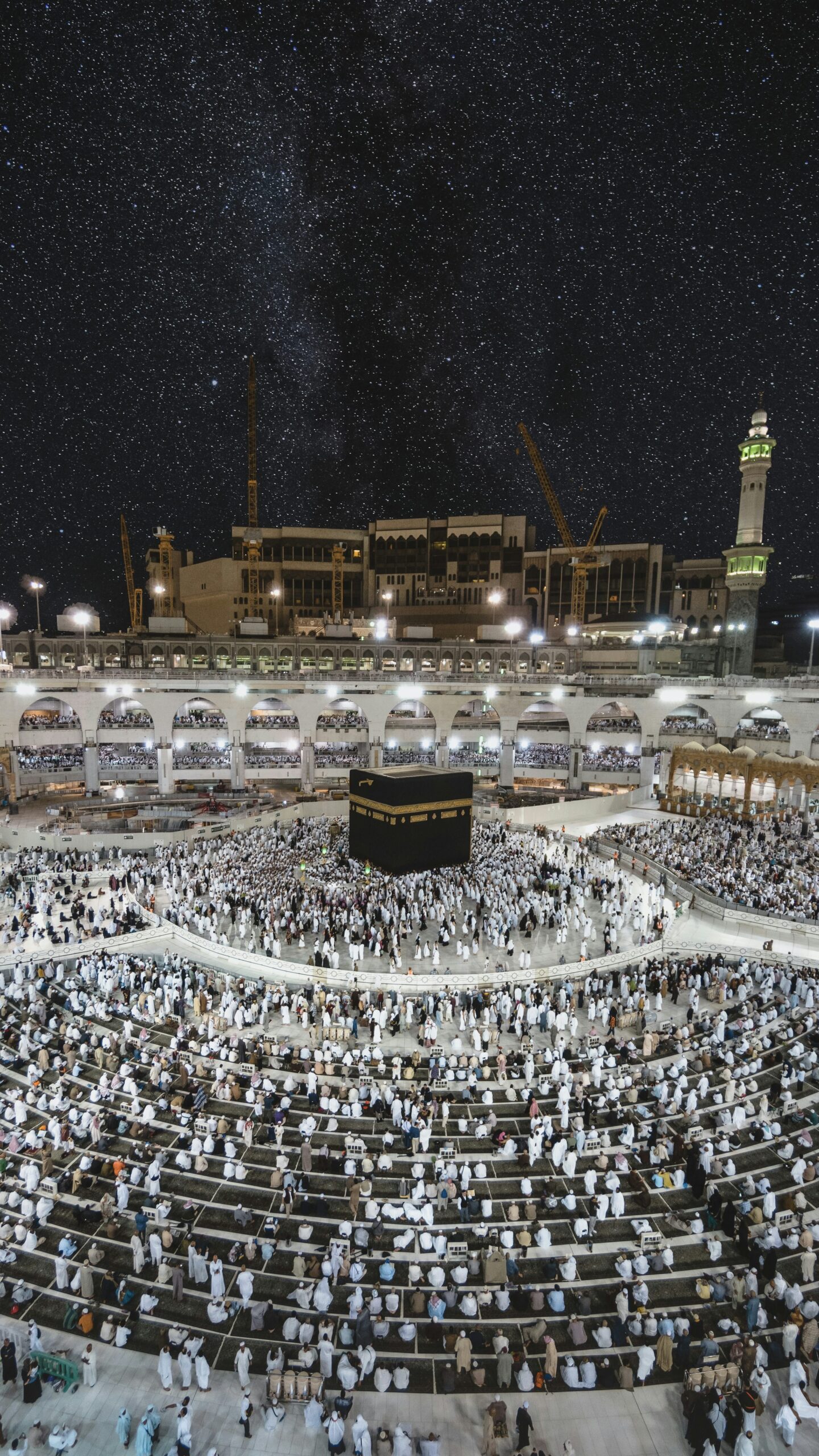
Allah has honored Makkah and Madinah above all other cities. Among the ways He protects them is by appointing angels who guard them by His command. This protection is by Allah’s will alone, and the angels are His obedient servants who carry out His decree.
Protection of Makkah
The Qur’an attributes the protection of the Kaʿbah primarily to Allah. The specific role of angels in guarding Makkah is detailed in authentic hadith concerning the Dajjāl.
| Topic | Explanation | Evidence |
|---|---|---|
| Sacred City | Allah made Makkah a sacred sanctuary. | Qur’an 3:96–97, 95:3 |
| Divine Protection | Allah protected the Kaʿbah from the Army of the Elephant. | Qur’an Sūrah al-Fīl (105:1–5) |
| Angels | Authentic hadith emphasize that Allah appoints angels for His sacred places, especially in relation to the end times. | Sahih Muslim |
Protection of Madinah
| Topic | Explanation | Evidence |
|---|---|---|
| Angels guard Madinah | Angels stand at the entrances to Madinah. | Sahih al-Bukhari |
| Dajjāl cannot enter | The False Messiah (Dajjāl) will not enter Madinah because angels guard every entrance. | Sahih al-Bukhari; Sahih Muslim |
| Plague | Authentic hadith also state that plague and Dajjāl will not enter Madinah. | Sahih al-Bukhari |
Angels and the Dajjāl
| Question | Answer | Evidence |
|---|---|---|
| Can Dajjāl enter Makkah? | ❌ No | Sahih al-Bukhari; Sahih Muslim |
| Can Dajjāl enter Madinah? | ❌ No | Sahih al-Bukhari; Sahih Muslim |
| Why not? | Angels guard every route leading to these cities by Allah’s command. | Sahih Muslim |
Conclusion
Belief in angels (al-Malā’ikah) is one of the Six Pillars of Faith and a fundamental part of Islamic belief. They are entrusted with countless responsibilities, including delivering revelation, recording human deeds, protecting people by Allah’s command, taking souls at death, carrying Allah’s Throne, welcoming the righteous into Paradise, and guarding Hell. Angels in Islam strengthen our awareness that Allah’s creation extends far beyond what we can see.
May Allah grant us beneficial knowledge, strengthen our faith in the unseen, make us among those whose deeds are accepted, and honor us with the greeting of His angels in Paradise:
“Peace be upon you for what you patiently endured. Excellent indeed is the final home.”
(Qur’an 13:24)
Angels play an important role in Islamic teachings about the unseen world and human existence. To learn more about other aspects of the unseen, explore the world of Jinn in Islam, the journey of the soul after death, and the remarkable event of Isra and Miraj.