
The Galaxy With No Stars: The Strange Mystery of Cloud-9. For 13.8 billion years, a skeleton has floated in the dark near our cosmic neighborhood. It has the weight of a galaxy. The gas to build one. But it never turned the lights on. NASA calls it Cloud-9.
And it shouldn’t be easy to find. Yet its strange properties may provide evidence for a long-predicted kind of dark-matter structure.
About 14 million light-years from Earth, near the spiral galaxy Messier 94, astronomers have been studying a compact cloud of neutral hydrogen that appears to contain essentially no stars. Radio telescopes can detect the gas. Hubble can see the surrounding universe. But inside the region where astronomers expected to find a population of stars, there is remarkably little.
And in 2026, an independent ultra-deep observation pushed the mystery even further: researchers using the Gran Telescopio Canarias reported no detectable stellar light, placing a very low upper limit on how many stars Cloud-9 could contain.
This isn’t simply a story about a strange cloud.
Cloud-9 could represent something much more fundamental:
A piece of the universe that started down the road toward becoming a galaxy but never managed to light itself up.
Table of Contents
What Exactly Is Cloud-9? (The Galaxy With No Stars)
Forget everything you know about galaxies. Cloud-9 has:
- No stars. No detectable stars. Not a normal stellar population. Hubble found no convincing stellar counterpart inside Cloud-9. Hubble’s Advanced Camera for Surveys stared at it and found nothing but background galaxies.
- Estimated dark-matter halo: ∼5 billion solar masses — inferred from the cloud’s gas dynamics and pressure balance.
- One million solar masses of neutral hydrogen gas: Just sitting there, cold and inert.
- Size: 4,900 light-years across, about 14 million light-years from Earth, near the spiral galaxy Messier 94 (M94).
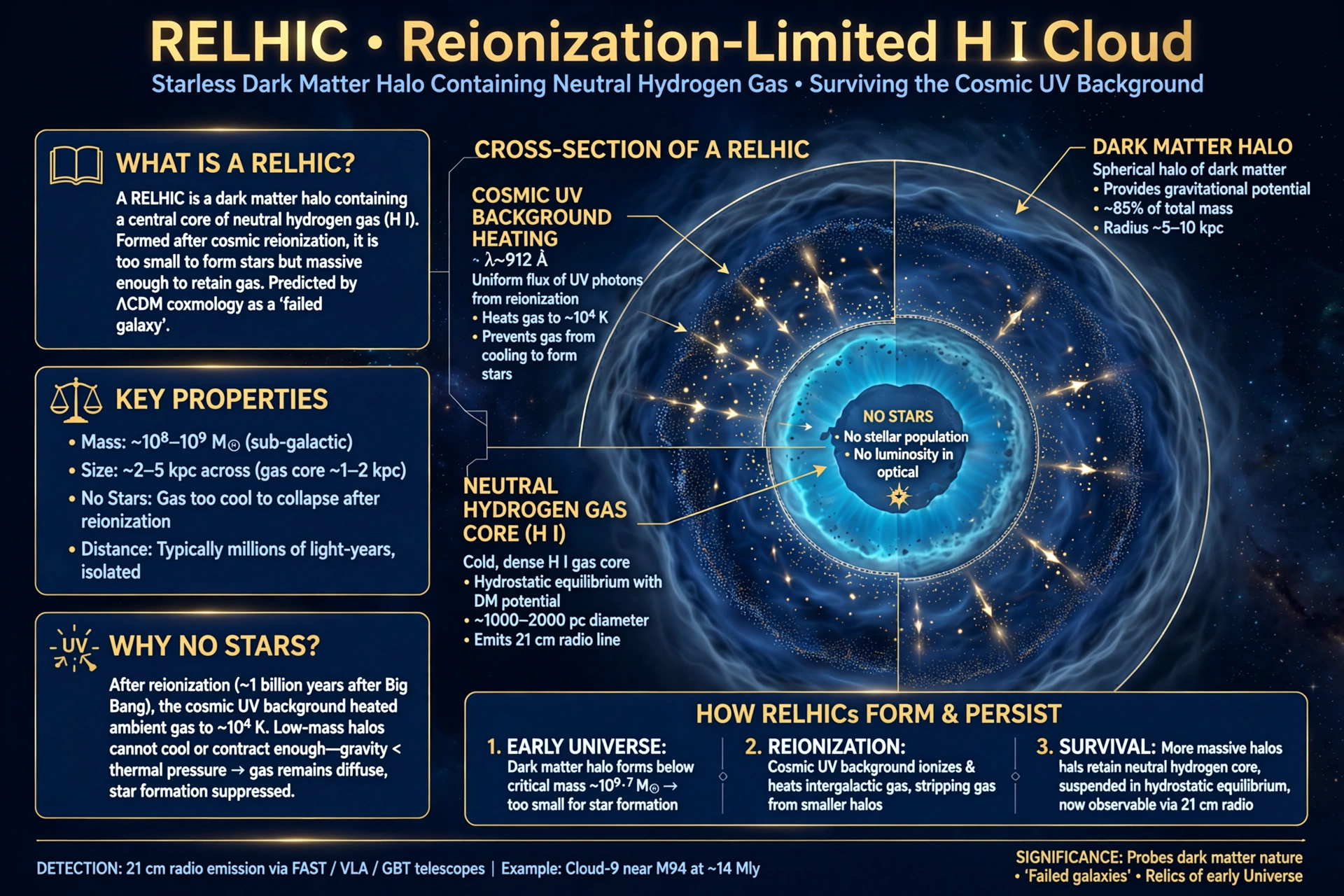
Astronomers classify it as a RELHIC – Reionization-Limited H I Cloud. A term for a primordial hydrogen cloud that is a fossil from the universe’s dawn.
“This is a tale of a failed galaxy,” said principal investigator Alejandro Benitez-Llambay of Milano-Bicocca University. “Seeing no stars is what proves the theory right.”
The mystery of Cloud-9 becomes even more fascinating when you look at how often the universe produces objects that challenge our expectations. For another remarkable Hubble discovery, read about the strange 10-sided shape found around Saturn, then explore how powerful space telescopes continue to reveal unexpected features hidden across the cosmos.
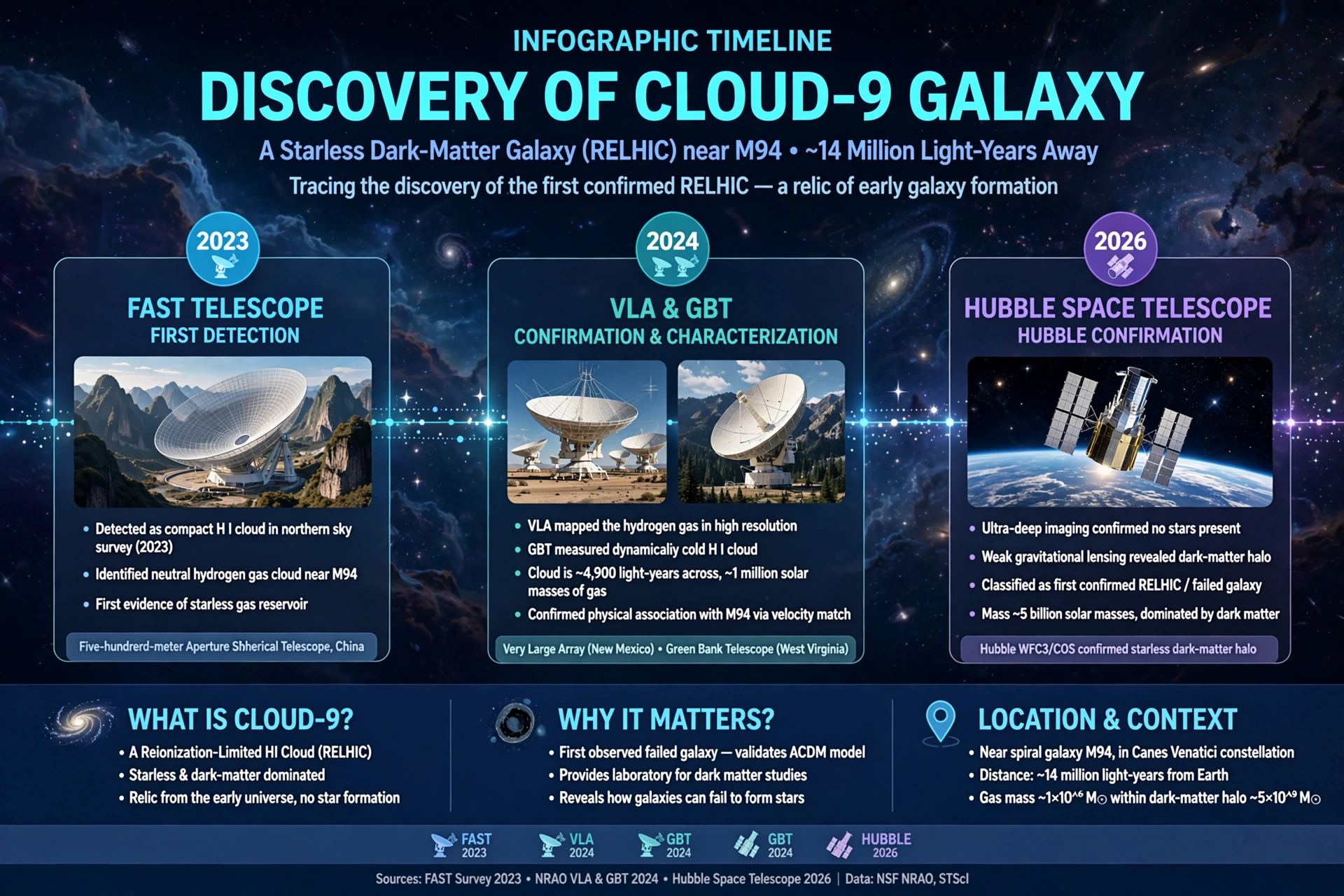
The Timeline of Discovery: From FAST to Hubble
This wasn’t a lucky snapshot. It was a 3-year hunt:
2023: First Whisper – China’s FAST
China’s Five-hundred-meter Aperture Spherical Telescope (FAST) detected a compact, cold hydrogen cloud during a survey near M94.
2024-2025: US Confirmation
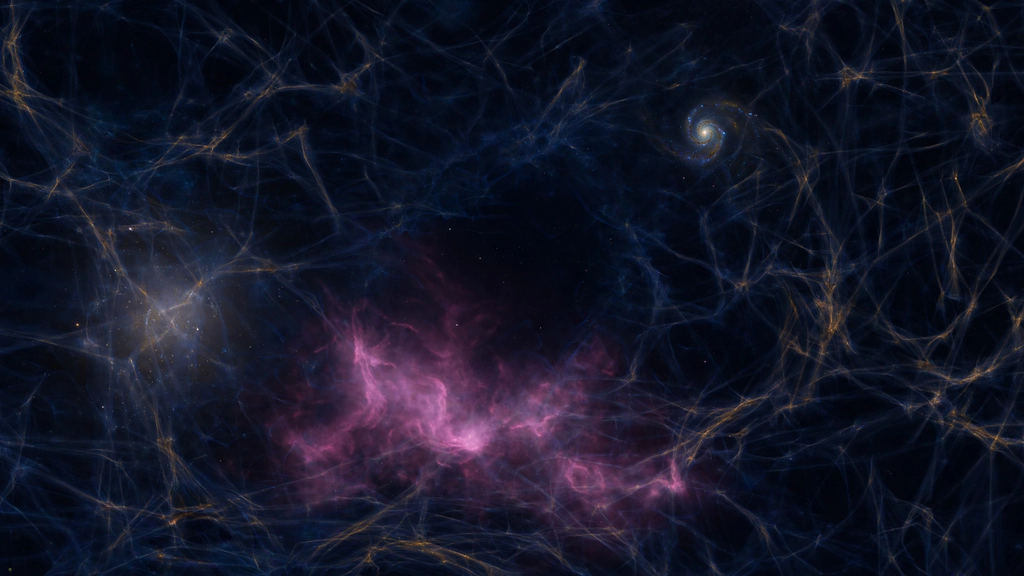
The NSF Green Bank Telescope (GBT) and Very Large Array (VLA) confirmed it. VLA mapped the diffuse magenta glow of radio emission and showed it was spherical and dynamically cold (W50 = 12 km/s).
Jan 5, 2026: Hubble Delivers the Verdict
At the 247th American Astronomical Society meeting in Phoenix, the team presented definitive proof. Lead author Gagandeep Anand (STScI) used Hubble program 17712 to rule out any dwarf galaxy with stellar mass > 10^3.5 solar masses.
“Before we used Hubble, you could argue that this is a faint dwarf galaxy that we could not see with ground-based telescopes. They just didn’t go deep enough,” said Anand. “But with Hubble’s Advanced Camera for Surveys, we’re able to nail down that there’s nothing there.”
The paper: Anand et al. 2025, The Astrophysical Journal Letters, 993, L55. Published November 10, 2025.
Why Cloud-9 Matters for the Missing Satellites Problem
ΛCDM predicts many low-mass dark-matter halos, but astronomers have historically observed far fewer small galaxies than some models predict. Cloud-9 doesn’t solve that problem by itself. Instead, it provides an unusually direct example of what one of those dark structures might look like when its gas never turns into a normal stellar galaxy.
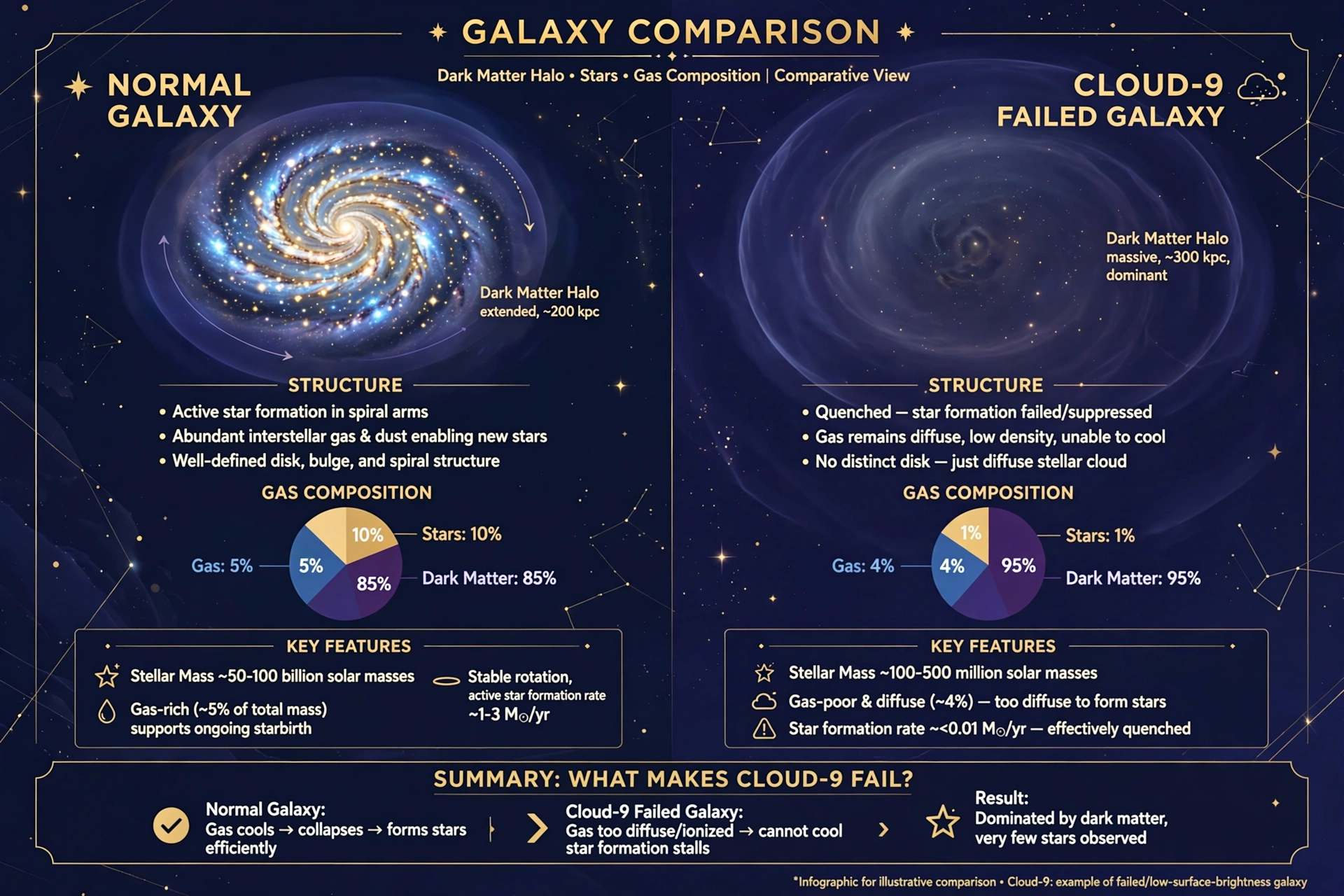
Our standard model of cosmology – Lambda Cold Dark Matter (Lambda CDM) – predicts the universe should be littered with thousands of tiny dark matter halos that never formed stars.
But we couldn’t find them. This is called the “missing satellites problem.”
RELHICs explain why:
During Epoch of Reionization (∼1 billion years after Big Bang), intense ultraviolet radiation from first stars heated gas everywhere.
At sufficiently low halo masses, reionization can heat and ionize gas, making it difficult for small halos to retain and cool enough material to form stars efficiently. Cloud-9 appears to occupy a particularly interesting part of that transition.
Cloud-9 is in a “sweet spot”: Massive enough to survive 13 billion years, not massive enough to ignite.
Team member Andrew Fox of STScI/ESA said: “This cloud is a window into the dark universe… Cloud-9 gives us a rare look at a dark-matter-dominated cloud.”
Co-author Rachael Beaton added: “Among our galactic neighbors, there might be a few abandoned houses out there.”
Not The First Ghost – Past Failed Galaxies
Cloud-9 isn’t the first time we were fooled.
| Object | What made it mysterious | What happened |
|---|---|---|
| VirgoHI21 | Candidate dark galaxy | Tidal-origin interpretation became important |
| HI1232+20 | Dark H I cloud | Alternative environmental/tidal explanations |
| Dragonfly 44 | Extremely diffuse galaxy | Contains stars |
| Cloud-9 | Gas-rich but no detected stellar population | Leading RELHIC candidate |
What makes Cloud-9 different? It is the first to survive Hubble’s star-check AND VLA’s gas dynamics AND has no tidal origin. It is isolated, spherical, and starless – exactly as Benitez-Llambay’s simulations from 2017 predicted.
Cloud-9 also highlights why modern space telescopes are so important. NASA’s next-generation observatories are expanding that view even further. You can read more about the Roman Space Telescope mission and how new generations of telescopes could help astronomers investigate some of the universe’s strangest structures.
What Happens Next? Why You Should Care
This is bigger than one cloud.
If one RELHIC exists 14 million light-years away, models predict hundreds more orbit our Local Group invisibly. They are the ultimate dark matter laboratories – pure halos without starlight contamination.
NASA’s Nancy Grace Roman Space Telescope and SKA radio observatory will hunt for more.
For now, Cloud-9 floats there – a galaxy that chose to stay dark. A reminder that for every bright spiral we see, the universe built a thousand houses it never moved into.
What Cloud-9 Could Teach Us About Dark Matter
Dark matter remains one of the biggest unresolved questions in modern cosmology.
We have strong evidence that something gravitationally massive exists beyond the matter that emits or absorbs ordinary light.
But we don’t yet know exactly what dark matter is.
Cloud-9 doesn’t solve that problem.
What it could do is something subtler:
give astronomers an unusually clean laboratory for testing how dark matter structures behave.
A normal galaxy contains stars, dust, gas, stellar remnants and other complicated ingredients.
Cloud-9 may contain almost none of that visible complexity.
If its properties can be measured precisely, researchers can compare them with predictions for dark-matter halos.
That could help constrain:
- the smallest halos capable of retaining gas;
- the threshold at which galaxies begin forming stars;
- the effects of cosmic reionization;
- the distribution of dark matter;
- the physics controlling gas cooling;
- and how the first galaxies emerged.
Cloud-9 May Be a Snapshot of a Galaxy That Never Was
Astronomy is often presented as a science of spectacular things.
- Exploding stars.
- Black holes.
- Nebulae.
- Spiral galaxies.
- Supernovae.
- But Cloud-9 offers a different kind of astronomical beauty.
- Absence becomes evidence.
- There is no glowing spiral.
- No swarm of easily visible stars.
- No brilliant cluster announcing its existence.
- Instead, there is a faint radio signal from hydrogen.
- A gravitational mystery.
- A patch of darkness.
- And behind it, distant galaxies that are completely unrelated to the cloud itself.
Hubble essentially looked into the darkness and asked:
“Where are the stars?”
And the answer was:
They aren’t there — at least not in the numbers a normal galaxy would require.
Perhaps the best way to understand Cloud-9 is to imagine the universe as a gigantic construction project.
- Dark matter provides the gravitational framework.
- Hydrogen is the raw material.
- Gravity pulls the material inward.
- Cooling allows gas to become denser.
- Eventually, stars ignite.
- Stars transform galaxies.
- But Cloud-9 appears to have stopped somewhere before the final step.
- The framework may be there.
- The gas is there.
- The dark matter may be there.
- But the stars never arrived in meaningful numbers.
And that makes Cloud-9 scientifically valuable precisely because it is incomplete.
Cloud-9 at a Glance
| Property | What we know |
|---|---|
| Object | Cloud-9 |
| Proposed classification | Reionization-Limited H I Cloud (RELHIC) |
| Location | Near Messier 94 |
| Distance | Roughly 14–15 million light-years |
| Main detectable component | Neutral hydrogen |
| Hydrogen mass | About 1 million solar masses |
| Estimated total mass | About 5 billion solar masses in the relevant modeling |
| Stars detected? | No significant stellar population detected |
| 2025 Hubble result | Strong limits on a stellar counterpart |
| 2026 GTC result | No stellar emission detected; stellar mass constrained to ≲1.6 × 10⁴ solar masses under the study’s assumptions |
| First detected | FAST radio observations |
| Follow-up | Green Bank Telescope + VLA + Hubble |
| Major scientific question | Is this a starless dark-matter halo predicted by galaxy-formation theory? |
Zhou et al., “The nature of Cloud-9: a compact core embedded in a diffuse envelope.”
The new FAST + VLA analysis finds a two-component structure:
- a compact, kinematically quiet core;
- an extended gas envelope;
- a velocity gradient of roughly 25 km/s across ~7 kpc;
- evidence that the outer gas may be affected by interaction with M94;
- an interpretation consistent with a stripped RELHIC scenario.
Final Thought
The universe doesn’t always reveal its secrets by showing us something spectacular.
Sometimes it does the opposite.
Sometimes the discovery is a missing light.
Cloud-9 is intriguing because astronomers may have found a structure where the ingredients for a galaxy exist, but the galaxy itself never truly switched on.
If future observations confirm that interpretation and find more objects like it, Cloud-9 could become more than an unusual cloud near M94.
It could be a glimpse of the hidden, starless side of galaxy formation — a population of cosmic structures that existed all along but were almost impossible to see because they never learned how to shine.
And that raises an extraordinary possibility:
The night sky may contain far more structures than the stars have ever allowed us to see.
Cloud-9 is a reminder that some of the biggest mysteries in astronomy may not be the brightest objects in the sky. In fact, the universe can hide extraordinary phenomena in places that appear almost empty.
If you enjoy investigating unexplained events and scientific mysteries, take a look at the Dyatlov Pass mystery and the story of Iram, the mysterious ancient city mentioned in Islamic tradition for two very different examples of how unanswered questions can capture our imagination.
References:
- NASA Science — official Hubble release
NASA says Hubble found no stars within Cloud-9 and identifies it as a possible Reionization-Limited H I Cloud (RELHIC). - ESA — official release
ESA describes Cloud-9 as a starless, gas-rich, dark-matter-dominated object and gives its distance as about 14 million light-years. - Anand et al. 2025, The Astrophysical Journal Letters
This is the key peer-reviewed source. The paper reports approximately 10⁶ solar masses of H I, a radius of about 1.4 kpc, a velocity width of 12 km/s, and stringent limits on any stellar counterpart. - 2026 follow-up: Zhou et al.
FAQS
How does dark matter shape ordinary matter?
Cloud-9 may provide a rare opportunity to study that relationship without a large population of stars dominating the system.
Are there thousands of invisible structures waiting to be discovered?
If RELHICs are common, current optical galaxy catalogs could be missing an entire population of objects.
Why do some gas clouds make stars while others don’t?
The answer involves gravity, temperature, radiation, and environment.
How small can a galaxy be?
Astronomers are trying to understand where the transition occurs between dark-matter halos that remain dark and those that produce stars.