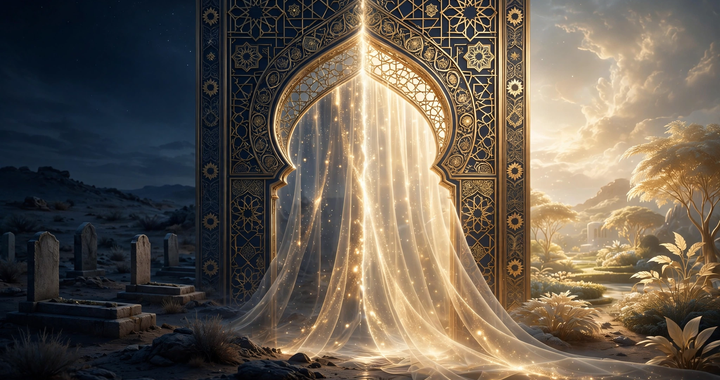


Paradise in Islam is the everlasting abode that Allah has created for the believers after the Day of Judgment. It is a real creation, not merely symbolic or spiritual, where the righteous will enjoy eternal comfort, security, and blessings.
The ultimate purpose and greatest blessing of Paradise is Allah’s pleasure (Riḍwān) and the believers’ vision of Allah, alongside eternal peace and happiness.
Table of Contents
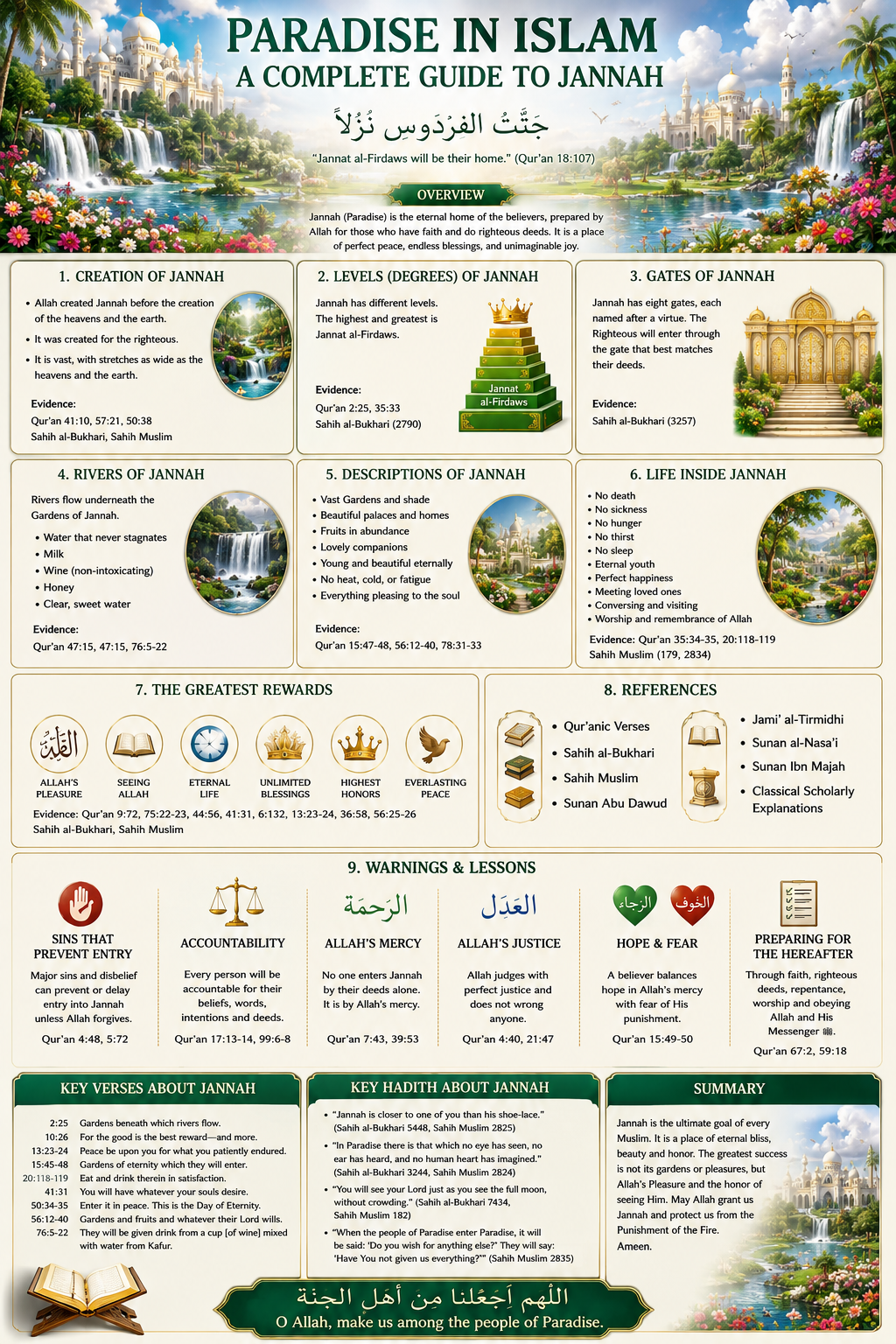
Introduction to Jannah (Paradise)
Paradise in Islam is the eternal home promised by Allah for the righteous believers. The Quran and authentic Hadith describe Paradise in Islam as a place of everlasting peace, happiness, and countless blessings.
The Arabic word Jannah (الجنة) comes from the root ج ن ن (J-N-N), which means “to cover,” “to conceal,” or “to hide.” A garden filled with dense trees is called jannah because its thick foliage covers the ground beneath it. Hazrat Muhammad ﷺ saw paradise during Isra and Miraj Journey.
Jannah is described in the Qur’an as:
- A place of eternal life.
- A reward for faith and righteous deeds.
- A home of complete peace.
- A place where every lawful desire is fulfilled.
- The greatest success for a believer.
Allah says:
“No soul can imagine what delights are kept in store for them as a reward for what they used to do..”
(Qur’an 32:17)
The purposes of Jannah include:
- A reward for faith and righteous deeds.
- A place of eternal peace, free from fear, grief, illness, and death.
- The fulfillment of Allah’s promise to His believing servants.
- The manifestation of Allah’s mercy and generosity.
- The believers’ everlasting home after the trials of worldly life.
- The greatest honor: earning Allah’s pleasure and seeing Him in the Hereafter.
The Prophet ﷺ also taught believers to ask Allah for the highest level of Paradise:
“When you ask Allah for Paradise, ask Him for Al-Firdaws, for it is the highest part of Paradise.”
Reference: Sahih al-Bukhari (2790)
Allah created Jannah to:
- Reward sincere faith and righteous deeds.
- Manifest His mercy and generosity.
- Fulfill His promise to the believers.
- Distinguish those who obey Him from those who reject Him.
- Provide an eternal home after the temporary life of this world.
Creation of Jannah (Paradise)
One of the most important beliefs in Islam is that Jannah (Paradise) is a real creation of Allah. It is not a symbolic place or something that will only come into existence after the Day of Judgment. Jannah was created before the Day of Judgment. It already existed during the time of Prophet Adam (AS). It has been prepared for the righteous since before mankind entered the world.
Allah says:
“And hasten towards forgiveness from your Lord and a Paradise as vast as the heavens and the earth, prepared for those mindful ˹of Allah˺.”
(Qur’an 3:133)
The word “prepared” (أُعِدَّتْ) is in the past form, indicating that Paradise has already been prepared.
Allah says:
“We cautioned, “O Adam! Live with your wife in Paradise and eat as freely as you please, but do not approach this tree, or else you will be wrongdoers.””
(Qur’an 2:35)
Al-Firdaws is the highest level of Paradise. Above Al-Firdaws is Allah’s Throne (‘Arsh). Paradise is above the seven heavens.
- Jannah is prepared.
“A Garden as wide as the heavens and the earth, prepared for the righteous.”
(Qur’an 3:133)
- It is prepared for believers.
“Prepared for those who believe in Allah and His Messengers.”
(Qur’an 57:21)
- Adam lived in Paradise.
“O Adam, dwell, you and your wife, in Paradise.”
(Qur’an 2:35)
Names of Jannah (Paradise) in Islam
The Qur’an describes Paradise using several beautiful names. Expands for more information.
Jannah (ٱلْجَنَّة)
The Arabic word Jannah comes from the root ج ن ن (J-N-N), meaning: To cover, To conceal and To hide
Jannat ‘Adn (جَنَّاتُ عَدْنٍ)
The word ‘Adn means: Permanent residence, Everlasting home and Eternal settlement. It explains that Paradise is a place where believers will live forever without leaving.
Dar as-Salam (دَارُ السَّلَامِ)
Dar means Home, and As-Salam means Peace. Together, Dar as-Salam means: “The Home of Peace.” It highlights the complete safety and tranquility found in Paradise.
Dar al-Muqamah (دَارُ الْمُقَامَةِ)
Dar al-Muqamah means: “The Home of Permanent Residence.” It emphasizes that believers will never leave Paradise.
Dar al-Khuld (دَارُ الْخُلْدِ)
Khuld means: Eternity, Everlasting life and Endless existence. Thus, Dar al-Khuld means: “The Home of Eternity.” The expression appears in the Qur’an to describe the eternal abode.
Jannat an-Na’im (جَنَّةُ النَّعِيمِ)
An-Na’im means: Bliss, Delight and Complete enjoyment. Thus, Jannat an-Na’im means: “The Garden of Bliss.”
Al-Maqam al-Amin (ٱلْمَقَامُ ٱلْأَمِينُ)
Al-Maqam al-Amin means: The Secure Place, The Safe Dwelling and The Place of Complete Security
In addition to the names above, the Qur’an uses several descriptive expressions for Paradise:
| Name | Meaning |
|---|---|
| Jannāt Tajrī Min Taḥtihā al-Anhār | Gardens beneath which rivers flow |
| Jannāt al-Ma’wā | Gardens of Refuge or Abode |
| Ḥusnā | The Best Reward |
| Al-Dār al-Ākhirah | The Home of the Hereafter |
| Ajr Kabīr | Great Reward |
Structure of Jannah (Paradise) in Islam

It has different levels (darajāt), vast gardens, lofty palaces, and varying ranks according to faith, righteous deeds, and above all, Allah’s mercy.
Allah says:
“Each ˹of the two groups˺ will be ranked according to what they have done so He may fully reward all. And none will be wronged.”
The Prophet ﷺ said:
“Paradise has one-hundred grades which Allah has reserved for the Mujahidin who fight in His Cause, and the distance between each of two grades is like the distance between the Heaven and the Earth. So, when you ask Allah (for something), ask for Al-firdaus which is the best and highest part of Paradise.” (i.e. The sub-narrator added, “I think the Prophet also said, ‘Above it (i.e. Al-Firdaus) is the Throne of Beneficent (i.e. Allah), and from it originate the rivers of Paradise.”)”
Reference: Sahih al-Bukhari (2790)
The Highest Level Of Paradise
Among all the levels of Paradise, Al-Firdaws is the highest and most excellent. The rivers of Paradise originate from Al-Firdaws. It is the level every Muslim should aspire to reach.
Characteristics of Al-Firdaws
- Highest level of Paradise.
- Best and most honored part of Jannah.
- Closest level to Allah’s Throne.
- Source from which the rivers of Paradise flow.
- The destination every believer is encouraged to ask Allah for.
The Lowest Level of Paradise
Even the lowest rank in Paradise is beyond anything imaginable in this world.
The Prophet ﷺ described the least rewarded inhabitant of Paradise.
The Prophet ﷺ said:
“I know the person who will be the last to come out of the (Hell) Fire, and the last to enter Paradise. He will be a man who will come out of the (Hell) Fire crawling, and Allah will say to him, ‘Go and enter Paradise.’ He will go to it, but he will imagine that it had been filled, and then he will return and say, ‘O Lord, I have found it full.’ Allah will say, ‘Go and enter Paradise, and you will have what equals the world and ten times as much (or, you will have as much as ten times the like of the world).’ On that, the man will say, ‘Do you mock at me (or laugh at me) though You are the King?” I saw Allah’s Messenger (ﷺ) (while saying that) smiling that his premolar teeth became visible. It is said that will be the lowest in degree amongst the people of Paradise.”
Reference: Sahih al-Bukhari 6571
This shows that:
- Every inhabitant of Paradise is immensely blessed.
- No one in Paradise experiences deprivation or regret.
- Even the lowest level surpasses all worldly kingdoms.
Deeds That Raise a Believer’s Rank
The Qur’an and authentic Sunnah mention many acts that increase a believer’s rank, including:
- Sincere Tawhid.
- Performing the five daily prayers.
- Voluntary prayers.
- Fasting Ramadan and recommended fasts.
- Giving charity.
- Reciting and acting upon the Qur’an.
- Patience during trials.
- Good character.
- Honoring parents.
- Seeking beneficial knowledge.
- Calling others to righteousness.
- Remembering Allah (Dhikr).
- Sincere repentance.
- Striving in Allah’s cause.
The Prophet ﷺ also said:
“The one who was devoted to the Qur’an will be told on the Day of Resurrection: ‘Recite and ascend (in ranks) as you used to recite when you were in the world. Your rank will be at the last Ayah you recite.”
Reference: Riyad as-Salihin 1001
No one will enter Paradise because of his deeds alone. Entry into Paradise is ultimately by Allah’s mercy. Good deeds are a means through which Allah grants His mercy. Deeds also distinguish the ranks of the people of Paradise.
Allah says:
“˹So˺ compete with one another for forgiveness from your Lord and a Paradise as vast as the heavens and the earth, prepared for those who believe in Allah and His messengers. This is the favour of Allah. He grants it to whoever He wills. And Allah is the Lord of infinite bounty.”
(Qur’an 57:21)
The Eight Gates of Jannah
The gates are an honor from Allah. Believers who excel in particular acts of worship may be invited through the gate most closely associated with their righteous deeds. The names of the remaining gates have not been authentically identified, so they should not be presented as confirmed facts.
The Prophet ﷺ said:
“”Paradise has eight gates, and one of them is called Ar-Raiyan through which none will enter but those who observe fasting.””
Reference: Sahih al-Bukhari 3257
The Prophet ﷺ said:
“Whoever gives two kinds (of things or property) in charity for Allah’s Cause, will be called from the gates of Paradise and will be addressed, ‘O slaves of Allah! Here is prosperity.’ So, whoever was amongst the people who used to offer their prayers, will be called from the gate of the prayer; and whoever was amongst the people who used to participate in Jihad, will be called from the gate of Jihad; and whoever was amongst those who used to observe fasts, will be called from the gate of Ar-Raiyan; whoever was amongst those who used to give in charity, will be called from the gate of charity.” Abu Bakr said, “Let my parents be sacrificed for you, O Allah’s Messenger (ﷺ)! No distress or need will befall him who will be called from those gates. Will there be any one who will be called from all these gates?” The Prophet (ﷺ) replied, “Yes, and I hope you will be one of them.”
Reference: Sahih al-Bukhari (1897)
Bab As-Salah (باب الصلاة) – The Gate of Prayer
Believers will enter, who:
- Guarded the five daily prayers.
- Performed them sincerely and consistently.
- Increased in voluntary (nafl) prayers.
Bab Ar-Rayyan (باب الريان) – The Gate of Those Who Fast
Those will enter, who:
- Fasted Ramadan sincerely.
- Observed voluntary fasts seeking Allah’s pleasure.
Bab As-Sadaqah (باب الصدقة) – The Gate of Charity
Believers will enter, who
- Regularly gave charity.
- Supported those in need.
- Spent their wealth sincerely for Allah’s sake.
Bab Al-Jihad (باب الجهاد) – The Gate of Striving in Allah’s Cause
Those who sincerely strove for Allah in ways accepted by Islamic teachings will enter. Sincere striving for Allah’s pleasure is among the highest acts of worship.
Bab Al-Kazimin Al-Ghayz (باب الكاظمين الغيظ)
Controlling anger is a highly praised characteristic in Islam. Some books and lectures mention a “Gate of Those Who Restrain Anger,” but this specific gate name is not established in authentic hadith.
Bab Al-Dhikr (باب الذكر)
Dhikr brings immense reward, but Muslims should not attribute a specific gate name to Paradise without authentic evidence. Although remembering Allah (dhikr) is among the greatest acts of worship, the designation of a specific gate by this name is not proven in authentic sources.
Guardians of Paradise (Jannah) in Islam
Paradise is guarded and cared for by noble angels appointed by Allah. These angels are honored servants who never disobey Allah. They protect Paradise, welcome the believers, and greet them with words of peace when they enter.
Duties of the Angels of Paradise
According to the Qur’an and authentic Sunnah, the angels:
1. Guard the Gates of Paradise
Allah says:
“Gardens of perpetual residence, whose doors will be opened for them.”
(Qur’an 38:50)
The gates of Paradise are under the care of angels appointed by Allah.
2. Welcome the Believers
When believers reach Paradise after the Day of Judgment, angels receive them with honor and joy.
Allah says:
“And those who feared their Lord will be driven to Paradise in groups until, when they reach it while its gates have been opened, its keepers will say, ‘Peace be upon you! You have done well, so enter it to abide eternally.'”
(Qur’an 39:73)
This is one of the greatest welcomes a believer will ever receive.
3. Visit the People of Paradise
The angels continue to visit the inhabitants of Paradise.
Allah says:
“And the angels will enter upon them from every gate, saying, ‘Peace be upon you for what you patiently endured. Excellent indeed is the final home.'”
(Qur’an 13:23–24)
This verse shows that the angels congratulate the believers because of their faith, patience, and righteous deeds.
Ridwan (Riḍwān) – Is He the Keeper of Paradise?
The name Riḍwān became well known through some later reports and works of Islamic literature, but these reports are generally considered weak (ḍaʿīf) or lack an authentic chain of transmission.
Who Will Enter Jannah (Paradise)?
The following summarized table explains
| Category | Who Are They? | Conditions for Entry | Special Reward or Honor |
|---|---|---|---|
| Believers (Al-Mu’minūn) | Those who sincerely believe in Allah, His angels, His books, His messengers, the Last Day, and Divine Decree. | Correct faith (Iman), sincerity (Ikhlas), and righteous deeds. | Eternal Paradise with rivers, gardens, and Allah’s pleasure. |
| Prophets (Al-Anbiyā’) | Allah’s chosen messengers sent to guide humanity. | They fulfilled Allah’s mission and remained steadfast. | Highest ranks in Paradise. Prophet Muhammad ﷺ will receive Al-Wasīlah. |
| Truthful (As-Siddīqūn) | Those who are completely truthful in belief, speech, and action. | Perfect honesty, unwavering faith, and obedience to Allah. | Ranked immediately after the Prophets. |
| Martyrs (Ash-Shuhadā’) | Those who die as martyrs according to Islamic teachings while sincerely seeking Allah’s pleasure. | Sincerity, lawful circumstances recognized in Islam, and faith. | Alive with Allah, forgiven, honored, and granted a high rank. |
| Righteous Servants (As-Sāliḥūn) | Believers who consistently obey Allah and avoid sin. | Prayer, charity, honesty, patience, good character, and obedience. | Gardens of Paradise and everlasting happiness. |
| Repentant Believers (At-Tā’ibūn) | Muslims who sincerely repent after committing sins. | Stop the sin, feel remorse, resolve not to return, and restore others’ rights if applicable. | Allah forgives them and may replace evil deeds with good deeds. |
| Poor Believers | Believers who remain patient and faithful despite poverty. | Patience, gratitude, trust in Allah, and righteous deeds. | The Prophet ﷺ saw that many inhabitants of Paradise are from among the poor. |
| Children of Believers | Children who die before reaching the age of accountability. | They die before becoming morally responsible. | Under Allah’s mercy and cared for in Paradise. |
| Believing Families | Parents, spouses, and children who all die upon faith. | Shared faith in Allah and righteousness. | Families are reunited in Paradise without reducing anyone’s reward. |
| People of Taqwa (The God-Conscious) | Those who fear Allah and obey Him in public and private. | Living with piety and avoiding major sins. | Gardens beneath which rivers flow and eternal residence. |
| Those Who Establish Prayer | Believers who consistently perform the five daily prayers. | Sincere and regular Salah. | Success, inheritance of Al-Firdaws, and invitation through Bab As-Salah. |
| Those Who Fast | Muslims who observe Ramadan and voluntary fasts sincerely. | Fasting solely for Allah’s pleasure. | Invitation through Bab Ar-Rayyan, the Gate of Fasting. |
| Those Who Give Charity | Believers who spend their wealth sincerely for Allah. | Sincere charity without showing off. | Invitation through Bab As-Sadaqah, the Gate of Charity. |
| People of Good Character | Muslims known for kindness, honesty, patience, humility, and mercy. | Excellent manners and treatment of others. | Nearness to the Prophet ﷺ and a high status in Paradise. |
| Those Who Control Their Anger | Believers who restrain anger and forgive others. | Self-control and forgiveness. | Great reward from Allah. (A specific gate for them is not established in authentic hadith.) |
| Those Who Remember Allah Often | Believers who regularly engage in dhikr (remembrance of Allah). | Frequent and sincere remembrance. | Great reward and closeness to Allah. (No authentic evidence names a gate “Bab al-Dhikr.”) |
| Those Who Recite and Act Upon the Qur’an | Believers who learn, recite, understand, and live by the Qur’an. | Consistent recitation and implementation of its teachings. | Their rank in Paradise rises according to the last verse they recite. |
| Those Dutiful to Their Parents | Muslims who honor and care for their parents. | Kindness, respect, and obedience in what is lawful. | One of the greatest causes of Allah’s pleasure and entry into Paradise. |
| Those Who Care for Orphans | People who sponsor and care for orphaned children. | Compassion, protection, and financial or personal care. | The Prophet ﷺ said such a person will be close to him in Paradise. |
| Those Who Die Upon Tawhid | Those who die sincerely worshipping Allah alone without associating partners with Him. | Pure monotheism and faith at death. | Ultimate salvation by Allah’s mercy, though some believers may first be held accountable according to Allah’s justice. |
The Journey to Paradise (Jannah) in Islam
Worldly Life (Dunya)
│
▼
- Death (Al-Mawt)
│
▼ - Barzakh (Life in the Grave)
│
▼ - Resurrection (Al-Ba’th)
│
▼ - Gathering (Al-Hashr)
│
▼ - Receiving the Book of Deeds
│
▼ - Reckoning (Al-Hisab)
│
▼ - Mizan (The Scale)
│
▼ - Hawd al-Kawthar (The Prophet’s ﷺ Reservoir)
│
▼ - Intercession (Ash-Shafa’ah)
│
▼ - Crossing the Sirat Bridge
│
▼ - Al-Qantarah (Bridge of Settling Rights)
│
▼ - Entry into Jannah
You can read this topic in detail in the article Journey of the Soul After Death | The Eye-Opening Truth.
Description of Jannah (Paradise)

The Qur’an and authentic Sunnah describe Jannah as the most beautiful and perfect creation prepared by Allah for the believers.
The Prophet ﷺ said:
“Allah said, “I have prepared for My Pious slaves things which have never been seen by an eye, or heard by an ear, or imagined by a human being.” If you wish, you can recite this Verse from the Holy Qur’an:–“No soul knows what is kept hidden for them, of joy as a reward for what they used to do.”
References: Sahih al-Bukhari 3244
- Gardens (Al-Jannāt): The word “Jannah” itself means “garden.” The Qur’an repeatedly describes Paradise as magnificent gardens filled with greenery, shade, and everlasting life.
- Rivers (Al-Anhār): The Qur’an explicitly mentions: Rivers of pure water, Rivers of milk., Rivers of wine that causes no intoxication or harm and Rivers of purified honey. The Prophet ﷺ also taught that the rivers of Paradise flow from Al-Firdaws. Rivers flow beneath gardens.
- Springs (‘Uyūn): In addition to rivers, Paradise contains many springs. The pious shall reside among springs and gardens. There are two gushing springs in them. A spring therein named Salsabīl. Additionally, the Qur’an cites Tasnīm and Kāfūr, both of which are connected to beverages or springs of Paradise.
- Trees: The trees of Paradise are unlike any trees on earth. The Prophet ﷺ mentioned the Ṭūbā tree in authentic narrations. There is a tree in Paradise whose shade would prevent a rider from crossing it for a hundred years.
- Fruits: The fruits of Paradise are always available and never spoil. Its clusters will be hanging low.
- Soil: The soil of Paradise resembles white flour mixed with musk unlike earthly soil.
- Light: Paradise is filled with light.
- Fragrance: The fragrance of Paradise is extraordinary. It is sweeter than musk, fills all of Paradise, and never fades.
Homes of Jannah
| Home Feature | Authentic Description | Main Evidence |
|---|---|---|
| Palaces | Magnificent dwellings, including palaces made from hollow pearls. | Qur’an 39:20; Sahih al-Bukhari (4879); Sahih Muslim (2838) |
| Mansions | Pleasant eternal homes in Gardens of Everlasting Residence. | Qur’an 9:72 |
| Tents of Pearl | Enormous tents formed from a single hollow pearl. | Sahih al-Bukhari (4879); Sahih Muslim (2838) |
| Rooms (Al-Ghuraf) | Lofty, elevated chambers for the righteous. | Qur’an 25:75; 39:20; Jami’ al-Tirmidhi (1984) |
| Thrones (Arā’ik) | Beautiful couches and thrones for reclining in honor. | Qur’an 18:31; 55:54; 15:47 |
| Furniture | Raised couches, cushions, carpets, and luxurious furnishings. | Qur’an 55:76; 88:13–16 |
| Decorations | Gold, silver, pearls, silk garments, and brocade adornments. | Qur’an 18:31; 22:23; 76:21 |
Clothing & Adornment in Jannah
| Adornment | Description | Evidence |
|---|---|---|
| Silk Garments | The people of Paradise will wear garments made from fine silk and thick brocade. | Qur’an 18:31, 22:23, 44:53, 76:21 |
| Green Clothing | Allah specifically describes the garments of Paradise as green. | Qur’an 18:31 |
| Bracelets | Believers will be adorned with beautiful bracelets made from precious materials. | Qur’an 18:31, 22:23, 76:21 |
| Gold | Gold is used as jewelry and adornment in Paradise. | Qur’an 18:31, 22:23, 35:33 |
| Silver | Silver bracelets and silver vessels are among the blessings of Paradise. | Qur’an 76:15–16, 76:21 |
| Pearls | Pearls are used as ornaments and are also mentioned in descriptions of Paradise’s beauty. | Qur’an 22:23, 52:24, 56:23 |
| Crowns | Crowns are mentioned in authentic hadith as a special honor connected with devotion to the Qur’an. | Sunan Abu Dawud (1453), Musnad Ahmad |
| Perfumes | Paradise is filled with extraordinary fragrance, and the people of Paradise are pure and pleasant. | Sahih al-Bukhari (6507); Sahih Muslim |
People of Jannah
| Category | Who Are They? | Description |
|---|---|---|
| Men | Believing men who die upon faith and are admitted to Paradise by Allah’s mercy. | They will enjoy eternal life, perfect health, youth, happiness, beautiful homes, spouses, and Allah’s pleasure. They will never experience death, illness, sadness, or fatigue. |
| Women | Believing women who die upon faith. | They receive every reward promised to believing men. Allah promises them eternal gardens, honor, joy, and complete satisfaction. No woman will be treated unjustly. |
| Children | Children who die before reaching the age of accountability and the children of believers. | Authentic hadith indicate that children are under Allah’s mercy, and the children of believers are in Paradise. The Prophet ﷺ saw Prophet Ibrahim (AS) caring for many children in Paradise. |
| Prophets (Al-Anbiyā’) | Allah’s chosen messengers. | They occupy the highest ranks in Paradise. Prophet Muhammad ﷺ will receive Al-Wasīlah, the highest station granted to any servant. |
| Angels | Created from light, they are servants of Allah who never disobey Him. | Angels welcome the believers, greet them with peace, and enter upon them from every gate. They serve according to Allah’s command but are not inhabitants of Jannah in the same sense as rewarded humans and jinn, since Paradise is not a reward for their deeds. |
| Servants (Wildān Mukhalladūn) | Everlasting youthful attendants created to serve the people of Paradise. | They circulate among the inhabitants with drinks, food, and hospitality. They remain forever youthful. |
| Hur al-‘Ayn | Special companions created by Allah for Paradise. | They are described as pure, beautiful, modest, and untouched. They are among the blessings Allah has prepared for the people of Paradise. |
| Family Members | Believing parents, spouses, children, and descendants. | Allah reunites believing families in Paradise without reducing the reward of those in higher ranks. |
Life Inside Jannah (Paradise)
- The people of Jannah will never die after entering Paradise.
- There will be no sickness. Everyone will have perfect health forever in paradise.
- The people of Paradise will not need sleep. They will never become tired or exhausted.
- Nobody will feel hungry. Eating is for pleasure, not survival.
- Every inhabitant of Paradise will remain forever young.
- There will be complete peace and contentment forever in paradise.
- Believers will meet: Parents, Spouses, Children, Friends, Prophets, Martyrs and The righteous. Families will be reunited by Allah’s mercy.
- There will be peaceful discussions in Paradise. Hearts will be completely free from hatred and jealousy.
- The people of Paradise will continuously glorify Allah.
The Greatest Rewards of Jannah
- Allah’s Pleasure (Riḍwānullāh): Allah’s eternal pleasure is the greatest reward for the people of Paradise.
- Seeing Allah (Ru’yatullāh): The believers will have the supreme honor of seeing Allah in a manner befitting His Majesty.
- Eternal Life: The inhabitants of Paradise will live forever without death, aging, or suffering.
- Unlimited Blessings: The people of Jannah will receive every lawful desire and blessings beyond human imagination.
- Highest Honors: Allah will grant the believers lofty ranks and everlasting honor according to their faith and righteous deeds.
- Everlasting Peace: Paradise is a place of complete peace, free from fear, grief, conflict, and hardship forever.
Conclusion
Paradise in Islam is the greatest reward that Allah has prepared for those who believe in Him, follow His guidance, and strive to live righteous lives. Understanding Paradise in Islam inspires Muslims to strengthen their faith, perform righteous deeds, avoid sins, and prepare for the Hereafter with hope and sincerity.
The concept of Paradise is closely connected with Islamic teachings about death, accountability, the soul, and the Hereafter. To understand this journey more deeply, explore the journey of the soul after death, the concept of Hell in Islam, and the chronological order of life according to Islamic teachings.