
Alien Technology in Moon Dust? The Strange Idea Scientists Are Testing. What if the first physical evidence of an ancient alien civilization isn’t hiding on a distant planet but inside a handful of Moon dust?
It sounds like science fiction.
But scientists have proposed a surprisingly concrete way to investigate the possibility.
Instead of searching only for radio signals, strange transmissions, or enormous structures around distant stars, researchers are asking a different question:
Could microscopic fragments of extraterrestrial technology have traveled through interstellar space and eventually become trapped in lunar soil?
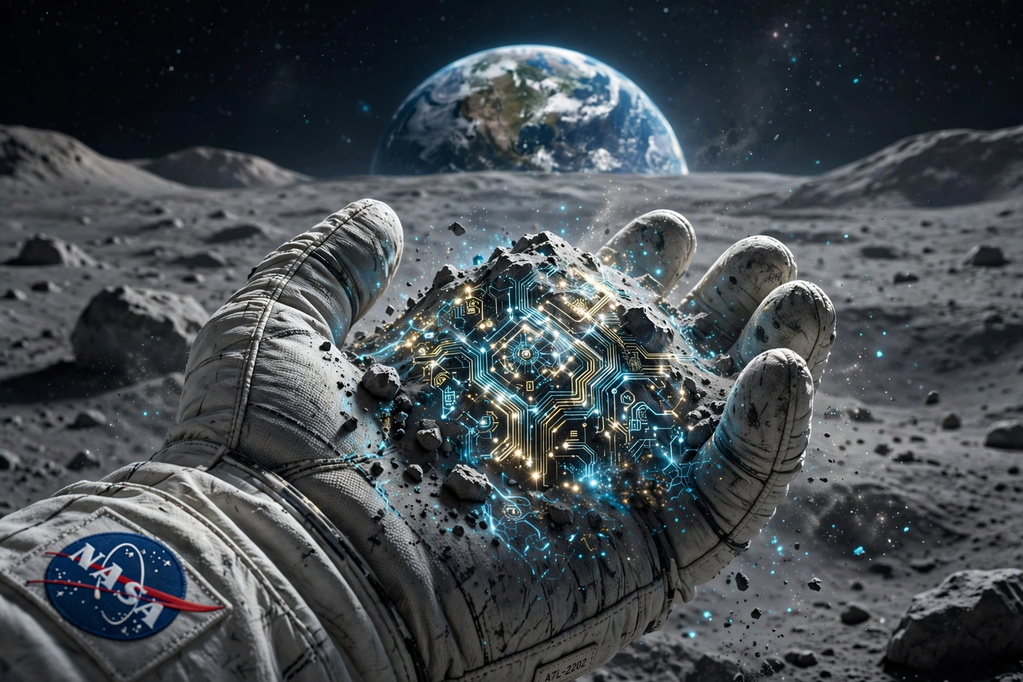
A new study led by researchers associated with the SETI Institute proposes searching the Moon’s regolith for tiny engineered particles possible technosignatures left behind by civilizations that may have existed long before humanity.
There is an important distinction, however.
Scientists have not found alien technology on the Moon.
The proposal is a new method for looking for it.
And the reason the Moon is interesting is stranger than the idea itself: our satellite may have been collecting material from space for billions of years while lacking many of the natural processes that erase evidence on Earth.
Table of Contents
The Strange Question: What If Alien Evidence Is Microscopic?
When people imagine evidence of extraterrestrial civilizations, they usually picture something enormous.
- A spacecraft.
- A signal.
- A megastructure.
- An artificial object orbiting a star.
But technology does not have to be large to be recognizable.
On Earth, even tiny pieces of manufactured material can reveal that intelligence was involved. A microscopic fragment with an unusual composition, structure, or manufacturing signature could potentially tell scientists something that natural geology cannot.
That is the basic idea behind technosignatures.
A technosignature is a potential detectable sign of technology produced by an extraterrestrial civilization.
The new lunar proposal takes this concept in an unusual direction:
Instead of asking whether an alien civilization is communicating with Earth today, what if we search for physical leftovers from civilizations that disappeared long ago?
That changes the entire search.
We would no longer be looking only across the sky.
We would also be looking down into the Moon.
Why Would the Moon Preserve Something This Old?
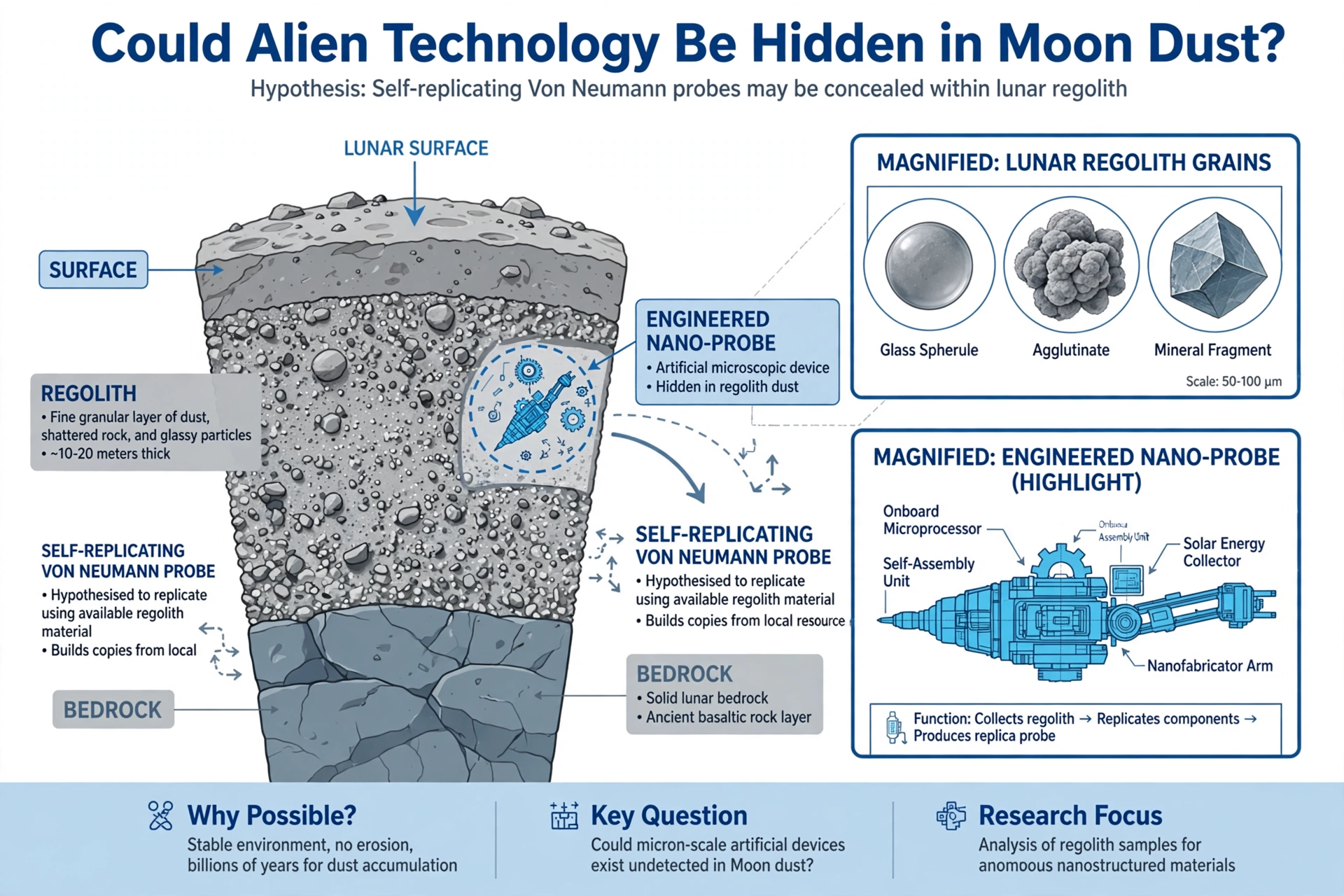
This is where the idea becomes scientifically interesting.
- Earth is constantly changing.
- Wind moves dust.
- Rain washes surfaces.
- Oceans recycle material.
- Plants grow.
- Rocks weather.
- Tectonic plates move enormous sections of the planet.
- Even the ground beneath our feet can eventually be buried, melted, transformed, or chemically altered.
- The Moon is different.
- It has no Earth-like atmosphere, no flowing rivers, no oceans and no active plate tectonics reshaping its surface.
- Its surface is covered by regolith—the loose layer of dust, soil and broken rock produced by billions of years of impacts and space weathering.
- That makes lunar soil more than just dirt.
In a sense, it is a layered record of the space environment.
Material arriving on the Moon can become incorporated into this regolith, potentially preserving traces that would be much harder to retain on an active world like Earth.
Researchers therefore describe the Moon as a possible long-term archive of material arriving from space.
Think of the difference like this:
Earth
Weather → erosion → water → geology → recycling
Moon
Impact → burial → accumulation → preservation
That doesn’t mean everything survives forever.
It means the Moon may give researchers an unusually stable environment in which to look for ancient material.
How Could Alien Technology Reach the Moon?
This is the part that sounds most like science fiction—but the proposed mechanism does not require an alien spacecraft to land on the Moon.
Imagine a technological civilization existing somewhere else in the Milky Way.
It develops advanced machines.
Over thousands or millions of years, technological activity could theoretically produce tiny durable particles or fragments.
If some of those particles escaped into interstellar space, they could potentially travel enormous distances.
Eventually, a very small fraction might enter our region of the galaxy.
Some could reach the Solar System.
And some could ultimately settle on the Moon.
The chain would look something like this:
Produces durable microscopic material
Tiny particles potentially travel between star systems
A tiny fraction could enter our cosmic neighborhood
Particles become incorporated into lunar regolith
Search for particles whose properties cannot be easily explained by natural processes
The important word throughout this scenario is could.
It is a hypothesis not an observation.
What Exactly Would Scientists Look For?
They would not simply scoop up Moon dust and search for something that “looks alien.”
That would not be enough.
The challenge is separating an unusual natural particle from something genuinely artificial.
Nature can produce extraordinarily strange structures.
Minerals can form complex shapes.
Meteorites can contain unusual chemistry.
Microscopic particles can have unexpected compositions.
So a convincing technosignature would need to survive several levels of investigation.
Researchers could potentially examine candidates using techniques such as:
- Advanced microscopy
- Chemical and materials analysis
- Spectroscopy
- Three-dimensional imaging
- Tomography
- AI-assisted image analysis
The goal would be to determine whether a particle’s characteristics can be explained naturally or whether it displays properties consistent with engineered material.
That distinction is crucial.
“We found something unusual” is not the same as “we found alien technology.”
Why Would AI Be Useful?
There is another fascinating part of the proposal.
Imagine examining enormous quantities of lunar material at microscopic scales.
A human scientist cannot inspect every possible particle individually with unlimited attention.
AI-assisted imaging could help identify unusual structures or particles worth investigating further.
The process could resemble a scientific filtering system:
Millions of particles
↓
Computer vision identifies unusual candidates
↓
Researchers examine promising particles
↓
Chemical and structural tests
↓
Natural explanation found?
↓
If not, investigate further
This would not allow AI to “detect aliens.”
Instead, AI could help researchers manage the enormous amount of visual and analytical information involved in examining lunar material.
The SETI proposal specifically incorporates modern microscopy, materials analysis and AI-assisted techniques into the suggested search framework.
The One-Cubic-Meter Question
One of the most intriguing numbers in the proposal is one cubic meter of lunar regolith.
That is roughly the volume of a large household refrigerator.
Researchers use this as an initial scientific benchmark for examining whether microscopic technosignatures could be detected and what limits could be placed on the amount of long-lived technological material that might have existed in the galaxy.
But this does not mean scientists expect to find an alien artifact inside exactly one cubic meter of soil.
It is better understood as a starting point for a quantitative search.
Even a negative result could be scientifically useful.
If researchers examine lunar material carefully and find no convincing technosignatures, they could begin placing limits on how much durable artificial material might have accumulated over cosmic history.
In other words:
Finding nothing would still tell scientists something.
That is one of the strongest scientific aspects of the idea.
Why Haven’t We Found Alien Technology Already?
This question is easy to overlook.
Humans have already brought Moon rocks and soil back to Earth.
So why haven’t scientists discovered microscopic alien machinery in those samples?
There are several obvious limitations.
The Apollo samples were collected for specific scientific purposes, not as a systematic search for microscopic extraterrestrial technology.
Researchers also cannot assume that an unusual particle is artificial simply because it is unusual.
And the amount of material examined so far represents only a tiny fraction of the Moon’s enormous surface and regolith.
The new proposal is therefore less about saying:
“Scientists missed alien technology.”
It is about saying:
“Perhaps we should deliberately search for a type of evidence we previously weren’t specifically looking for.”
That is a much more interesting scientific question.
The Moon May Be More Than a Destination
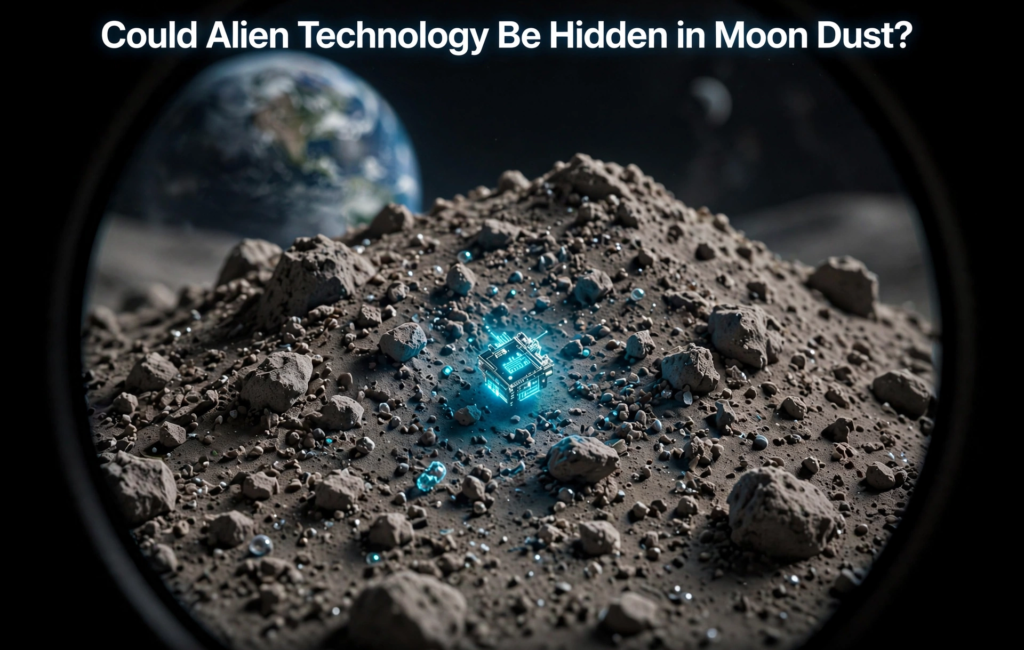
The proposal also changes how we think about lunar exploration.
For decades, the Moon has been treated primarily as:
- A nearby world to study
- A geological laboratory
- A stepping stone for deeper space exploration
- A place to investigate Earth’s early history
But the Moon could potentially serve another role:
An archive of material from the wider Solar System and perhaps the wider galaxy.
Every microscopic particle preserved in lunar soil potentially carries information about where it came from.
Most of these particles would be completely natural.
But if technological civilizations have ever existed elsewhere, researchers wonder whether some exceptionally durable traces could have survived long enough to become part of this cosmic archive.
The idea does not require an ancient alien base on the Moon.
It requires only that tiny physical traces can survive long enough to be found.
What Would Count as Convincing Evidence?
This is where a future discovery would become extremely difficult and extremely fascinating.
Suppose researchers found an unusual microscopic particle.
That alone would prove almost nothing.
Scientists would need to ask:
1. Could geology produce it?
If ordinary lunar processes explain the structure, the mystery ends there.
2. Could a meteorite have produced it?
The Moon receives material from asteroids and comets, so extraterrestrial does not automatically mean artificial.
3. Could it be contamination from Earth?
Human spacecraft have been visiting the Moon for decades. Any serious investigation would need to rule out contamination from missions, equipment and sample handling.
4. Does its chemistry make sense naturally?
An unusual chemical composition would require careful interpretation.
5. Does its physical structure indicate manufacturing?
This could potentially be more interesting than chemistry alone.
6. Can independent laboratories reproduce the result?
Extraordinary claims would require extraordinary levels of verification.
Only after surviving these questions would a candidate become truly compelling.
Natural “Alien-Looking” Objects Are a Major Problem
There is an important lesson here.
Strange does not mean artificial.
The universe is extremely good at producing structures that look almost designed.
Crystals can appear geometrically perfect.
Minerals can form intricate patterns.
Meteorites can contain unexpected compounds.
Lightning can create unusual materials.
Impact processes can produce complex microscopic structures.
Therefore, a future lunar discovery would need much more than an interesting photograph.
Scientists would need a chain of evidence showing that the material is:
unusual + difficult to explain naturally + demonstrably engineered + not contamination.
That is a very high bar.
And it should be.
Could This Actually Change the Search for Alien Life?
Possibly not because it proves extraterrestrial civilizations exist, but because it broadens the question.
Traditional SETI searches often focus on signals or other observable technological activity.
But civilizations can disappear.
A radio transmitter may eventually stop broadcasting.
A civilization may become extinct.
Its planet may change.
Its signals may weaken beyond detection.
A durable technological fragment could, in principle, outlast its creators.
That creates an intriguing distinction:
Searching for living civilizations is not necessarily the same as searching for civilizations that once existed.
The Moon could potentially help researchers investigate the second question.
The SETI Institute describes this proposed approach as a new class of microscopic technosignature search rather than evidence that extraterrestrial technology has already been detected.
The Biggest Problem: Space Is Enormous
There is a catch.
Even if alien technology exists somewhere in the Milky Way, the probability that a useful fragment happens to reach the Moon could be extremely small.
Space is vast.
Interstellar distances are enormous.
Particles traveling through space can collide with other material or be altered by radiation and impacts.
And the Moon itself is enormous compared with the tiny quantity of soil that humans can realistically examine.
So the proposed search is not:
“Dig into the Moon and find aliens.”
It is closer to:
“Use the Moon’s unusual preservation environment to place scientific limits on whether microscopic technological material could have accumulated there.”
That distinction makes the idea much more credible and much more interesting.
What Happens If Scientists Find Nothing?
This is perhaps the most overlooked possibility.
Imagine future missions carefully examine lunar regolith and find no technosignatures.
The experiment would not necessarily be a failure.
Scientists could learn:
- How much interstellar material reaches the Moon
- How efficiently microscopic particles survive
- How long artificial materials might remain detectable
- How natural lunar particles differ from engineered materials
- How effective AI-based microscopic searches can be
- How frequently technological debris might need to be produced to become detectable
A null result could therefore narrow the possibilities.
Science often advances not only through spectacular discoveries, but through better constraints on what is possible.
And What If They Actually Found Something?
That would be a completely different situation.
A convincing technosignature would require extraordinary verification.
Researchers would need to reproduce the observations, rule out contamination, test natural explanations and ideally have independent teams examine the material.
If those tests survived, the implications would extend far beyond astronomy.
It could raise questions about:
- How old was the technology?
- Where did it originate?
- How did its material reach our Solar System?
- Was the civilization still alive when the material was produced?
- How many technological civilizations could have existed before humanity?
And perhaps the most haunting question:
What happened to the civilization that made it?
The Moon would suddenly become more than an archaeological site for human history.
It could become an archaeological site for cosmic history.
What Scientists Have Actually Found So Far
This deserves a clear line between fact and speculation.
| Status | What It Means |
|---|---|
| ✅ Confirmed | Scientists have proposed a systematic method for searching lunar regolith for microscopic technosignatures. |
| ✅ Confirmed | The proposal uses models involving interstellar dust transport, lunar geology, and impact processes. |
| 🔬 Proposed | Microscopic engineered particles from an ancient technological civilization could theoretically become incorporated into lunar soil. |
| ❌ Not discovered | There is currently no confirmed evidence of alien technology on the Moon. |
| 📄 Current status | The research is a preprint and has been submitted for peer review in the International Journal of Astrobiology. |
That distinction matters because a fascinating hypothesis can be scientifically valuable without being a discovery.
Why the Moon Is Such a Fascinating Cosmic Time Capsule
The most beautiful part of this idea isn’t actually the aliens.
It is the possibility that the Moon has been quietly recording the history of its cosmic surroundings for billions of years.
While Earth changed dramatically, the Moon continued collecting dust.
While civilizations rose and disappeared on Earth, impacts continued marking its surface.
While stars were born and died elsewhere in the galaxy, tiny particles traveled through space.
And some of those particles may eventually have settled onto the lunar surface.
Most will simply be dust.
Some will be fragments of asteroids.
Some will come from comets.
Some will be material thrown into space by violent cosmic events.
And, purely as a scientific possibility, a microscopic fraction could someday reveal something no telescope has ever seen:
evidence that technology once existed somewhere beyond Earth.
The Moon Is Not Hiding Aliens Yet
It is tempting to turn this story into:
“Scientists found alien technology on the Moon.”
They haven’t.
The real story is subtler.
Scientists have proposed that lunar soil could be searched for microscopic remnants of technological civilizations, because the Moon provides an unusually stable environment for preserving material arriving from space.
That makes the idea testable.
And that is what makes it worth paying attention to.
The next major clue about extraterrestrial intelligence might not arrive as a mysterious message from a distant star.
It might not appear as a strange light in a telescope.
It might be much smaller.
Perhaps unimaginably small.
A particle hidden among billions of grains of lunar dust.
And if humanity ever finds one, the most important discovery may not be what the particle is.
It may be the realization that the universe has been leaving clues in places we never thought to search.
Conclusion
The search for extraterrestrial intelligence has traditionally looked outward.
Listen to the stars.
Watch distant planets.
Search the skies.
But the Moon offers another possibility:
Look at what the universe has already delivered to our doorstep.
For billions of years, lunar dust has been accumulating beneath an almost airless sky.
Perhaps it contains nothing unusual.
Perhaps it contains only the ordinary debris of a violent universe.
Or perhaps, buried among those grains, there is a microscopic clue to a story that began long before humanity existed.
For now, we do not know.
And that is exactly why the Moon dust idea is so fascinating.
The search for possible alien technology in Moon dust raises a much bigger question: how much of the universe still remains unexplained? Scientists are already studying strange phenomena across space, from the mysterious 10-sided shape around Saturn to the extraordinary possibility that Venus may have once had a moon.
And while science searches for evidence beyond Earth, humanity has also explored mysteries through history and faith, including the mystery of Iram and the Islamic account of Ya’juj and Ma’juj.
References
- SETI Institute — Researchers Propose Searching the Moon for Microscopic Technosignatures
This is the most directly relevant source. It covers the new proposal, lunar regolith, microscopic technosignatures, the one-cubic-meter concept, and possible detection methods.
Read the SETI Institute article - Original research paper — arXiv
Micron-Scale Technosignatures: How a Cubic Metre of Lunar Regolith May Begin to Constrain the Number of Past Technological Civilisations in the Galaxy. This is the underlying research paper by Lewis J. Pinault and co-authors.
Read the research paper on arXiv - NASA — Challenging Conditions at the Lunar South Pole
Useful for supporting your explanation of lunar regolith, including how lunar dust and broken rock are produced and how the Moon differs from Earth because its surface isn’t weathered by wind or water.
Read NASA’s lunar regolith information - SETI Institute — What Are Technosignatures?
Useful for explaining the broader scientific meaning of technosignature and how the search for extraterrestrial technology extends beyond traditional radio signals.
Read the SETI technosignature information - Earlier research — Searching for Alien Artifacts on the Moon
An older scientific proposal exploring the possibility of looking for physical traces of extraterrestrial technology on the Moon. It provides useful historical context for your article.
Read the earlier research paper
Frequently Asked Questions
Could there really be alien technology in Moon dust?
It is scientifically possible in principle, but there is currently no confirmed evidence of alien technology in lunar soil. The current research proposes a method for searching for microscopic technosignatures.
What is a technosignature?
A technosignature is a potential detectable sign of technology produced by an extraterrestrial civilization. It can include physical artifacts, unusual technological emissions or other evidence associated with technological activity.
Why is the Moon useful for searching for alien artifacts?
The Moon lacks an atmosphere, flowing water and Earth-like geological activity. Its regolith can therefore preserve material for extraordinarily long periods, making it a potential archive of material arriving from space.
Have scientists found alien artifacts on the Moon?
No confirmed alien artifact or technosignature has been found. The current proposal is a strategy for conducting a more targeted search.
How would scientists identify possible alien technology?
Researchers could combine microscopy, spectroscopy, materials analysis, three-dimensional imaging and AI-assisted techniques to identify unusual particles and determine whether natural explanations are sufficient.
Could an alien civilization have existed millions or billions of years ago?
Scientists do not currently know whether extraterrestrial technological civilizations have ever existed. The proposed lunar search is partly interesting because physical remnants could potentially outlast the civilization that produced them.