

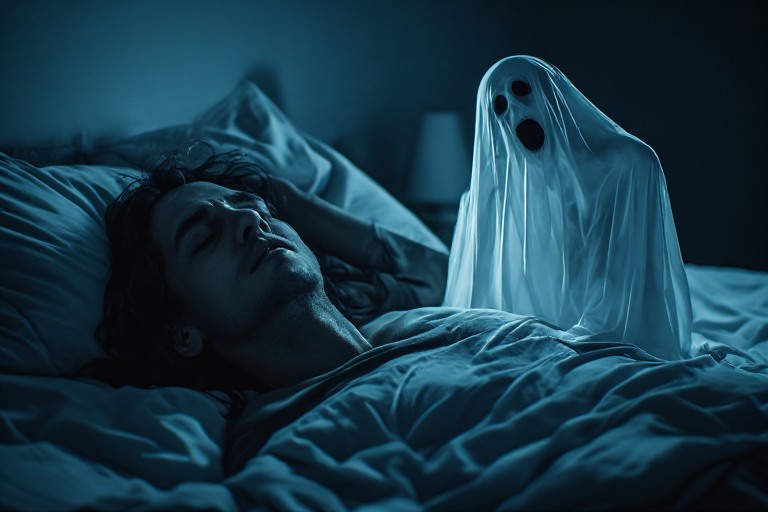
Have you ever opened your eyes, realized you were awake, but couldn’t move your body? Maybe you felt a strange presence in the room, heard unusual sounds, or even thought someone was standing beside your bed. This frightening experience is called sleep paralysis.
Although it can feel supernatural, science has shown that sleep paralysis is a natural sleep phenomenon that happens when your brain wakes up before your muscles do.
Table of Contents
What does sleep paralysis mean?
Sleep paralysis is a short-term situation in which your mind wakes up but your body stays totally still. It lasts between a few seconds and two minutes most of the time.
During this time, you may:
- Know everything that’s going on around you.
- Not be able to speak or move.
- Even though it may feel hard, keep breathing normally.
- Dream or have images that are very real.
The American Academy of Sleep Medicine (AASM) and the International Classification of Sleep Disorders (ICSD-3) both say that sleep paralysis is a type of REM-related parasomnia, which means it is linked to REM sleep.
How does sleep paralysis occur?
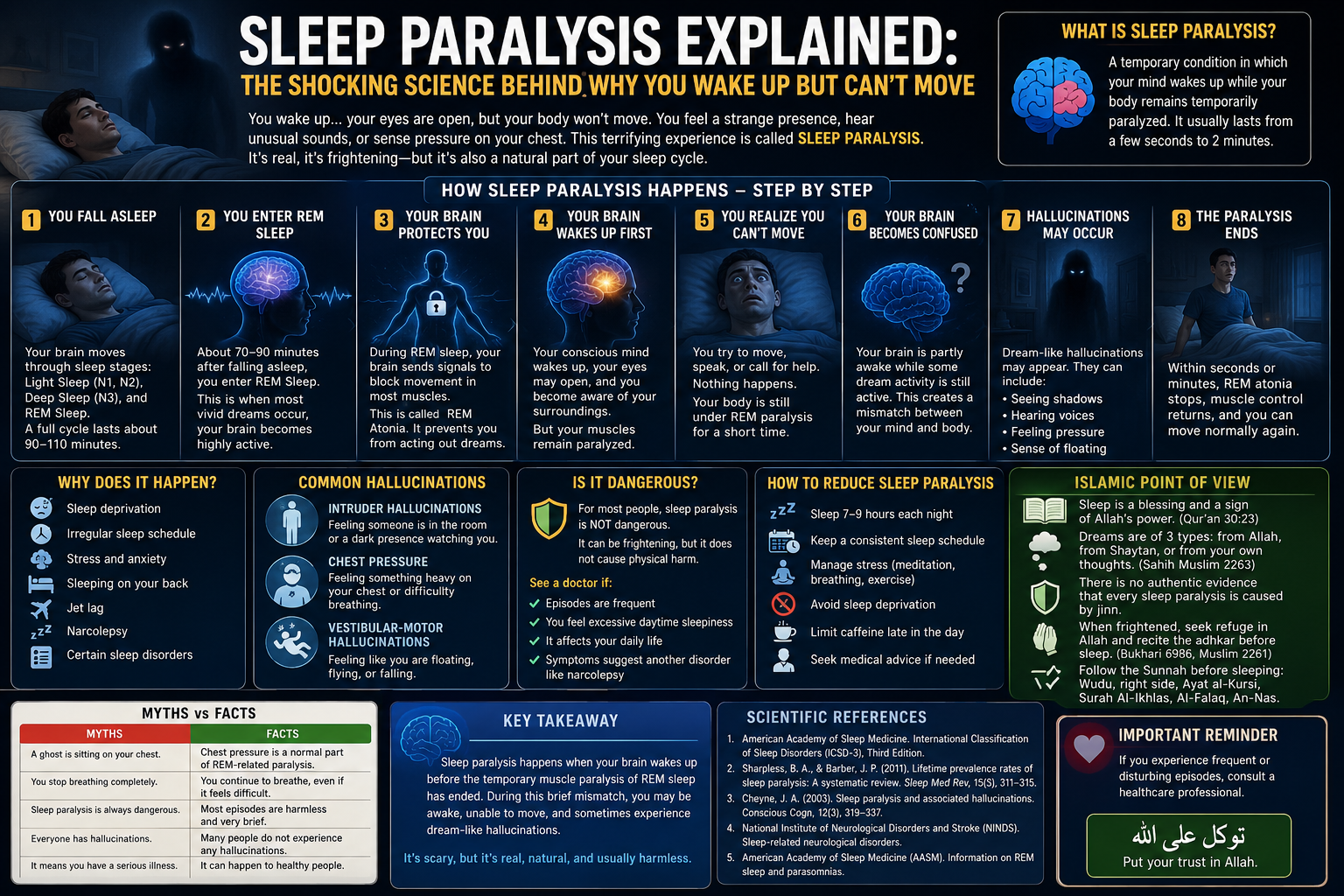
Step 1: You Fall Asleep
Every night, your brain guides you through different stages of sleep.
These stages include:
- Light Sleep (N1)
- Light Sleep (N2)
- Deep Sleep (N3)
- REM Sleep (Rapid Eye Movement)
A complete sleep cycle lasts about 90–110 minutes, repeating 4–6 times each night.
Step 2: You Enter REM Sleep
About 70–90 minutes after falling asleep, you enter REM (Rapid Eye Movement) sleep.
This is when:
- Most vivid dreams occur.
- Your brain becomes highly active.
- Your eyes move rapidly beneath closed eyelids.
- Your body becomes almost completely motionless.
This temporary paralysis is called REM atonia.
Step 3: Your Brain Protects You
During REM sleep, the brain sends signals through the brainstem to block movement in most skeletal muscles.
This prevents you from physically acting out your dreams.
Without REM atonia, people could unknowingly
- Kick
- Punch
- Walk
- Jump from bed
This safety mechanism protects both you and anyone sleeping nearby.
Step 4: Your Brain Wakes Up First
Normally, your brain and body wake up together.
In sleep paralysis, however:
- Your conscious mind wakes up.
- Your eyes may open.
- You become aware of your bedroom.
But your muscles remain under REM paralysis for a short time.
This creates a mismatch between your awake brain and sleeping body.
Step 5: You Realize You Can’t Move
Now you try to:
- Move your arms.
- Sit up.
- Turn your head.
- Call for help.
Nothing happens.
Your muscles are still temporarily “switched off” by REM atonia. Although this feels alarming, it is usually harmless and resolves on its own.
Step 6: Your Brain Becomes Confused
At this stage, your brain is partly awake while some dream-related activity is still occurring. Because REM dreaming has not completely ended, your brain may combine dream imagery with the real environment.
This can produce vivid hallucinations.
Step 7: Hallucinations May Occur

Not everyone experiences hallucinations, but when they do occur, they commonly fall into three categories.
1. Intruder Hallucinations
You may feel:
- Someone is standing nearby.
- A shadowy figure is watching you.
- Someone is entering the room.
2. Chest Pressure
Many people feel:
- Something heavy pressing on the chest.
- Difficulty taking a deep breath.
This happens because the breathing muscles used during REM are functioning differently, while awareness has returned. People continue to breathe, but the sensation can feel uncomfortable.
3. Vestibular-Motor Hallucinations
Some people experience sensations of:
- Floating.
- Flying.
- Falling.
- Leaving the body.
These experiences feel real but are generated by the brain during the transition out of REM sleep.
Step 8: The Paralysis Ends
Within seconds or a few minutes:
- REM atonia stops.
- Muscle control returns.
- You can move normally again.
Many people immediately sit up, speak, or move once the episode ends.
Does Islam Say Sleep Paralysis Is Caused by Jinn?

The balanced Islamic answer is no. No authentic evidence proves this.
Many cultures believe sleep paralysis is caused by jinn, but there is no authentic Qur’anic verse or Sahih Hadith stating that every case of sleep paralysis is caused by jinn or demons.
Al-Kabus (also spelled Al-Kaboos or known as Al-Jathoom in Arabic) refers to a specific type of Jinn in traditional Islamic folklore believed to be responsible for what modern science calls sleep paralysis.
The word kabus literally translates to “nightmare” in Arabic. In traditional lore, Al-Kabus is described as a heavy, unseen entity or shadow-like Jinn that descends upon a person’s chest while they are sleeping or just waking up.
Commonly reported “attacks” involve:
- Physical Paralysis: The sensation that your limbs are completely frozen and you cannot move or speak.
- Chest Pressure: A feeling of a heavy weight crushing your torso, making it feel very difficult to breathe.
- Panic: Waking up abruptly, gasping for air as soon as the pressure lifts.
Islam teaches that
- Jinn exist.
- Shaytan can whisper and try to frighten people.
- Bad dreams can come from Satan.
However, it is incorrect to conclude that every episode of sleep paralysis is a jinn attack. Some episodes may simply be explained by the normal functioning of the sleep cycle, as described by medical science.
Muslims should avoid making claims about the unseen (ghayb) without evidence from the Qur’an or authentic Sunnah.
What Causes Sleep Paralysis?
Researchers have found various sleep paralysis risk factors.
This includes:
- Lack of sleep
- Poor sleep schedules
- Stress, anxiety
- Some individuals sleep on their backs
- The jet lag
- Narcolepsy
- Certain sleep problems
A single occurrence does not indicate a medical issue.
Sleep paralysis: dangerous?
Sleep paralysis seldom harms anyone. Though alarming, it rarely causes bodily injury.
However, seek medical advice if:
- Episodes are frequent.
- Your daytime sleepiness is excessive.
- Episodes disrupt life.
- Symptoms suggest narcolepsy.
- To Reduce Sleep Paralysis
How to Reduce Sleep Paralysis
- Nightly 7–9 hours sleep.
- Keep a sleep schedule.
- Stress management through relaxation.
- Preventing sleep loss.
- Limiting caffeine late in the day if it impacts sleep.
- Consult a doctor about persistent symptoms.
Common Myths vs Facts
| Myth | Facts |
|---|---|
| There’s a ghost on your chest. | People who have REM-related sleep paralysis often feel pressure in their chest. |
| You stop breathing all together. | You can still breathe normally, even if it feels hard. |
| It’s always dangerous to be paralysed by sleep. | Most episodes are short and safe. |
| Hallucinations happen to everyone. | A lot of people don’t have hallucinations. |
| If you become paralysed during sleep, you have a dangerous illness. | It can happen to healthy people, but if it happens a lot, you might want to see a doctor. |
Sleep paralysis is a fascinating example of how scientific explanations can sometimes help us understand experiences that once appeared mysterious. If you enjoy exploring unexplained phenomena, you may also be interested in the Dyatlov Pass Incident and the greatest mysteries of the universe.
Scientific References
- American Academy of Sleep Medicine. International Classification of Sleep Disorders (ICSD-3), Third Edition.
- Sharpless, B. A., & Barber, J. P. (2011). Lifetime prevalence rates of sleep paralysis: A systematic review. Sleep Medicine Reviews, 15(5), 311–315.
- Cheyne, J. A. (2003). Sleep paralysis and associated hallucinations. Consciousness and Cognition, 12(3), 319–337.
- National Institute of Neurological Disorders and Stroke (NINDS). Sleep-related neurological disorders.
- American Academy of Sleep Medicine (AASM). Information on REM sleep and parasomnias.