


The journey from wake to sleep includes many secrets. By studying this topic, we are ultimately amazed by seeing the abilities of Allah, and our faith becomes stronger.
Researchers have studied sleep for decades using brain-wave recordings (EEG), MRI scans, and laboratory tests. Sleep is not simply “switching off.” It involves the brain, neurological system, hormones, immune system, metabolism, and practically every organ in the body.
Table of Contents
Wake to Sleep Journey
1. The Brain Begins Measuring Time
A. The Circadian Clock
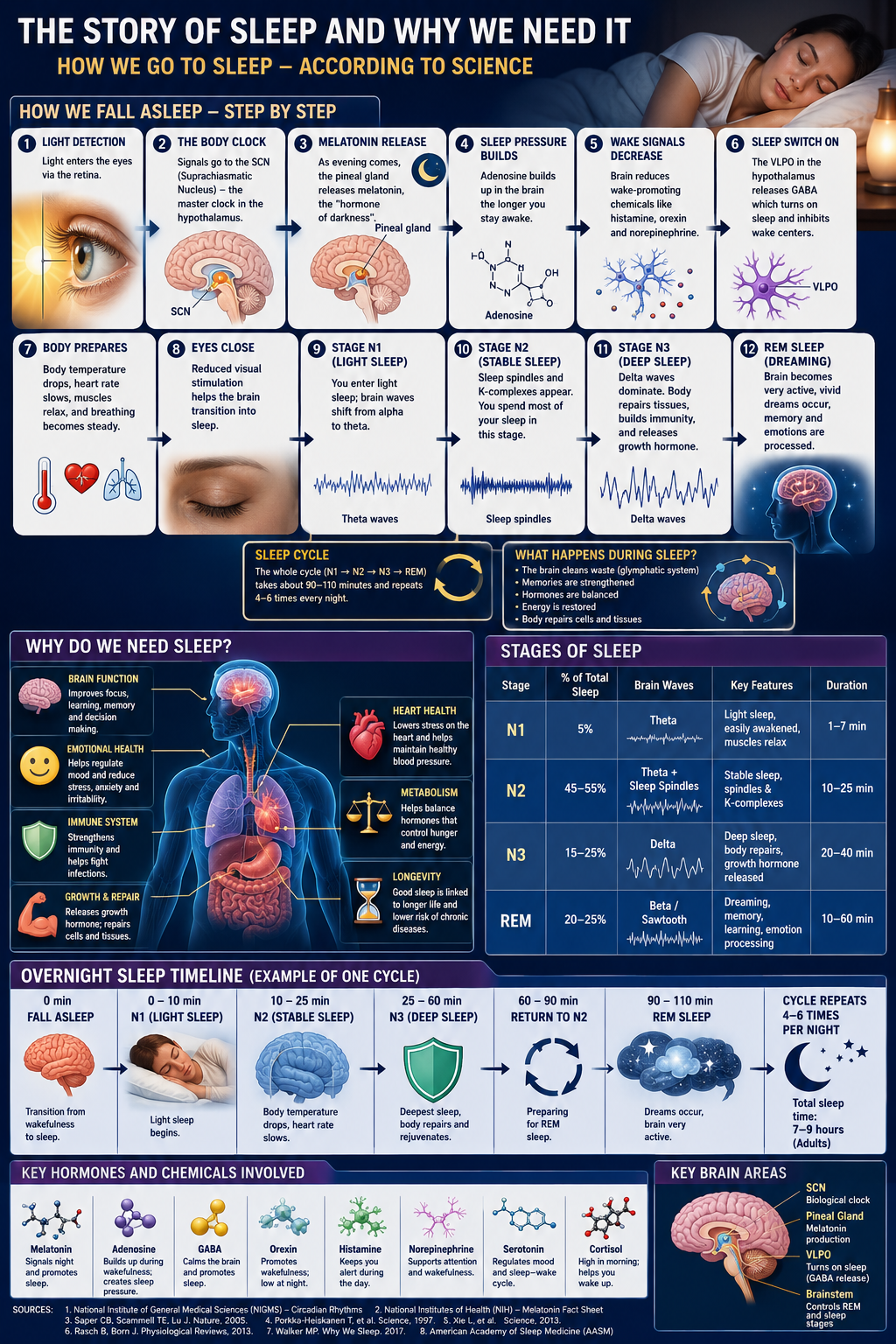
The suprachiasmatic nucleus (SCN) is a small brain structure. It is located in the hypothalamus. This is the body’s master clock. The light enters from the eyes. It signals the SCN to synchronize the body’s 24-hour cycle.
During Daylight
- The SCN keeps the body awake.
- Increased alertness.
- Suppressing melatonin.
During Evening
- Less light enters the retina.
- The SCN announces night.
- The brain prepares for sleep.
B. Sleep Pressure Builds
Every hour you stay awake, a molecule called adenosine accumulates in your brain. Adenosine is produced as brain cells use energy (ATP).
The longer you’re awake:
- Adenosine levels rise.
- You feel increasingly sleepy.
During sleep:
- Adenosine is gradually cleared.
- You wake feeling refreshed.
This is why caffeine helps temporarily—it blocks adenosine receptors rather than removing adenosine.
2. Darkness Triggers Melatonin
As evening falls, the pineal gland begins releasing melatonin, often called the “hormone of darkness.”
Melatonin:
- Signals that it is nighttime.
- Helps coordinate the timing of sleep.
- Does not directly “knock you out.”
Blue light from phones, tablets, and LED screens can delay melatonin release, making it harder to fall asleep.
3. The Brain Reduces Alertness
As sleep approaches:
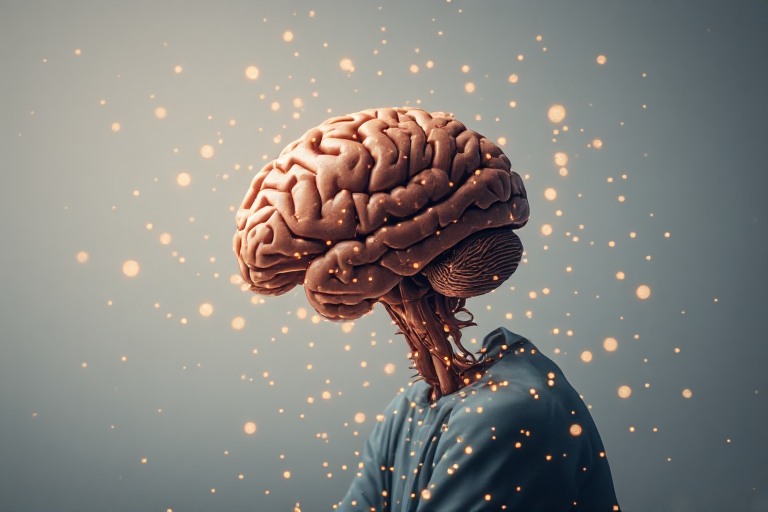
The brain decreases production of:
- Histamine.
- Orexin (hypocretin).
- Norepinephrine.
- Serotonin (wake-promoting activity changes).
At the same time, GABA (gamma-aminobutyric acid) becomes more active, inhibiting wake-promoting neurons.
The ventrolateral preoptic nucleus (VLPO) in the brain helps people become less awake.
This “flip-flop switch” allows a rapid transition from wakefulness to sleep.
4. Your Body Starts Cooling Down
Before sleep:
- Core body temperature drops slightly.
- Blood vessels in the hands and feet widen, helping release heat.
- Heart rate slows.
- Blood pressure decreases.
- Breathing becomes more regular.
These changes create conditions that favor sleep.
5. The Eyes Close
Closing your eyes reduces incoming visual stimulation. This decreases activity in visual processing areas and supports the transition into sleep.
6. Brain Waves Change
Scientists use electroencephalography (EEG) to measure electrical activity in the brain.
While Awake
- Beta waves: alert, focused.
- Alpha waves: relaxed with eyes closed.
7. Stage N1 (Light Sleep)
- Alpha waves decrease.
- Theta waves appear.
- You may experience sudden muscle jerks (hypnic jerks).
This stage usually lasts only a few minutes.
8. Stage N2: Stable Sleep
This is the stage in which adults spend the greatest portion of the night.
Brain activity shows:
- Sleep spindles.
- K-complexes.
These features help:
- Reduce responses to outside sounds.
- Support memory processing.
- Stabilize sleep.
9. Stage N3: Deep (Slow-Wave) Sleep
This is the deepest non-REM sleep.
Delta waves dominate.
During this stage:
- Growth hormone is released.
- Tissue repair increases.
- Immune function is strengthened.
- Energy stores are replenished.
People are difficult to awaken during deep sleep.
10. REM Sleep (Rapid Eye Movement)
About 90 minutes after falling asleep, most people enter REM sleep.
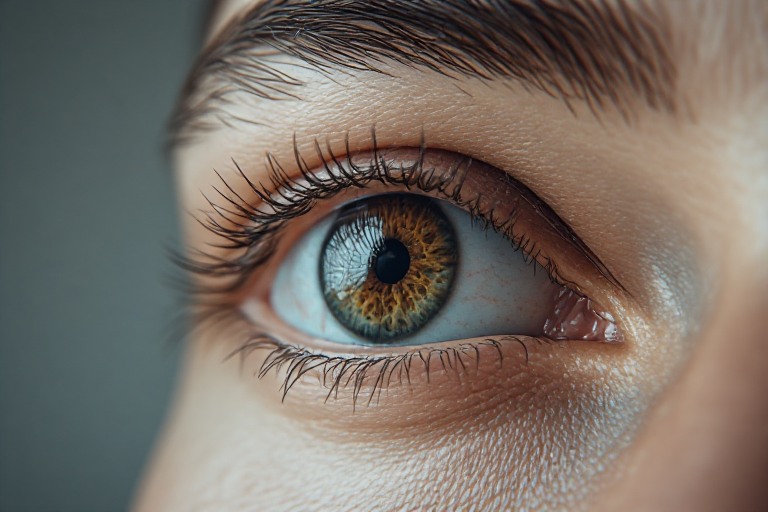
Characteristics:
- Rapid eye movements.
- Highly active brain.
- Most vivid dreaming.
- Temporary paralysis of most skeletal muscles (to prevent acting out dreams).
REM sleep supports:
- Emotional regulation.
- Learning.
- Memory consolidation.
- Creativity.
11. The Brain Cleans Itself
The glymphatic system is one of the most amazing new findings in neuroscience.
During sleep:
- Cerebrospinal fluid flows more effectively through the brain.
- Waste products are removed, including proteins such as beta-amyloid.
- Brain cells temporarily shrink, allowing fluid to circulate more easily.
This process may contribute to long-term brain health.
12. Memory Is Strengthened
During sleep, the brain reorganizes information from the day.
Different sleep stages contribute to:
- Learning facts.
- Motor skill improvement.
- Emotional memory.
- Problem-solving.
Sleep does not simply “store” memories—it helps strengthen important ones while reducing less useful information.
13. You Cycle Through Sleep
Sleep is not one long, unchanging state.
A typical adult cycles through:
- N1
- N2
- N3
- REM
Each cycle lasts about 90–110 minutes, and most adults experience 4–6 cycles per night.
Why Do We Need Sleep?
Research shows that adequate sleep is important for:
- Brain function and attention.
- Learning and memory.
- Emotional regulation.
- Immune system performance.
- Hormone balance.
- Metabolism.
- Cardiovascular health.
- Tissue growth and repair.
Chronic sleep deprivation increases the risk of obesity, type 2 diabetes, cardiovascular disease, depression, and cognitive decline, however numerous factors affect these connections.
How to Go to Sleep in Islam?
According to Islamic tradition, you must follow a strict hygiene routine every night before bed to close the door between your subconscious mind and the parallel world of the Jinn.
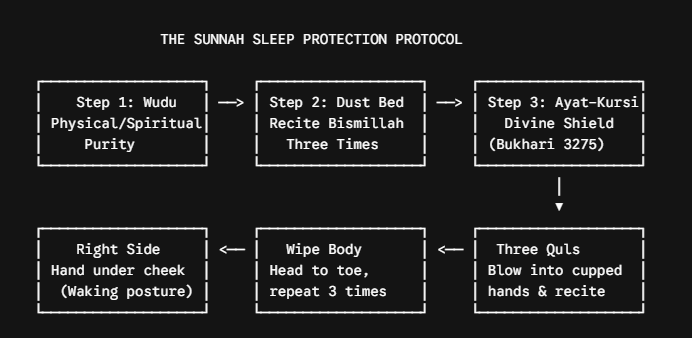
- When you do wudu, which means “bath,” you should always be physically and spiritually clean before going to sleep.
- Clean Your Bed: While you say three times “Bismillah” (In the name of Allah), clean your bed and sheets. As the Prophet ⷺ taught, “None of you know what sat on his bed after he got up.” (Sahih al-Bukhari 6320).
- Say Ayat al-Kursi, also known as “The Throne Verse” (Surah Al-Baqarah 2:255). This is the Qur’an’s greatest defense. If you say this verse before going to sleep, an authentic Hadith says that “…there will remain over you a guardian from Allah, and no devil (Shaytan) will approach you until morning.” (Sahih al-Bukhari 3275).
- Say the “Three Quls“: cup your hands together, say Surah Al-Ikhlas, Surah Al-Falaq, and Surah An-Nas, blow into your hands, and then wipe your whole body with them. Do this three times over.
- If you want to be alert, lie on your right side with your right hand under your right cheek. This keeps your sleep light and healthy and keeps your brain from getting too heavy, which makes you more likely to be hit by the chest-crushing Kaboos.
Sleep, consciousness, and human existence remain fascinating subjects that connect science, psychology, and spirituality. To explore another perspective on the human journey, read about the journey of the soul after death and the chronological order of life in Islam.
References
- National Heart, Lung, and Blood Institute. Sleep Deprivation and Deficiency.
- National Institute of General Medical Sciences. Circadian Rhythms. https://www.nigms.nih.gov/education/fact-sheets/Pages/circadian-rhythms.aspx
- Foster RG, Kreitzman L. Rhythms of Life.
- Porkka-Heiskanen T. et al. “Adenosine: A Mediator of the Sleep-Inducing Effects of Prolonged Wakefulness.” Science (1997).
- National Institutes of Health (NIH). Melatonin Fact Sheet.
- Cajochen C. et al. “Evening exposure to blue light…” Journal of Applied Physiology (2005).
- Saper CB, Scammell TE, Lu J. “Hypothalamic regulation of sleep and circadian rhythms.” Nature (2005).
- Krauchi K. “The Human Sleep-Wake Cycle…” Sleep Medicine Reviews (2007).
- Xie L. et al. “Sleep Drives Metabolite Clearance from the Adult Brain.” Science (2013).
- Walker MP. Why We Sleep (2017).
- Rasch B, Born J. “About Sleep’s Role in Memory.” Physiological Reviews (2013).