
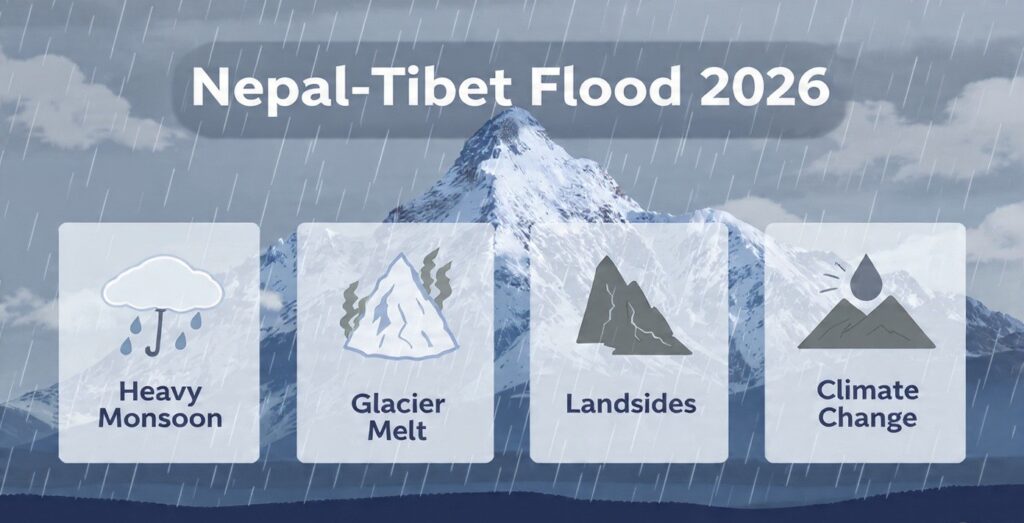
The Nepal–Tibet flash flood 2026 was a devastating Himalayan disaster linked to a suspected glacier-related ice-and-rock collapse near the Nepal–China border.
On August 26, 2026, a devastating flash flood struck Nepal’s Rasuwa District near the Nepal–China border, after a major glacier-related ice-and-rock collapse in the high Himalayas triggered a powerful debris flow into the Lhende Khola and Bhote Koshi river system.
Satellite evidence indicates that part of a glacier broke away at roughly 5,200 metres and fell about 1,200 metres, gathering rock, snow and sediment before reaching the river; the resulting debris temporarily obstructed the channel and was followed by a destructive surge downstream through the Bhote Koshi and Trishuli river systems.
The flood devastated settlements and infrastructure around Rasuwa, affected the Tibet-side Gyirong area, and sent dangerous water and sediment farther downstream. A magnitude 5.2 seismic signal was initially associated with an earthquake, but the U.S. Geological Survey later identified the signal as being generated by the glacial collapse itself.
As rescue operations continue, casualty and missing-person figures remain subject to change, while scientists are still examining the precise sequence of the collapse, river blockage, and flood release.
Nepal–Tibet Flash Flood 2026
A sudden Himalayan flood struck Nepal’s Rasuwa district after an upstream ice-and-rock event on the Tibet side of the border. Satellite observations and scientific assessments are helping investigators reconstruct how the disaster unfolded.
📌 Nepal–Tibet Flood 2026: At a Glance
📍 Where Did the Flood Travel?
High-Altitude Failure
A large section of ice and associated mountain material appears to have failed in the high-altitude region upstream of Rasuwa.
Rapid Descent
The collapsing material travelled down steep terrain, carrying ice, rock, snow and sediment toward the Lhende river environment.
Temporary River Blockage
Preliminary assessments indicate that debris may have obstructed the river, allowing water to accumulate upstream.
Sudden Breakthrough
The temporary blockage appears to have failed, releasing stored water together with sediment and debris.
Bhote Koshi Surge
The resulting surge entered the Bhote Koshi system and rapidly moved through the narrow river corridor in Rasuwa.
Trishuli Expansion
The flood continued downstream through the Trishuli system, carrying large quantities of water and sediment beyond the original impact zone.
⏱️ How the Disaster Unfolded
⚠️ What Was Damaged?
🔬 Why Did the Flood Become So Destructive?
🔎 The Disaster in One Line
Conclusion
The Nepal–Tibet flash flood 2026 was a devastating Himalayan disaster that began with a suspected glacier-related ice-and-rock collapse near the Nepal–China border and developed into a powerful flood and debris surge through the Lhende Khola, Bhote Koshi and Trishuli river systems.
The destruction in Rasuwa District highlights how quickly high-altitude geological events can become dangerous downstream emergencies. Although the evidence strongly points toward a glacier collapse or ice-rock avalanche, scientists are still examining the exact sequence of events and the role of temporary river blockage.
As rescue and assessment operations continue, casualty and damage figures may change. The disaster also underscores the growing importance of Himalayan glacier monitoring, early-warning systems and disaster preparedness.
For readers following major emergencies around the world, the PIMS Hospital fire in Pakistan is another example of how rapidly a crisis can develop and why reliable information and emergency preparedness matter.
Natural disasters demonstrate the immense power of Earth’s environment and the importance of understanding the natural world. You may also be interested in exploring how water became the source of life and other scientific mysteries that help us better understand the world around us.
Sources & references
1. ICIMOD — Primary scientific/regional source
ICIMOD — Major flash flood sweeps through Nepal’s Rasuwa district.
2. Reuters — Cause and glacier collapse
Reuters — Glacier collapse may have triggered deadly Nepal flash flood
3. Reuters — Disaster mechanism
Reuters — What triggered the catastrophic flood on the Nepal-Tibet border?
4. Reuters — Latest rescue situation
Reuters — Rescuers search for survivors after devastating Nepal flood
5. Associated Press — Glacier and climate context
AP News — Nepal floods highlight growing glacier risks in warming Himalayas
6. AP News — Latest impact
AP News — People from more than 30 countries are missing after flash floods in Nepal and China
7. ICIMOD — Official organization background
International Centre for Integrated Mountain Development (ICIMOD)
FAQs
What caused the Nepal–Tibet flash flood in 2026?
Preliminary scientific assessments point to a major glacier-related ice-and-rock collapse that sent debris into the river system, producing a destructive flood surge.
When did the Nepal–Tibet flash flood happen?
The disaster occurred on August 26, 2026, in the Himalayan border region between Nepal and Tibet.
Was the Nepal flood caused by an earthquake?
No. Although an initial seismic signal created uncertainty, the magnitude 5.2 signal was associated with the glacial collapse and debris movement, rather than an ordinary earthquake triggering the flood.
What happened to the glacier near the Nepal–Tibet border?
Satellite observations indicated that a section of the glacier collapsed from high elevation, falling roughly 1,200 metres toward the valley and carrying ice, rock and sediment with it.
How did the glacier collapse turn into a flash flood?
The collapsing ice and rock entered the river environment, generating a large debris-and-water surge. Preliminary assessments also indicate that temporary obstruction of the river may have contributed to the sudden release of water downstream.
How far did the Nepal flood travel downstream?
The flood moved beyond the immediate border zone through the Bhote Koshi and Trishuli river systems, affecting communities and infrastructure farther downstream.
Could similar glacier-related floods happen in the Himalayas?
Scientists warn that glacier retreat, unstable mountain slopes and changing cryosphere conditions create significant flood and landslide risks across the Hindu Kush Himalaya.
What is an ice-rock avalanche?
It is a rapid movement of ice, rock and other mountain material down a steep slope. When such material reaches a river, it can generate a powerful debris flow or flood surge.