
How Water Became the Source of Life: Science and the Quran
Water looks simple: two hydrogen atoms and one oxygen atom. Yet this ordinary-looking molecule is fundamental to life as we know it. Every day, water moves through clouds, rivers, soil, plants, animals, and human bodies, connecting different parts of Earth’s life-support system.
Interestingly, the Quran repeatedly draws attention to water—not simply as something people drink, but as a means through which Allah gives life to living creatures, vegetation, and apparently lifeless land.
The statement invites reflection on a question that modern biology also considers fundamental: Why is water so important to life?
Science provides many answers. Water enables chemical reactions inside cells, transports substances, helps regulate temperature, and provides the environment in which biological processes occur. NASA describes water as one of the essential requirements for life as we know it on Earth.
But does this mean the Quran is a scientific textbook? No. The Quran’s purpose is guidance, and its references to nature are signs for people to contemplate. The fascinating point is that the Quran repeatedly connects water with life, growth, nourishment, and the revival of barren land.
Table of Contents
Water and Life in the Quran
The Quran mentions water in many different contexts. Several passages connect it directly with living creatures and the growth of plants.
1. “We Made From Water Every Living Thing”
Allah says:
“Do the disbelievers not realize that the heavens and earth were ˹once˺ one mass then We split them apart? And We created from water every living thing. Will they not then believe?” — Quran 21:30
The verse appears within a passage encouraging people to reflect on the signs of Allah in creation.
The wording is broad: living things are connected with water. Modern biology does not say that every molecule in every organism is simply “made from water,” so the verse should not be reduced to that simplistic claim.
Rather, the verse can be understood as drawing attention to water’s fundamental relationship with living creation.
Modern science strongly confirms that water is indispensable to all known terrestrial life. NASA explains that life requires water and that water supports cellular functions and the chemical reactions necessary for organisms to obtain energy, grow, and eliminate waste.
2. The Quran Also Says Living Creatures Were Created From Water
Another striking passage appears in Surah An-Nur:
And Allah has created from water every living creature. Some of them crawl on their bellies, some walk on two legs, and some walk on four. Allah creates whatever He wills. Surely Allah is Most Capable of everything. — Quran 24:45
The verse then describes different forms of movement: creatures that crawl, creatures that walk on two legs, and creatures that walk on four.
This is significant because the Quran does not mention water only as something humans drink. It places water within a broader description of living creatures.
How Water Moves Through Earth’s Water Cycle
Water is constantly moving between the oceans, atmosphere, land, soil, underground rocks, and living organisms. This continuous movement is known as the water cycle.
Evaporation
The Sun provides energy that warms water at Earth’s surface. Oceans, seas, lakes, rivers, wetlands, and other exposed water surfaces can lose water to the atmosphere when liquid water molecules gain enough energy to escape as water vapor.
This invisible water vapor rises into the atmosphere. Oceans are especially important because they cover a large part of Earth’s surface and contain most of Earth’s water.
Transpiration
Water does not enter the atmosphere only through evaporation. Plants also move water from the soil into their roots and through their tissues.
Much of this water eventually leaves the plant through tiny openings called stomata in the leaves. The release of water vapor from plants is called transpiration.
Atmospheric Transport
Once water becomes vapor, it can be transported through the atmosphere by winds and other atmospheric movements.
This means water that evaporates from an ocean does not necessarily remain above that ocean. Atmospheric circulation can move moisture across large distances before it eventually returns to Earth’s surface.
Condensation
As moist air rises or moves into different atmospheric conditions, it can cool. When air becomes sufficiently saturated, water vapor can condense into tiny liquid water droplets or, under suitable conditions, form ice crystals.
These tiny particles can remain suspended in the atmosphere and contribute to the formation of clouds.
Cloud Development & Precipitation
Clouds contain microscopic water droplets, ice crystals, or both. These particles can collide, combine, freeze, melt, and grow under changing atmospheric conditions.
When water or ice particles become large enough that gravity overcomes the forces keeping them suspended, they can fall toward Earth’s surface as precipitation.
Depending on temperature and atmospheric conditions, precipitation may occur as rain, snow, sleet, or hail.
Surface Water & Collection
When precipitation reaches Earth’s surface, some water collects in rivers, lakes, ponds, wetlands, reservoirs, glaciers, and other surface-water systems.
Eventually, much of this surface water can flow toward larger rivers, seas, and oceans.
However, not all precipitation follows the same path. Some enters the soil, some becomes runoff, some is temporarily stored as snow or ice, and some is used by plants and living organisms.
Surface Runoff
When rainfall or melting snow reaches the ground faster than the soil can absorb it, some water flows across the land surface.
Gravity generally moves this water from higher areas toward lower areas. Small streams can join larger streams, which can eventually feed rivers, lakes, coastal waters, and oceans.
The amount of runoff depends on factors such as rainfall intensity, soil type, vegetation, slope, and the amount of paved or compacted land.
Infiltration
Some water does not flow across the surface. Instead, it enters the soil through pores and spaces between soil particles.
This process is called infiltration. The rate of infiltration depends on the characteristics of the soil, vegetation, ground conditions, rainfall, and other environmental factors.
Once inside the ground, water can remain in the soil, be absorbed by plants, or continue moving downward.
Groundwater
Water that moves below the soil can enter underground spaces in sediments and rocks and become groundwater.
Groundwater does not necessarily move quickly. In many places it travels slowly through underground materials. Some groundwater may remain underground for long periods before reaching another part of the water cycle.
Groundwater Flow & Discharge
Groundwater can slowly move through underground formations. Eventually, it may emerge naturally through springs or contribute water to streams, rivers, wetlands, lakes, or coastal environments.
In many regions, humans also obtain groundwater through wells for drinking water, agriculture, and other uses.
Snow, Ice & Glaciers
In cold regions, precipitation can accumulate as snow and ice. Large amounts of Earth’s freshwater are stored in glaciers and permanent ice sheets.
When temperatures rise, some snow and ice melt. Meltwater can enter streams, rivers, lakes, soil, and groundwater, eventually continuing through other parts of the cycle.
Water and Living Organisms
Water is fundamental to known life on Earth. Plants require water for photosynthesis and other biological processes, while animals and humans require water for many physiological functions.
Water can temporarily become part of living organisms. Plants may later release water through transpiration, while animals return water to the environment through normal biological processes.
Return to Oceans and Water Bodies
Rivers, runoff, groundwater discharge, melting ice, and other pathways can eventually return water to oceans and other major water bodies.
The oceans act as Earth’s largest water reservoir. From their surfaces, water can once again evaporate into the atmosphere.
“And We sent down from the sky rain charged with blessing, and We produced with it gardens and grain for harvests.”
Quran 50:9“And We made from water every living thing.”
Quran 21:30“And We sent down water from the sky in due measure, then We caused it to settle in the earth.”
Quran 23:18How Water Became the Source of Life
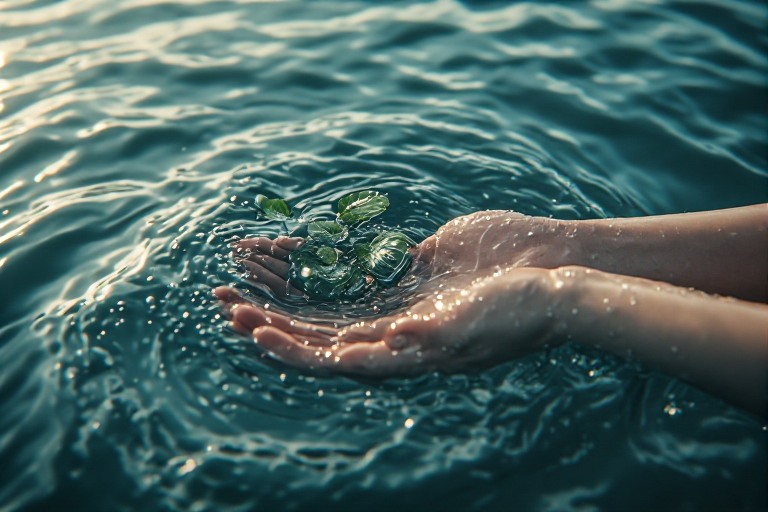
Science gives us several reasons why water is exceptionally important.
Water Enables Cellular Chemistry
Life depends on countless chemical reactions. Inside cells, substances must interact, dissolve, move, and transform.
Water is particularly useful because it is a polar molecule. Its molecular structure allows it to interact with many different substances and dissolve a wide range of compounds.
NASA explains that water’s properties allow important chemical reactions to occur within cells and help organisms obtain energy and remove waste.
In simple terms:
Water provides an environment in which much of life’s chemistry can happen.
Water Helps Transport Nutrients
Living organisms need to move substances from one location to another.
In humans, water is a major component of blood and other body fluids. In plants, water is transported through vascular tissues and participates in the movement of dissolved minerals and nutrients.
This makes water more than a passive ingredient. It acts as a medium for biological transport.
Water Helps Regulate Temperature
Water has a relatively high heat capacity, meaning it can absorb considerable amounts of heat without its temperature changing as rapidly as some other substances.
NASA notes that this property helps provide protection against rapid temperature changes.
This is important for organisms because biological processes generally depend on conditions staying within suitable ranges.
Water Supports Photosynthesis
Plants use water as one of the raw materials involved in photosynthesis.
Through photosynthesis, plants use light energy to convert carbon dioxide and water into organic molecules while releasing oxygen.
This creates a profound connection:
Water → plants → food → ecosystems → life
NASA identifies water as part of the chemical process through which plants produce sugars using energy from sunlight.
The Quran Connects Rain With Vegetation
The Quran repeatedly describes rain as a source of growth.
Allah says:
“He is the One Who sends down rain from the sky, from which you drink and by which plants grow for your cattle to graze. — Quran 16:10
The following verse describes crops, olives, date palms, grapes, and other fruits growing through this water.
This gives us a simple chain:
Rain → water → plants → animals and people
That relationship is also fundamental to ecosystems.
“Water for Every Living Thing”
The Quran’s description in 21:30 is particularly memorable because it places water and living things together in a single statement.
Science gives us a detailed explanation of why this relationship exists.
All known terrestrial life depends on water. Even organisms adapted to extremely dry environments require some water to carry out their biological processes. NASA notes that water is critical to cellular function and that scientists consider the presence of water when investigating the possibility of life beyond Earth.
This is why scientists searching for potentially habitable environments beyond Earth pay close attention to evidence of water.
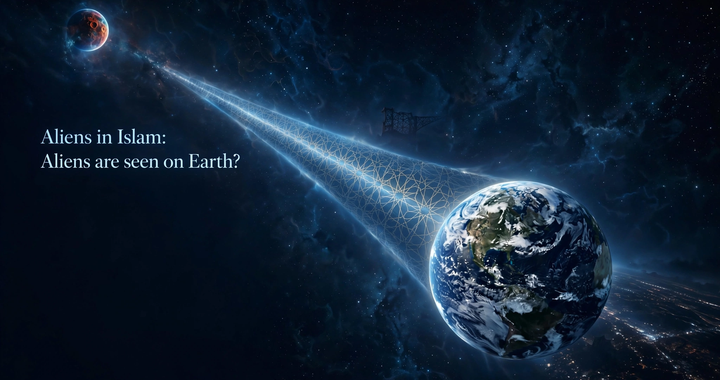
Why Scientists Search for Water on Other Worlds
One of the fascinating questions in modern astronomy is:
Could life exist somewhere other than Earth?
Scientists do not yet have confirmed evidence of extraterrestrial life. NASA states that the only life currently known is on Earth.
Nevertheless, water is one of the important clues scientists investigate when studying potentially habitable worlds. NASA’s astrobiology research examines places such as Mars and icy moons that show evidence of water.
Why?
Because water is so closely associated with the chemistry of life on Earth.
This does not mean that finding water automatically proves life exists somewhere. It means water is an important condition worth investigating.
The Quran’s Picture of Rain Is Bigger Than Drinking Water
The Quran describes rain in several interconnected ways.
Surah Al-Furqan says that Allah sends down pure water from the sky and that this water is used to bring life to barren land and provide drinking water to animals and people.
This is a remarkable ecological picture:
Rain → soil and land → vegetation → animals → humans
Water therefore supports entire systems of life rather than only satisfying thirst.
Water and the Revival of Dead Land
One of the Quran’s recurring images is barren land becoming alive after rainfall.
Quran 25:49 describes water bringing life to a lifeless land and providing water to animals and people.
Another passage, Quran 39:21, describes rain entering the earth as springs and producing crops of different colors before those crops eventually dry and wither.
The observation is both natural and spiritual.
A person sees dry ground, rain arrives, plants appear, crops grow, and eventually vegetation dies and returns to the earth.
The Quran repeatedly presents these natural processes as signs worthy of reflection.
Water Has a Remarkable Scientific Chemistry
Water’s importance is not merely because Earth happens to contain a lot of it.
Its molecular properties make it unusually useful for life.
Water:
- dissolves many substances
- provides a medium for chemical reactions
- transports materials
- participates in biological reactions
- helps regulate temperature
- supports photosynthesis
- exists naturally as a solid, liquid, and gas under Earth’s conditions
- participates in Earth’s hydrological cycle
NASA explains that water’s polarity and other physical properties contribute to its importance for biological chemistry.
Why Does Ice Float?
There is another unusual property of water: solid water—ice—is less dense than liquid water.
As a result, ice floats.
NASA notes that this property has important consequences for aquatic ecosystems. Floating ice can form an insulating layer, helping water underneath remain liquid rather than allowing an entire body of water to freeze solid.
This illustrates something important about Earth’s habitability.
Water is not merely present on Earth; its physical and chemical properties help create conditions in which complex life can survive.
Water, Rain and the Earth’s Water Cycle
Water constantly moves between different parts of Earth’s environment.
It can:
- evaporate from oceans, lakes, and soil;
- enter the atmosphere as water vapor;
- condense into clouds;
- return as precipitation;
- flow across the surface;
- enter soil and groundwater;
- return to rivers, lakes, and oceans;
- evaporate again.
The Quran draws attention to several components of this process, including rain entering the earth and emerging as springs.
Quran 39:21 describes water sent down from the sky and made to flow as springs in the earth, followed by the growth of crops.
The verse is not presented as a modern hydrology textbook. Instead, it directs attention toward a natural process and asks people to reflect upon it.
Did the Quran Predict Modern Science?
This question deserves a careful answer.
It is tempting to describe every scientific observation mentioned alongside a Quranic verse as a “scientific miracle.” But responsible writing should distinguish between what the Quran explicitly says and what modern science later discovered.
The Quran says:
“We created from water every living thing.” — Quran 21:30
Modern science shows that water is indispensable to all known life on Earth.
That is a meaningful point of correspondence.
However, the Quran does not provide modern biochemical equations, cellular diagrams, or laboratory measurements.
Therefore, the strongest approach is not to force modern discoveries into the verses. Instead, we can appreciate how the Quran repeatedly directs human attention to water, life, rain, vegetation, and the revival of barren land.
Water in the Teachings of Prophet Muhammad ﷺ
The importance of water is also reflected in the Sunnah.
In Sahih al-Bukhari 2363, Abu Hurairah رضي الله عنه narrated that the Prophet ﷺ described a man who gave water to a thirsty dog. Allah appreciated his act and forgave him. When people asked whether there was a reward for serving animals, the Prophet ﷺ replied that there is a reward in serving living creatures.
A similar account is recorded in Sahih Muslim 2245b.
The lesson is powerful:
Water is not merely a resource; giving it can become an act of mercy.
Islam therefore connects water with compassion, responsibility, and kindness toward creation.
What Islam Teaches Us About Water
The Quran and Sunnah encourage believers to recognize blessings and act responsibly.
Water should not be treated as something unlimited simply because it comes from the sky.
Allah says:
“And do not commit excess. Indeed, He does not like the transgressors.” — Quran 6:141
The Islamic principle of avoiding waste is relevant to water consumption.
The Prophet Muhammad ﷺ also taught moderation in the use of water, including in purification.
A famous narration reports that the Prophet ﷺ performed ablution with a small amount of water and ghusl with a larger amount. This narration is recorded in Sahih al-Bukhari and Sahih Muslim.
The broader lesson is clear: even a blessing as essential as water should not be wasted.
Water Is a Sign of Allah’s Mercy
The Quran frequently describes rain as a blessing.
It provides:
- drinking water
- vegetation
- crops
- food
- pasture
- water for animals
- renewed life to barren land
Surah An-Nahl connects rainfall with drinking water and vegetation, while Surah Al-Furqan connects pure rain with the revival of lifeless land and the provision of water for people and animals.
This creates an important spiritual perspective.
When Muslims see rain, they can see both a natural process and a blessing from Allah.
The Deeper Mystery: Why Is Earth Suitable for Life?
Earth is remarkable because several conditions work together.
Liquid water is abundant. Temperatures allow water to exist in liquid form across enormous areas. Water interacts with minerals, atmosphere, organisms, and the energy supplied by the Sun.
Life depends on this interconnected system.
NASA’s astrobiology material explains that water is one of the essential requirements for life as we know it and that scientists therefore investigate water when looking for potentially habitable environments elsewhere.
The Quran invites a different but complementary kind of reflection:
Who created these systems and made them suitable for life?
For a believer, the scientific investigation of water can therefore become an opportunity for contemplation rather than merely a collection of facts.
Quran and Science: What We Can Safely Say
There are three important points to keep in mind.
1. The Quran clearly associates water with life
Quran 21:30 and 24:45 explicitly connect water with living creation.
2. Modern science confirms water’s central role in known terrestrial life
Water is essential for cellular chemistry and biological processes.
3. The Quran is not a science textbook
Its primary purpose is guidance. Its references to nature encourage people to observe, think, and recognize signs of Allah.
This distinction makes the argument stronger, not weaker.
What Happens If Water Disappears?
Imagine a world without accessible liquid water.
Plants could not maintain their normal biological processes. Animals could not survive. Human societies would collapse. Ecosystems would disappear.
Even the search for life beyond Earth would look very different because scientists would have fewer clues about where life might be possible.
Water is therefore not simply another natural resource.
For life as we know it, water is foundational.
Water Is a Test of Human Responsibility
The Quran’s emphasis on blessings also creates a responsibility.
If water sustains life, then wasting or contaminating it affects other living creatures as well as humans.
The Hadith about giving water to a thirsty animal shows the Islamic value placed on relieving thirst and showing mercy to creation.
That lesson remains relevant today.
Clean water should be appreciated, protected, and used responsibly.
Final Reflection
Water may appear ordinary, but without it, the world of life as we know it would not exist.
The Quran draws attention to this extraordinary relationship:
Water → life → plants → animals → humans
Science explains many of the mechanisms behind this relationship. Water enables cellular chemistry, transports substances, participates in photosynthesis, regulates temperature, and supports ecosystems.
The Quran takes us one step further by asking us to reflect on the One who created these signs.
“…and We created from water every living thing. Then will they not believe?” — Quran 21:30
Perhaps the mystery is not simply that water exists.
The deeper question is:
Why was this simple molecule given such an extraordinary role in sustaining life?
For science, that question leads to chemistry, biology, Earth science, and astrobiology.
For a believer, it can also lead to gratitude, reflection, and recognition of Allah’s signs in creation.
Water remains one of the most essential and mysterious elements of life on Earth. Its importance can also be explored through the relationship between science, creation, and the universe. You may also enjoy reading about the origin of the universe in the Quran and the unexplained mysteries scientists continue to investigate.
Frequently Asked Questions
What does the Quran say about water and life?
Quran 21:30 says that Allah made every living thing from water. Quran 24:45 similarly says Allah created every living creature from water.
Which Quran verse says life was made from water?
The most commonly cited verse is Surah Al-Anbya 21:30: “…and We created from water every living thing.”
Does science agree that water is essential for life?
Yes. All known life on Earth requires water, and water plays crucial roles in cellular chemistry and biological processes. NASA identifies water as an essential requirement for life as we know it.
Does the Quran say that all life is literally made entirely of water?
No. That would be an oversimplification. The Quran connects living things with water, while modern organisms are composed of many different substances.
Why do scientists look for water when searching for extraterrestrial life?
Because water is essential to all known life on Earth and provides an environment in which important biological chemistry can occur. Therefore, places with evidence of water are scientifically interesting when assessing potential habitability.
What does Islam say about giving water to animals?
The Prophet Muhammad ﷺ taught that there is reward for showing kindness to living creatures. In Sahih al-Bukhari 2363, a man was forgiven after giving water to a thirsty dog.
Which Quran verses mention rain and plants?
Among the important examples are Quran 16:10–11, 25:48–49, and 39:21. These passages connect water from the sky with drinking, vegetation, crops, springs, and the revival of barren land.
Is water a scientific miracle mentioned in the Quran?
It is better to say that the Quran makes profound statements about water and its relationship to life, while modern science provides detailed explanations of water’s biological importance. Calling every scientific correspondence a “miracle” can go beyond what the text itself establishes.