
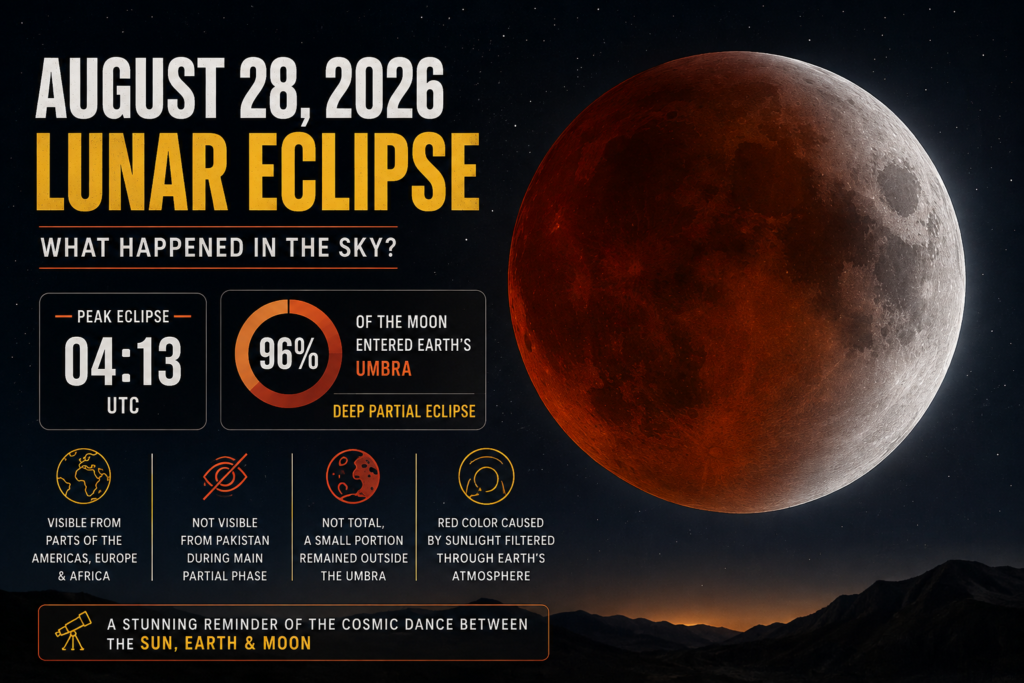
The August 28, 2026 lunar eclipse was a deep partial lunar eclipse that came remarkably close to totality, with approximately 96.3% of the Moon’s disk entering Earth’s umbra at greatest eclipse around 04:13 UTC. The event occurred when the Sun, Earth, and Moon aligned, causing Earth’s shadow to move across the Moon and creating a dramatic dark or reddish appearance.
Unlike a total lunar eclipse, a small portion of the lunar disk remained outside the umbra, so the event was officially classified as partial. The eclipse was visible from different parts of the world depending on local time and whether the Moon was above the horizon, while Pakistan did not have a meaningful view of the deepest 96.3% partial phase.
In this complete visual guide, Noor After Dark explains the August 28, 2026 lunar eclipse, exact eclipse timing, 96.3% Moon coverage, Earth’s umbra and penumbra, the science behind the red Moon, global visibility, Pakistan’s viewing conditions, and the difference between a partial and total lunar eclipse.
🌕 August 28, 2026 Lunar Eclipse The Deep Partial Eclipse That Almost Reached Totality
A rare celestial alignment sent the Moon deep into Earth’s shadow. At maximum eclipse, approximately 96% of the lunar disk entered the umbra—creating a dramatic “almost Blood Moon” effect.
01 — The Eclipse at a Glance
The essential facts in seconds
02 — What Created the Eclipse?
Three worlds aligned in space
Sun → Earth → Moon
Earth moved between the Sun and Moon, allowing Earth’s shadow
to sweep across the lunar surface.
03 — Earth’s Shadow Has Two Main Parts
The Moon passed through Earth’s shadow
🌗 Penumbra
The lighter outer region of Earth’s shadow. The Moon experiences only a subtle dimming here.
🌑 Umbra
The darkest central region of Earth’s shadow. Entering the umbra produces the clearly visible partial-eclipse phase.
04 — The “Almost Total” Moment
Why this eclipse looked so dramatic
Because almost the entire lunar disk crossed into the darkest part of Earth’s shadow, the event could resemble a total lunar eclipse in photographs. Technically, however, it remained partial.
05 — Why Can an Eclipsed Moon Turn Red?
The color comes from Earth’s atmosphere
06 — Eclipse Journey
From subtle shadow to deepest eclipse and back
The Moon enters Earth’s lighter outer shadow. The change can be difficult to notice.
The Moon begins crossing into Earth’s darker umbra, producing an obvious shadow across the lunar surface.
Greatest eclipse. Approximately 96% of the lunar disk is within Earth’s umbral shadow.
The Moon gradually moves away from the darkest portion of Earth’s shadow.
The Moon leaves Earth’s outer shadow and returns to its ordinary appearance.
07 — Where Could People See It?
Visibility depended on location and local time
🌎 Global View
The eclipse was observable from broad areas including parts of the Americas, Europe and Africa, depending on the Moon’s position above the local horizon.
👀 Why Views Differed
An eclipse can be happening globally while remaining invisible from a particular location if the Moon is below that location’s horizon.
08 — What About Pakistan?
A crucial detail for Pakistani readers
🇵🇰 Pakistan’s View
In Pakistan, the dramatic partial phase occurred while the Moon was below the horizon. A short penumbral phase was listed locally around sunrise, but observers could not see the spectacular 96%-eclipsed Moon from most locations.
09 — Why Wasn’t It a Total Lunar Eclipse?
The answer is orbital geometry
🌑 Total Lunar Eclipse
The entire lunar disk enters Earth’s umbra. The whole Moon can take on a dark reddish appearance.
🌘 August 28, 2026
Almost the entire disk entered the umbra, but a small portion remained outside it. Therefore, astronomers classify it as a deep partial eclipse.
10 — Why Doesn’t Every Full Moon Become an Eclipse?
Because the Moon’s orbit is tilted
The Moon circles Earth every month, but its orbital plane is tilted relative to Earth’s orbit around the Sun. Most full Moons therefore pass above or below Earth’s shadow.
Only a close alignment creates a lunar eclipse.
11 — What Does the Eclipse Teach Us?
A natural demonstration of orbital mechanics and atmospheric optics
12 — Is a Lunar Eclipse Safe to Watch?
Unlike a solar eclipse, lunar viewing is safe
A lunar eclipse can be viewed with the naked eye. No special eclipse glasses are required. Binoculars or a telescope can provide a closer look, but they are optional.
13 — Lunar Eclipse FAQs
Quick answers to the questions people search for
Was the August 28, 2026 eclipse total?
No. It was a deep partial lunar eclipse, with approximately 96% of the Moon entering Earth’s umbra.
Why did the Moon appear red?
Sunlight passing through Earth’s atmosphere can be filtered and scattered so that more reddish light reaches the Moon.
Could Pakistan see the Blood Moon?
Pakistan did not receive a meaningful view of the main partial eclipse because the Moon was below the horizon during that stage.
How much of the Moon entered Earth’s shadow?
Approximately 96% of the lunar disk entered Earth’s darkest shadow at maximum eclipse.
Why doesn’t a lunar eclipse happen every month?
The Moon’s orbit is tilted, so most full Moons pass above or below Earth’s shadow.
Can you safely look at a lunar eclipse?
Yes. Looking at a lunar eclipse with the naked eye is safe.
🌌 The Final Picture
Sunlight → Earth → Earth’s shadow → Moon
The August 28, 2026 event was a deep partial lunar eclipse, not a total eclipse. Nearly 96% of the Moon entered Earth’s umbra, bringing the lunar surface remarkably close to complete immersion in Earth’s darkest shadow.
Its dramatic appearance came from precise celestial geometry, while any reddish glow was produced by sunlight interacting with Earth’s atmosphere.
One small portion of the Moon remained outside the umbra— and that tiny difference changed the classification from “total” to “partial.”
Events such as lunar eclipses remind us how fascinating and complex the universe truly is. If you are interested in astronomy and cosmic mysteries, explore the unexplained secrets of the universe, learn about the origin of the universe in the Quran, and discover how modern space missions continue to expand our understanding of space.
Sources & References
- NASA — Lunar Eclipses
- Information on lunar-eclipse mechanics, Earth’s shadow, eclipse geometry, and long-term eclipse calculations.
- NASA — Lunar Eclipses
- Timeanddate — August 27–28, 2026 Partial Lunar Eclipse
- Specific information for the 2026 eclipse, including the 96.2% partial eclipse, visibility regions, timing, and eclipse stages.
- Timeanddate — August 27–28, 2026 Lunar Eclipse
- NASA/JPL Night Sky Network — 2026 Partial Lunar Eclipse
- Provides public-observation information and confirms that this was a deep partial lunar eclipse visible across the Americas, Greenland, Iceland, Europe and Africa.
- NASA/JPL — August 2026 Partial Lunar Eclipse
- NASA/JPL Night Sky Network — 96% Lunar Eclipse Observation
- Example observation data showing the Moon reaching approximately 96% coverage by Earth’s shadow during the event.
- NASA/JPL — 96% Partial Lunar Eclipse Event
- Timeanddate — Why Does the Moon Turn Red?
- Useful for your explanation of the red/copper appearance, atmospheric scattering, and why lunar eclipses can produce a reddish Moon.
- Timeanddate — Why Does the Moon Look Red During a Lunar Eclipse?