
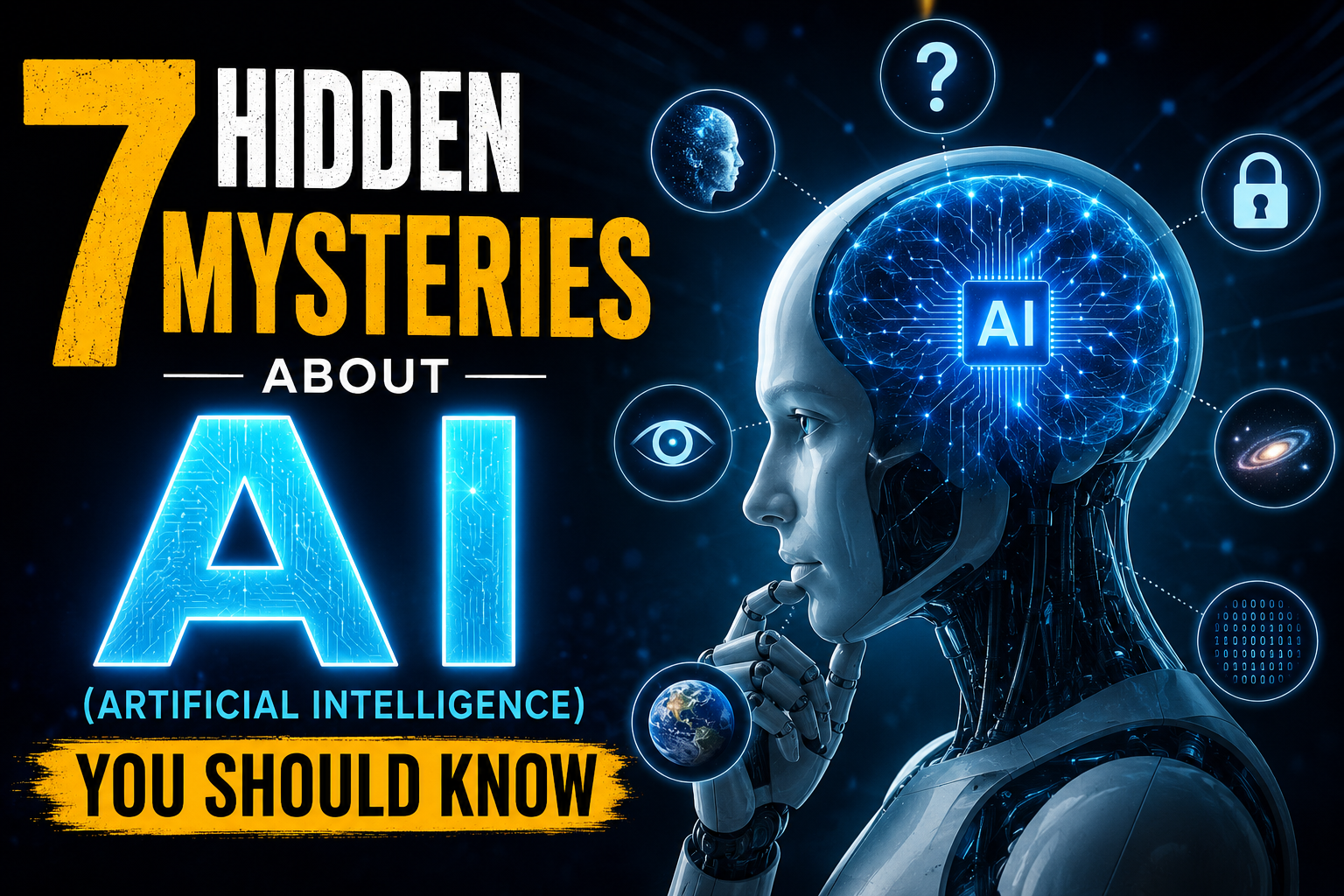
The mysteries about AI have fascinated researchers, technology experts, and everyday users for years. As Artificial Intelligence becomes more advanced, many people assume scientists understand everything about how AI works. However, the truth is that several mysteries about AI remain unsolved. While AI can write articles, recognize images, translate languages, and solve complex problems, researchers are still trying to understand why some AI systems behave the way they do.
In this article, we explore seven real mysteries about AI based on current scientific research. These are not myths or conspiracy theories but genuine questions that researchers around the world are working to answer. By understanding these mysteries about AI, you will gain a deeper understanding of both the incredible potential and the current limitations of Artificial Intelligence.
Table of Contents
7 Hidden Mysteries About AI
One of the biggest mysteries about AI is that modern AI models can sometimes produce brilliant answers and, at other times, make unexpected mistakes. Another mystery is how AI develops certain abilities that were never directly programmed by its creators. These unanswered questions have led to growing research in AI interpretability, explainable AI, and AI safety.
1. Why Does AI Sometimes Give Brilliant Answers and Sometimes Completely Wrong Ones?
One of the biggest mysteries about AI is why it can produce brilliant, accurate answers in one situation and completely incorrect answers in another. Even the people who build large AI models cannot always explain why a model gives a particular answer.
Researchers can see what the AI does, but it’s still hard to figure out the exact internal reason behind each reaction. This field is called AI interpretability, and it is still an active area of research.
Hidden truth: We know how to train powerful AI, but we do not fully understand every internal decision it makes.
2. AI Learns Things That Nobody Explicitly Taught It
Large AI models sometimes develop unexpected abilities after training on enough data.
For example, an AI trained mainly to predict the next word can also learn to:
- Translate languages
- Write computer code
- Summarize books
- Solve reasoning tasks
These are often called emergent abilities because they were not programmed one by one.
Researchers call these emergent abilities, and they remain one of the biggest mysteries about AI today.
Hidden truth: Some AI capabilities appear naturally as models become larger, and researchers are still studying why this happens.
3. AI Creates Internal “Concepts”
Inside an AI model, there are millions or billions of numerical values.
Researchers have discovered that some internal patterns represent concepts such as:
- Cities
- Languages
- Emotions in text
- Famous people
- Programming syntax
The surprising part is that nobody manually creates these internal concepts.
Hidden truth: AI develops its own internal representations, and we are still learning how they form.
4. AI Can Be Fooled by Tiny Changes
An image that looks exactly like a panda to a human can be slightly modified so that an AI confidently labels it as something completely different.
These are called adversarial examples.
Humans notice almost no difference, but AI can become confused.
Hidden truth: AI can sometimes fail in ways that humans would never expect.
5. Nobody Knows the Exact Limits of AI
Researchers cannot say with certainty what future AI systems will or will not be able to do.
AI has advanced much faster than many experts predicted over the past decade.
Some expected certain capabilities to take decades, but they appeared much sooner.
Hidden truth: Predicting AI’s future progress is extremely difficult.
6. AI Has No Inner Experience
AI can describe happiness, sadness, fear, or love.
However, there is no evidence that current AI systems actually experience these emotions.
They generate language about feelings without having feelings themselves.
Hidden truth: Human-like conversation does not mean human-like consciousness.
7. We Still Do Not Know What Consciousness Is
This mystery isn’t just about AI; it’s also about people.
Scientists still do not fully understand:
- What consciousness is.
- How subjective experience arises.
- Whether consciousness could ever exist in a machine.
Until we understand human consciousness better, it is difficult to answer whether an AI could ever become conscious.
Hidden truth: The greatest mystery may not be AI. It may be the human mind itself.
The Biggest Real Mystery
Perhaps the most fascinating mystery is this:
We know how to build AI systems that perform remarkably well, but we still cannot fully explain everything they learn internally or every reason behind every decision they make.
This is why many scientists are investing heavily in AI interpretability and AI safety to better understand powerful AI systems before they become even more capable.
These are not secret theories or hidden secrets that are being looked into today; they are real scientific mysteries.
As Artificial Intelligence becomes more advanced, solving these mysteries about AI will be essential for building more reliable, transparent, and trustworthy AI systems. The answers to these questions could shape the future of technology and determine how humans and AI work together in the years to come.
Why Does AI Make Unexpected Decisions?
One of the most surprising facts about modern AI is this:
Even engineers who work on making very complex AI models can’t always explain why the AI came up with a certain answer instead of another.
This does not mean AI has secrets or consciousness. It means the internal calculations are so complex that tracing every step is extremely difficult.
Imagine a Human Brain
If I ask you:
“How did you recognize your mother’s face?”
You probably can’t explain every neuron that fired in your brain. You simply recognize her instantly.
Modern AI works in a somewhat similar way. It processes information through billions of mathematical parameters, not neurons. By the time it produces an answer, there may have been trillions of calculations.
Researchers can inspect pieces of this process, but they usually cannot point to one simple chain of reasoning for every response.
A Real Example
Suppose an AI is shown thousands of pictures of cats and dogs.
Eventually, it correctly identifies new cat photos with high accuracy.
Now ask:
“Which exact mathematical values made the AI decide this picture is a cat?”
There isn’t a simple answer.
The decision depends on countless interacting values spread throughout the model, rather than one “cat detector.”
This Is Called the “Black Box” Problem
Many powerful AI systems are described as black boxes because:
- We know what data goes in.
- We know what answer comes out.
- The internal thinking, on the other hand, is often hard to break down step by step.
That is why researchers are developing methods to “look inside” AI systems and better understand their internal representations.
Why Is This Important?
Imagine an AI helping doctors diagnose diseases.
If it says:
“This patient has disease X.”
Doctors naturally ask:
“Why?”
If the AI cannot clearly explain its reasoning, doctors may hesitate to trust it for critical decisions.
The same issue matters in:
- Healthcare
- Banking
- Hiring
- Criminal justice
- Self-driving cars
Understanding AI’s reasoning is essential for building trust and ensuring safety.
Researchers Are Working on Solutions
Although many mysteries about AI remain unanswered, researchers around the world are actively developing solutions to better understand how Artificial Intelligence works. Scientists in the fields of AI interpretability, Explainable AI (XAI), and AI safety are working to make AI systems more transparent, reliable, and easier to understand.
- Highlight which parts of an image influenced a prediction.
- Identify which words most affected a language model’s response.
- Detect internal patterns associated with certain concepts.
- Find behaviors that could lead to errors.
Progress is being made, but a complete explanation of every decision made by large AI models remains an open research challenge.
The Real “Hidden Truth”
The real hidden truth behind the mysteries about AI is not that Artificial Intelligence is secretly conscious or hiding unknown knowledge. The mystery is not that AI is hiding something or secretly thinking like a human.
The real mystery is this:
Modern AI has become so mathematically complex that humans do not yet have a complete way to explain every individual decision it makes.
That is one of the biggest scientific challenges in AI today, and solving it could make future AI systems more transparent, trustworthy, and safer to use.
Conclusion
The mysteries about AI continue to challenge scientists, engineers, and technology experts around the world. Although Artificial Intelligence has made remarkable progress in areas such as language processing, image recognition, and problem-solving, many mysteries about AI remain unsolved. Researchers are still working to understand why AI develops unexpected abilities, how it reaches certain decisions, and why its internal reasoning is often difficult to explain.
Artificial intelligence is becoming one of the most powerful and misunderstood technologies in the modern world. To understand the technology behind these developments, read our detailed guide explaining how artificial intelligence actually works in simple words.
References
- Anthropic. (2025). On the Biology of a Large Language Model. https://www.anthropic.com/research
- Google DeepMind. Explainability and Interpretability Research. https://deepmind.google/research
- OpenAI. Research on Interpretability and Alignment. https://openai.com/research
- DARPA. Explainable Artificial Intelligence (XAI). https://www.darpa.mil/program/explainable-artificial-intelligence
- Nature Machine Intelligence. Explainable Artificial Intelligence Research. https://www.nature.com/natmachintell/
- Stanford HAI. https://hai.stanford.edu/
- MIT Technology Review. Artificial Intelligence. https://www.technologyreview.com/topic/artificial-intelligence/
Frequently Asked Questions (FAQs)
1. What are the biggest mysteries about AI?
The biggest mysteries about AI include the AI black box problem, emergent abilities, and unexplained AI decision-making.
2. Why do mysteries about AI still exist?
Mysteries about AI exist because researchers cannot fully explain every internal process of advanced AI models.
3. Can scientists explain every AI decision?
No. Explaining every AI decision remains one of the biggest mysteries about AI.
4. Do the mysteries about AI mean AI is conscious?
No. The mysteries about AI do not mean AI is conscious or has human emotions.
5. Will the mysteries about AI be solved?
Many mysteries about AI may be solved as AI research and explainability improve.
6. Why should we understand the mysteries about AI?
Understanding the mysteries about AI helps us use AI wisely and separate facts from myths.