

Artificial intelligence works by processing large amounts of data, identifying patterns and using those patterns to make predictions, decisions or generate responses. Unlike humans, AI does not usually “think” or understand the world in the same way. Instead, it uses mathematical models trained on examples.
In simple terms, AI learns patterns from data and uses what it learned to handle new information.
How Artificial Intelligence works is actually simpler than many people think. Artificial Intelligence learns from data, finds patterns, and uses those patterns to make predictions or complete tasks. Instead of thinking like a human, Artificial Intelligence uses mathematical models and algorithms to process information quickly and accurately. There are many mysteries of AI.
In this beginner-friendly guide, you will learn how Artificial Intelligence works, how AI learns from data, the steps involved in AI training, real-life examples, and why Artificial Intelligence is changing industries around the world.
Table of Contents
What is Artificial Intelligence?
A technology known as artificial intelligence (AI) enables computers and other devices to carry out tasks that often call for human intelligence.
These tasks include:
- Understanding language
- Recognizing pictures
- Answering questions
- Making decisions
- Learning from experience
- Solving problems
AI does not think like humans. Instead, it studies large amounts of information, finds patterns, and uses those patterns to make predictions or complete tasks.
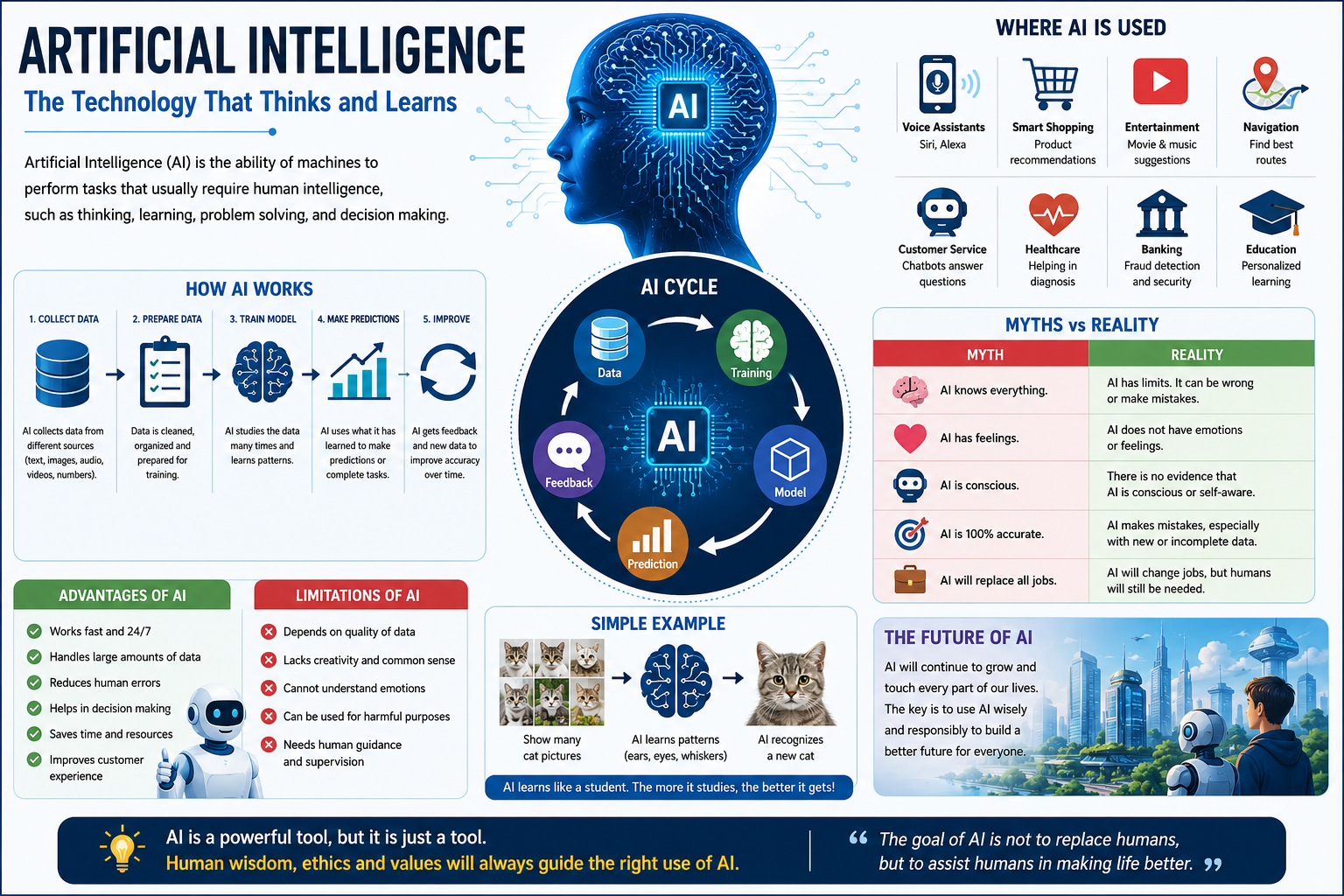
How Does Artificial Intelligence Work?
AI works in a series of simple steps.
Step 1: Collect Data
Everything starts with data.
Data is information that AI learns from. It can be:
- Text
- Images
- Videos
- Audio
- Numbers
Example
If we want AI to recognize cats, we show it thousands of cat pictures.
Step 2: Clean and Organize the Data
Not all data is useful.
Before AI learns, the data is cleaned by removing mistakes, duplicates, and missing information.
This helps AI learn correctly.
Step 3: Train the AI Model
Training means teaching AI.
The computer studies the data many times until it learns the patterns.
For example, after seeing many cat pictures, AI learns that cats usually have:
- Two ears
- Whiskers
- Four legs
- A tail
The more examples AI studies, the better it becomes.
Step 4: Make Predictions
After training, AI can use its knowledge.
If someone uploads a new picture, AI checks the patterns it learned and predicts what the picture shows.
For example:
New Image → AI says → “This is a cat.”
Step 5: Improve with Feedback
AI keeps learning.
If it makes a mistake, developers can correct it.
With more data and feedback, AI usually becomes more accurate over time.
Flow Chart
Start
│
▼
Collect Data
│
▼
Clean and Organize Data
│
▼
Train AI Model
│
▼
Learn Patterns
│
▼
Make Prediction/Answer
│
▼
Receive Feedback
│
▼
Improve Accuracy
│
▼
End
Real-Life Example
Imagine teaching a small child to recognize apples.
First, you show many apples.
Then you explain that apples are usually round and have a stem.
After seeing many examples, the child can recognize a new apple.
AI learns in a similar way.
The difference is that AI learns using computers, mathematical calculations, and large amounts of data.
Where Do We Use AI?

One of the best ways to understand how Artificial Intelligence works is to look at where it is used in our daily lives. Artificial Intelligence (AI) is no longer limited to research laboratories. Today, AI powers many of the apps, devices, and services we use every day. By learning from data, recognizing patterns, and making predictions, Artificial Intelligence helps improve efficiency, accuracy, and user experiences across many industries.
| Area | How AI Helps |
|---|---|
| Smartphones | Face unlocking and voice assistance |
| Healthcare | Aids medical professionals in identifying illnesses |
| Education | Individualized instruction and tutoring |
| Banking | Identifies questionable transactions and fraud |
| Shopping | Suggests goods that you could enjoy |
| Social Media | Recommends articles and videos |
| Maps | Determines the quickest paths |
| Customer Service | Chatbots respond to frequently asked questions |
| Translation | Translates one language into another |
| Entertainment | Suggested films and music |
Advantages of Artificial Intelligence
Understanding how Artificial Intelligence works also helps explain why it offers so many advantages across different industries. By learning from data, recognizing patterns, and making intelligent predictions, Artificial Intelligence (AI) can improve efficiency, accuracy, and decision-making. Here are some of the key advantages of Artificial Intelligence:
- Saves time by doing repetitive work.
- Works quickly with large amounts of data.
- Reduces human errors in many tasks.
- Is available 24 hours a day.
- Improves customer service.
- Helps doctors and scientists make better decisions.
- Makes everyday technology smarter.
Limitations of Artificial Intelligence
While understanding how Artificial Intelligence works reveals its many advantages, it also highlights several important limitations. Artificial Intelligence (AI) is a powerful technology, but it is not perfect. Knowing these limitations helps people use AI more responsibly and effectively.
- It can make mistakes if the data is poor.
- It cannot think or feel like humans.
- It does not have emotions or common sense.
- It depends on human-created data and instructions.
- It may produce incorrect answers if it lacks enough information.
Simple Example of AI in Daily Life
On an online shopping website, you search for “running shoes“. Later, the website recommends more running shoes, sportswear, or fitness products that match your interests. This is a simple example of how Artificial Intelligence works in everyday life. Artificial Intelligence (AI) analyzes your browsing history, search behavior, and previous clicks to identify patterns.
Based on these patterns, the AI system predicts what you are most likely to buy and displays personalized product recommendations. This real-world example clearly shows how Artificial Intelligence works by using data to make accurate predictions and improve the online shopping experience.
Why Is Data Important for AI?
Data is the foundation of Artificial Intelligence and plays a vital role in how Artificial Intelligence works.
The quality of an AI system depends on the quality of the data it learns from. Good, accurate, and well-organized data helps Artificial Intelligence make better predictions, recognize patterns, and make reliable decisions. On the other hand, poor, incomplete, or incorrect data can lead to inaccurate results and wrong predictions.
This is why collecting clean, reliable, and high-quality data is one of the most important steps in how Artificial Intelligence works and in building effective AI systems.
Most Popular AI Models Today
The Hidden Truth About AI
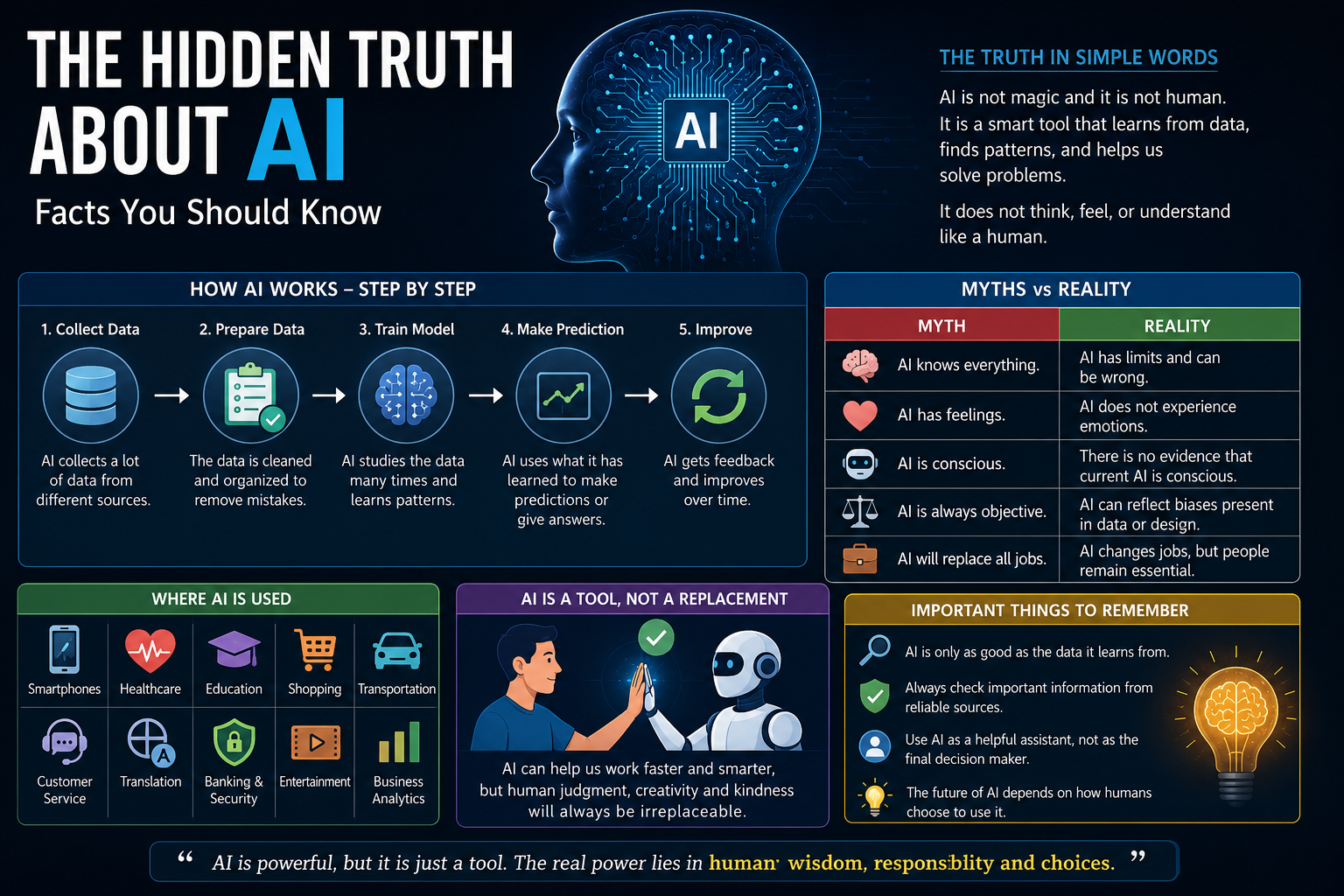
Many people think Artificial Intelligence (AI) is either a magical genius or a dangerous machine secretly controlling the world. However, the reality is far more practical and, in many ways, more interesting.
Understanding how Artificial Intelligence works helps separate facts from myths. Artificial Intelligence does not possess magical powers or independent intentions. Instead, AI works by learning patterns from data, making predictions, and generating responses based on its training.
Once you understand how Artificial Intelligence works, it becomes easier to see AI as a powerful technology designed to assist humans rather than a mysterious force controlling the world.
1. AI Does Not Think Like Humans
One of the biggest hidden truths is that AI does not think, understand, or feel the way people do.
When I answer a question, I am not “thinking” in the human sense. I generate responses by recognizing patterns learned during training.
I do not have:
- Consciousness
- Emotions
- Personal beliefs
- Desires
- Self-awareness
I can sound human because I am trained to communicate naturally.
2. AI Can Sound Confident Even When It Is Wrong
This surprises many people.
AI sometimes gives an answer that sounds completely convincing but is actually incorrect. This is because it predicts likely words rather than verifying every fact.
That is why important information should be checked with reliable sources.
3. AI Is Only as Good as Its Data
AI learns from enormous amounts of data.
If the data contains mistakes, gaps, or biases, AI can reflect those problems. Developers work to reduce these issues, but no AI is perfect.
4. AI Does Not Know Everything
People often assume AI has access to every fact in the world.
In reality:
- I do not automatically know current events unless I access up-to-date information.
- I do not know private information about people.
- I cannot read minds.
- I cannot see your computer or phone unless you explicitly share something with me.
5. AI Is a Tool, Not a Replacement for Human Judgment
AI can help with:
- Writing
- Coding
- Learning
- Research
- Brainstorming
- Translation
But humans still make the important decisions.
Doctors, engineers, teachers, judges, and researchers should not rely on AI alone.
6. AI Is Created by Humans
Every AI system is designed, trained, tested, and updated by people.
It does not appear by itself or evolve independently without human involvement.
7. AI Is Not Secretly Alive
Some conversations with AI can feel so natural that people wonder whether it is conscious.
There is no reliable scientific evidence that today’s AI systems are conscious or sentient. They simulate conversation effectively, but simulation is not the same as awareness.
8. AI Can Be Used for Good or Bad
Like electricity or the internet, AI is a technology.
It can help:
- Detect diseases
- Translate languages
- Assist disabled people
- Improve education
- Speed up scientific research
It can also be misused for:
- Scams
- Deepfakes
- Spam
- Misinformation
- Cyberattacks
The impact of technology relies on how people use it; it is neither intrinsically good nor bad.
Conclusion
How Artificial Intelligence works can be understood through a simple process. Artificial Intelligence collects data, organizes it, learns patterns, makes predictions, and continuously improves through feedback. The biggest hidden truth about Artificial Intelligence is that its greatest strength is not that it thinks like a human, but that it can process massive amounts of data and recognize patterns at a speed and scale humans cannot match.
At the same time, one of the biggest limitations of how Artificial Intelligence works is that AI lacks genuine understanding, consciousness, emotions, and human judgment. It does not truly “know” or “feel” what it says—it generates responses based on learned patterns. Therefore, the most reliable way to use Artificial Intelligence is as a powerful assistant that supports human decision-making, not as an infallible authority that should be trusted without verification.
Artificial intelligence continues to transform technology, communication, education, and everyday life. However, AI still raises many unanswered questions about intelligence, consciousness, and the future of humanity. To explore the more mysterious side of this technology, discover seven hidden mysteries about artificial intelligence.
Frequently Asked Questions (FAQs)
1. What is Artificial Intelligence in simple words?
Artificial Intelligence is technology that enables computers to learn from data and perform tasks that usually require human intelligence.
2. Does AI think like humans?
No. AI learns patterns from data but does not have feelings, emotions, or human understanding.
3. What does AI need to learn?
AI needs large amounts of good-quality data and training to improve its performance.
4. Where is AI used?
AI is used in smartphones, healthcare, education, banking, online shopping, transportation, customer service, and many other fields.
5. Can AI make mistakes?
Yes. AI can make incorrect predictions if it learns from incomplete, biased, or poor-quality data.