
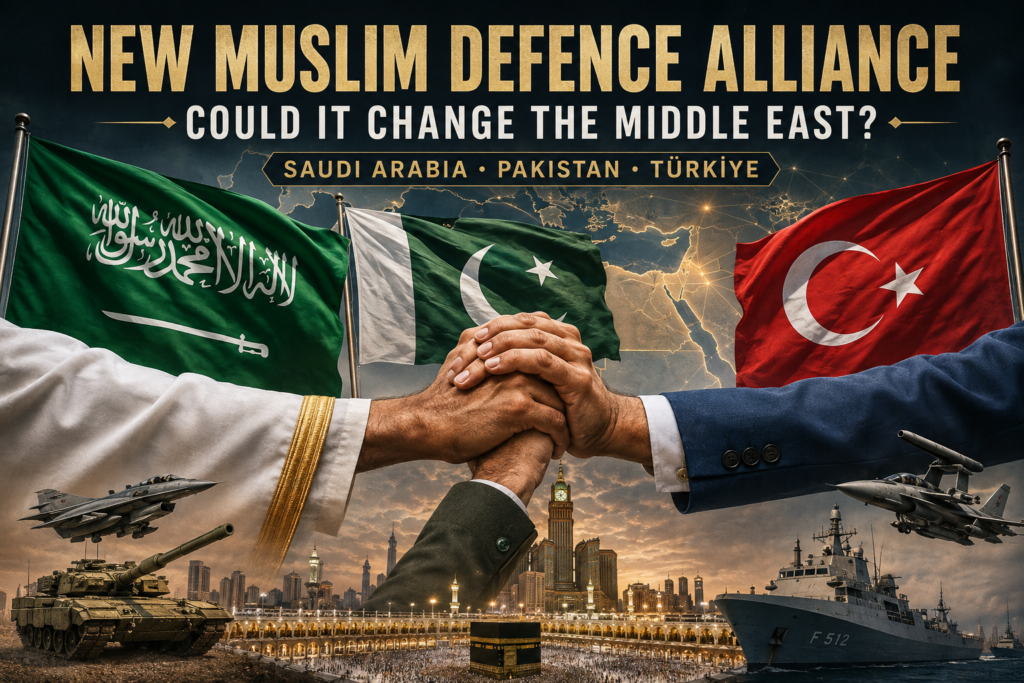
Three powerful Muslim countries. One historic agreement. And a question that could reshape Middle Eastern geopolitics: Is a new Muslim defence alliance emerging?
Saudi Arabia, Pakistan and Türkiye have signed the Makkah Joint Defence Agreement, creating a new trilateral security framework.
Pakistan’s government says an armed attack on one is to be regarded as an attack on all.
The Makkah Joint Defence Agreement could emerge as a major development in the Middle East’s changing security landscape. Pakistan, Saudi Arabia, and Türkiye signed the agreement on 7 August 2026, establishing a collective-defence principle under which an attack on one member is treated as a threat to all three. Because of this provision, the agreement has been compared with NATO’s Article 5, although it remains a separate three-country defence partnership rather than a Middle Eastern version of NATO.
The partnership is particularly significant because each country brings different strategic strengths to the table. Pakistan offers extensive military experience and possesses nuclear weapons, Türkiye has a powerful conventional military and an increasingly advanced domestic defence industry, while Saudi Arabia contributes considerable economic resources and holds an important strategic position in the Gulf. These strengths complement one another, although the agreement does not necessarily assign each country a specific role or responsibility.
Another important feature is the possibility of future expansion. Turkish President Recep Tayyip Erdoğan has indicated that Egypt could potentially become part of the arrangement, while Pakistani officials have suggested that the agreement could remain open to other countries that support its principles. If additional states eventually join, the current three-country partnership could develop into a much broader regional security framework.
Could the New Muslim Defence Alliance Change the Middle East?
A visual breakdown of the 2026 Makkah Joint Defence Agreement involving Saudi Arabia, Pakistan and Türkiye.
August 7, 2026 — Makkah Agreement
Saudi Arabia, Pakistan and Türkiye sign the Makkah Joint Defence Agreement, creating a new trilateral defence framework.
Why Is It Significant?
Three strategically important Muslim countries are connecting South Asia, the Arabian Peninsula and Anatolia through a common security framework.
Is It a “Muslim NATO”?
Not formally. The phrase is a comparison used to describe its potential importance. The agreement should currently be understood as a trilateral collective-defence framework.
Saudi Arabia’s Role
Saudi Arabia contributes major economic influence, energy importance and a strategically important position in the Gulf and Red Sea regions.
Pakistan’s Role
Pakistan connects the partnership to South Asia and brings long-standing defence relationships with Saudi Arabia.
Türkiye’s Role
Türkiye adds regional military influence, defence-industrial capabilities and a unique geographic position between Europe and Asia.
Potential Regional Impact
The partnership could influence Middle Eastern security calculations and encourage greater strategic cooperation among regional powers.
Could Other Muslim Countries Cooperate?
Potentially. If the framework proves effective, other Muslim-majority countries could seek closer defence, economic, technological or diplomatic cooperation.
What About the IMCTC?
The Islamic Military Counter Terrorism Coalition is a separate 43-member organization focused on counter-terrorism cooperation.
Possible Effects on Iran
A stronger Saudi-Pakistani-Turkish security relationship could influence regional strategic calculations involving Iran, but it should not automatically be labelled an anti-Iran alliance.
Possible Effects on Israel & Palestine
The partnership could influence wider regional diplomacy, but there is currently no basis for describing the agreement as a military alliance specifically created to confront Israel.
Potential Areas of Cooperation
Defence technology • Intelligence • Cybersecurity • Counter-terrorism • Energy security • Training • Diplomacy • Economic cooperation
The Biggest Challenge
Signing an agreement is easier than building a durable institution. Its long-term importance depends on implementation, political unity and cooperation during future crises.
Possible Future Path
Trilateral defence cooperation could potentially develop into wider economic, technological and diplomatic cooperation.
Could It Change the Middle East?
Potentially. The Makkah Joint Defence Agreement may become an important step toward a more coordinated Muslim security architecture. However, calling it a fully established “Muslim NATO” would be premature. Its real impact will depend on what happens after the agreement is signed.
HIGH POTENTIAL • NOT YET A MUSLIM NATONew Muslim Defence Alliance: Strengths vs Challenges
| Strengths | Challenges |
|---|---|
| Three strategically important Muslim states | Different national interests |
| Strong geographic reach | Long-term implementation remains uncertain |
| Saudi economic power | Regional rivalries |
| Pakistani strategic importance | Political changes can affect cooperation |
| Turkish defence capabilities | Not yet a NATO-style organization |
| Strong symbolic significance | Future expansion is uncertain |
| Existing bilateral relationships | Actual crisis response remains untested |
Could This Become the Beginning of a Larger Muslim Alliance?
This is where the story becomes particularly interesting.
The agreement could remain a three-country arrangement.
Or it could become the foundation for something larger.
A possible long-term evolution could look like:
Stage 1
Saudi Arabia + Pakistan + Türkiye
↓
Stage 2
More structured defence and security cooperation
↓
Stage 3
Expanded economic and technological partnerships
↓
Stage 4
Closer coordination with other Muslim-majority states
↓
Stage 5
A broader regional security architecture
But this is a scenario, not a prediction.
The coming years will determine whether the agreement becomes a lasting institution or remains primarily a political and strategic partnership among three countries.
Why the 2026 Agreement Could Be a Turning Point
The Middle East is becoming increasingly multipolar.
Regional powers are seeking greater strategic autonomy while maintaining relationships with major global powers.
The Makkah agreement fits into that broader transformation.
It represents a move toward:
individual security → collective security
bilateral relationships → trilateral cooperation
regional dependence → greater strategic autonomy
Whether that transformation succeeds is still unknown.
But the direction is significant.
What Happens Next?
The next stage will be more important than the signing ceremony itself.
Watch for developments involving:
- New defence agreements
- Joint institutional mechanisms
- Expanded intelligence cooperation
- Economic and technological partnerships
- Cooperation with additional Muslim-majority states
- Statements about regional crises
- The role of the alliance during future security emergencies
These developments will reveal whether the Makkah agreement is simply a political statement or the beginning of a deeper regional security system.
Conclusion
- Potential impact: HIGH
- Current size: LIMITED
- Long-term potential: SIGNIFICANT
- “Muslim NATO” status: NOT YET
- Biggest opportunity: Collective regional security
- Biggest challenge: Turning political commitments into durable cooperation
So, could the New Muslim Defence Alliance change the Middle East?
Yes, but its impact is not guaranteed.
The Makkah Joint Defence Agreement has created a strategically important relationship between Saudi Arabia, Pakistan and Türkiye.
It combines:
- Saudi Arabia’s economic and geographic importance
- Pakistan’s strategic and defence significance
- Türkiye’s regional position and defence capabilities
The Makkah agreement is therefore best understood not as the finished product of a new Muslim military bloc, but as a potentially important starting point.
The next chapter could determine whether Makkah 2026 becomes a historic turning point—or simply another chapter in the Middle East’s long history of strategic alliances.
Political developments in the Muslim world are often connected to larger questions about history, identity, and the global future. To explore the historical and spiritual side of Islamic civilization, you may also want to read about the nations mentioned in Islam and the mysteries surrounding the ancient city of Iram.
References & Sources
- Government of Pakistan — Press Information Department
Official announcement of the Makkah Joint Defence Agreement, including the date, participating countries, collective-defence provision, and stated purpose.
Pakistan Government — Makkah Al-Mukarramah Summit for Joint Defence - Ministry of Foreign Affairs, Pakistan
Official statement explaining that the Makkah Accord is defensive in nature and that an armed attack against one member is regarded as an attack against all three.
Pakistan Ministry of Foreign Affairs — Makkah Joint Defence Agreement - Saudi Government — National Platform
Saudi Arabia’s official joint statement from the Makkah Al-Mukarramah Summit, confirming the agreement and its collective-security provisions.
Saudi Government — Joint Statement of the Makkah Summit - Pakistan Ministry of Information & Broadcasting
Provides additional clarification that the agreement does not replace existing bilateral or multilateral agreements and is described by Pakistan as defensive rather than directed against a particular country.
Pakistan Ministry of Information — Makkah Accord Clarification - International Institute for Strategic Studies (IISS)
Independent strategic analysis examining the new defence pact and its possible implications for regional security.
IISS — Pakistan, Saudi Arabia and Türkiye: A New Defence Pact - Pakistan National Assembly
Official statement regarding the signing of the agreement and its significance for regional peace and security.
National Assembly of Pakistan — Joint Defence Agreement - Radio Pakistan
Official Pakistani reporting on the signing and the agreement’s collective-defence provision.
Radio Pakistan — Pakistan, Saudi Arabia, Türkiye Sign Makkah Joint Defence Agreement - UN General Assembly — Saudi Arabia Statement
Useful for the separate discussion of the Islamic Military Counter Terrorism Coalition (IMCTC), including its 43-member composition.
United Nations — Saudi Arabia Statement on Counter-Terrorism Cooperation
Frequently Asked Questions
What is the New Muslim Defence Alliance?
The term is being used to describe the new strategic defence relationship created by the Makkah Joint Defence Agreement between Saudi Arabia, Pakistan and Türkiye, signed on 7 August 2026.
When was the Makkah Joint Defence Agreement signed?
Saudi Arabia, Pakistan and Türkiye signed the agreement in Makkah on 7 August 2026.
Is the new alliance a Muslim NATO?
Not formally. The “Muslim NATO” label is an analogy. The available information supports describing the arrangement as a trilateral collective-defence framework rather than an established NATO-style organization.
Which countries are in the new alliance?
The agreement currently involves Saudi Arabia, Pakistan and Türkiye.
Is Iran part of the alliance?
No. Iran is not one of the three countries in the Makkah Joint Defence Agreement.
Is the Islamic Military Counter Terrorism Coalition the same thing?
No. The IMCTC is a separate 43-member organization focused primarily on counter-terrorism cooperation across intellectual, media, financial and military areas.
Could other Muslim countries join?
It is possible that other countries could develop closer relationships with the framework, but future expansion should not be treated as confirmed unless officially announced.
Could the agreement change Middle Eastern geopolitics?
Potentially. Its significance comes from bringing together three influential states from South Asia, the Arabian Peninsula and Anatolia. Its actual long-term effect will depend on implementation and future regional developments.